Original Story
A DNA Study Just Found That the Turin Shroud Contains Genetic Material From at Least 14 People, Corn, Peanuts, and Bananas. It Still Cannot Explain the Image.
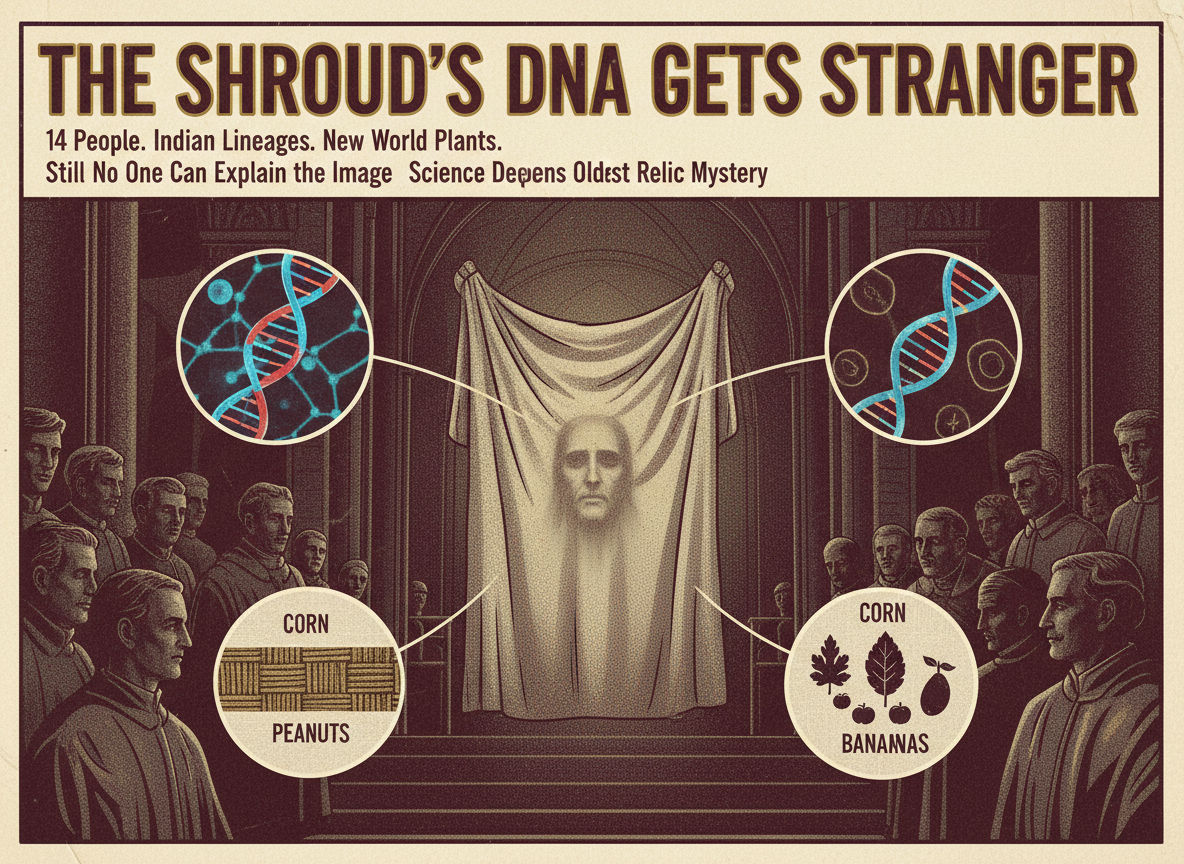
A metagenomics study led by Gianni Barcaccia of the University of Padova — analyzing DNA extracted from twelve samples taken from the Shroud of Turin during the 1978 STURP scientific examination — has been published as a preprint on bioRxiv. The findings add a dense new layer to the oldest and most intensively studied religious mystery in the world. The cloth contains human DNA from at least 14 individuals of multiple geographic origins. More than 55 percent of human DNA lineages are Near Eastern. Nearly 39 percent match lineages from India, suggesting the linen may have been produced there. Plant DNA includes species not native to the Middle East during biblical times, including corn, peanuts, and bananas. Microbial and animal DNA from at least a dozen domestic species is present. The researchers’ conclusion: metagenomics cannot determine whether the Shroud is medieval or 2,000 years old. And nobody still has an explanation for how the image was formed.
The Shroud of Turin is a 14-foot length of linen bearing faint, brownish images of the front and back of a bearded, crucified man. It has been housed in Turin’s Cathedral of Saint John the Baptist since 1578, studied more extensively than any other artifact in history, and the subject of sustained scientific debate for well over a century. The central questions — how old is it, and how was the image created — have never been resolved to the satisfaction of all parties.
The 1988 radiocarbon dating, conducted independently by laboratories at Oxford, Arizona, and Zurich, concluded with 95 percent confidence that the linen dated to between 1260 and 1390 CE — squarely in the medieval period, and physically impossible to be the burial cloth of Jesus. The Church accepted the results while declining to make any formal statement about the Shroud’s authenticity. Critics of the 1988 dating have never stopped arguing contamination, repair patches, and sampling bias.
The new 2026 DNA study does not settle the question in either direction. What it does is add an extraordinary amount of biological detail to the cloth’s history.
What the DNA Shows
Researchers analyzed twelve samples extracted from Shroud linen strands during the 1978 STURP examination — samples that had been held in storage for nearly fifty years. Of those twelve samples, seven yielded usable genomic data.
The human DNA is complex. At least fourteen distinct mitochondrial DNA lineages are present. The strongest signal — unsurprisingly, given that the 1978 collector’s DNA was identified — points to the sampler himself, whose lineage K1a1b1a matched the primary collection operator. But beyond that single modern contamination signature, the remaining human DNA presents a geographic puzzle. More than 55 percent of human lineages trace to the Near East, including the H33 lineage frequently found in populations of that region. Nearly 39 percent trace to India — a proportion the researchers note “hints at possible trade connections or an Indian origin for the linen.”
The plant DNA is the most surprising element. Among the species identified: wheat, carrots, corn, bananas, and peanuts. Corn and peanuts are not native to the Old World. They originated in the Americas and were not present in the Middle East during the first century CE. Their presence on the Shroud is, as NaturalNews noted, “difficult to reconcile with the hypothesis that the Shroud was present only in the Middle East and Europe.” The most plausible interpretation is contamination acquired during the centuries of public exhibitions, handling, and storage — but the researchers cannot specify when or how.
What It Cannot Resolve
The researchers are explicit on the limits of their method. “The age of the Turin Shroud cannot be determined through metagenomics because this methodology is unable to provide any robust evidence supporting either a Medieval origin or a history dating back two millennia,” they write.
Anders Götherström, a geneticist at Stockholm University unaffiliated with the study, was direct when contacted by New Scientist: “I still see no reason to doubt that the shroud is French and from the 13th-14th century.” The radiocarbon result, he argues, stands unless a methodologically rigorous challenge is produced.
That challenge has been building for decades. A 2022 study using wide-angle X-ray scattering found that the structural degradation of the Shroud’s linen is consistent with a sample dated to 55-74 CE — placing it firmly in the first century. The researchers of that study made no claim about authenticity. They suggested environmental carbon contamination may explain the radiocarbon discrepancy.
What no study of any kind has resolved is the image. There are no brush strokes. No pigment. No dye. No ink. The image is confined to the topmost layer of microscopic fibers, a depth no fluid or gas could produce without penetrating deeper. The most widely cited hypothesis — that a burst of ultraviolet radiation created the negative photographic image — has no historical or physical mechanism proposed for it that satisfies the scientific community. Forty-eight years after STURP examined the cloth, the image on the Shroud of Turin remains the most studied unexplained image in human history.
Sources: TechExplorist — DNA Study Sheds Light on the Mystery of the Shroud of Turin (March/April 2026) — Greek Reporter — New DNA Study Reveals Fresh Clues About the Shroud of Turin (March 30, 2026) — NaturalNews — Shroud of Turin DNA Study Deepens Mystery (April 3, 2026) — Britannica — Shroud of Turin, updated March 2026 — bioRxiv — Barcaccia et al., DNA Traces on the Shroud of Turin: Metagenomics of the 1978 Official Sample Collection (2026)

Nick Pope Is Gone, and the Field He Helped Build Has Never Mattered More
The man who ran Britain's government UFO desk, gave the phenomenon its credibility bridge to the mainstream, and spent his final weeks…
A Surf Cam in Western Australia Caught Something Large Moving Through the Water. Nobody Agrees on What It Is.
Swellnet operates a network of surf monitoring cameras along the Australian coastline. Their camera positioned at Scarborough, Western Australia, was rolling on…

Luis Elizondo Survived a Near-Fatal Motorcycle Crash on St. Patrick's Day. He Had Less Than 50% Chance of Living.
Luis Elizondo, the former Pentagon intelligence officer who ran the Advanced Aerospace Threat Identification Program and became the most prominent public face…

A Game Camera in an Alabama Backyard Photographed a 4-by-8-Foot Glowing Orb Standing Among Deer for Hours. The Deer Didn't Flinch.
A property owner in Wilmer, Alabama, submitted a series of game camera photographs to the National UFO Reporting Center (NUFORC) in late…