Original Story
A Bronze Age Spanish Treasure Sat in a Museum for 60 Years. Two Pieces of It Were Made from a Meteorite. Nobody Knew.
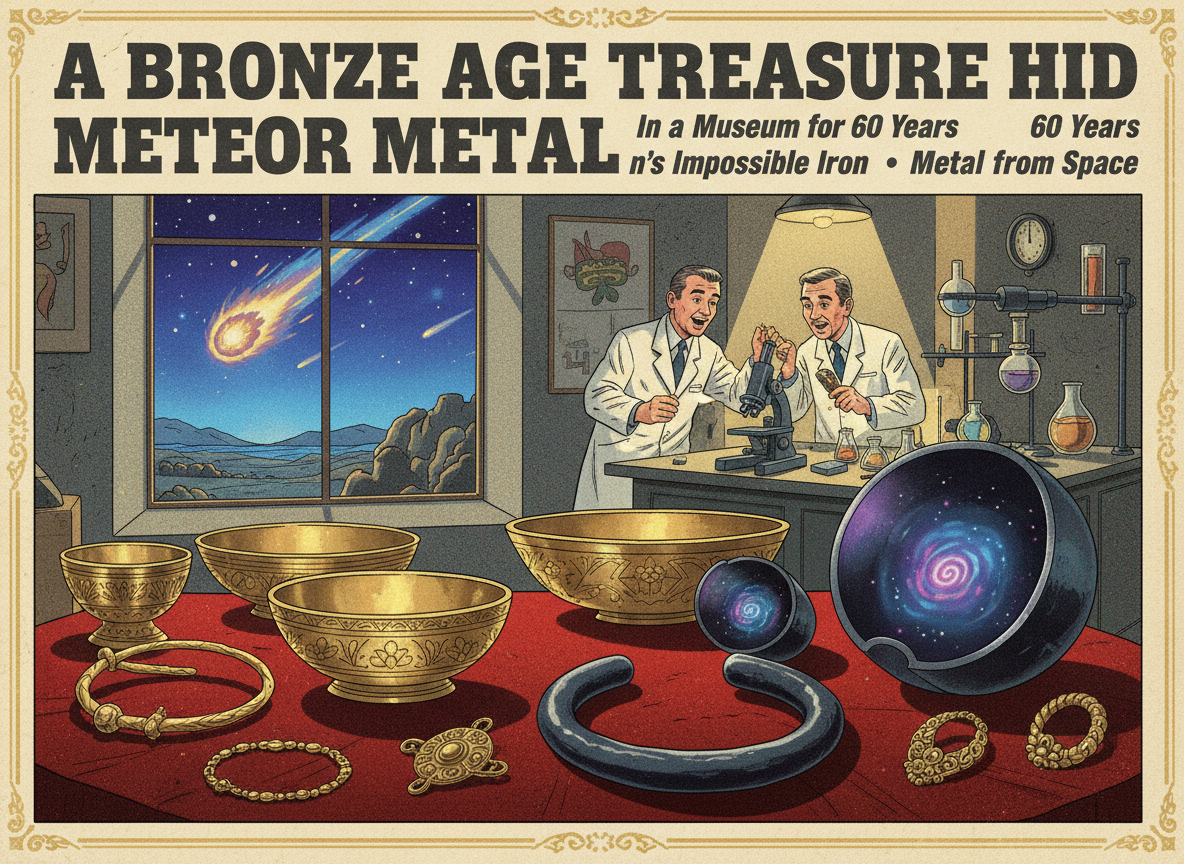
The Treasure of Villena — 66 objects found in 1963 near Alicante, Spain, dating to between 1400 and 1200 BCE — includes a bracelet and a hollow hemisphere that puzzled researchers for decades. The objects looked like iron but appeared in a hoard from the Bronze Age, centuries before iron smelting reached the Iberian Peninsula. Mass spectrometry analysis published in Trabajos de Prehistoria confirmed the answer: the objects are made of meteoritic iron, metal from a space rock that struck Earth approximately a million years ago. They are the first known meteoritic iron artifacts ever found on the Iberian Peninsula. Nobody knows which meteorite. Nobody knows how Bronze Age artisans found it.
The man who found the Treasure of Villena was a civil engineer digging foundations near the town of Villena in the province of Alicante in December 1963. His name was José María Soler. He unearthed 66 objects — bottles, bracelets, bowls, and ornamental pieces — most of them gold, representing nearly 10 kilograms of the metal in total. The collection was handed to the local museum. It became the most important prehistoric metal hoard in the western Mediterranean.
Among the gold pieces, two objects stood out as anomalies. A plain penannular bracelet and a small hollow hemisphere — both covered in a dark, corroded surface that looked like leaded iron. Soler noted the strange “dark leaden metal” in his original documentation. For decades it was catalogued and mostly left alone, the iron pieces overshadowed by the surrounding gold.
The Dating Problem
The timeline anomaly became apparent when archaeologists tried to place the hoard in its historical context. The gold objects, and their similarity to pieces from the nearby Cabezo Redondo hoard — a site archaeologically confirmed to have been abandoned by the 13th century BCE — pointed firmly to the Bronze Age, somewhere between 1400 and 1200 BCE.
But iron smelting from terrestrial ore did not reach the Iberian Peninsula until approximately 850 BCE at the earliest. That is the Iron Age beginning. If the two objects were made from ordinary smelted iron, they could not belong with the rest of the treasure. The timeline did not work.
The hypothesis that circulated quietly among specialists was that the iron might not be terrestrial at all. But testing required permission to take samples from objects of incalculable historical value. That permission took decades to obtain.
The Meteorite Answer
Researchers led by Salvador Rovira-Llorens, former head of conservation at the National Archaeological Museum of Spain, eventually received authorization to take microscopic samples from both objects. They were analyzed using mass spectrometry at the Curt-Engelhorn-Zentrum Archäometrie in Mannheim, Germany.
The diagnostic signature for meteoritic iron is nickel content. Terrestrial iron extracted from ore typically contains very little nickel. Meteoritic iron typically contains more than five percent nickel by weight, along with elevated cobalt and trace elements including gallium, germanium, and ruthenium. Corrosion depletes nickel from surface layers, which complicated the analysis — a surface sample from the bracelet initially came in below the threshold, but a second, deeper sample drilled through the corrosion layer showed 5.33 percent nickel, firmly within the meteoritic range. The hemisphere sample showed 5.5 percent nickel with elevated trace elements confirming the extraterrestrial signature.
The conclusion published in Trabajos de Prehistoria: both objects are made from meteoritic iron. The first known meteoritic iron artifacts from the Iberian Peninsula. Compatible with the Late Bronze Age timeline of the rest of the treasure. The dating anomaly was not an anomaly at all. The iron was simply not from Earth.
The Unanswered Questions
The researchers note that the chemical signature of the Villena pieces is similar to that of the Mundrabilla meteorite from Australia — but they are careful to state that a definitive attribution to any specific meteorite remains impossible with current data.
Who made the objects, and where they encountered the meteorite, also remains unknown. Bronze Age artisans working in southeastern Spain in 1400 BCE would have had to recognize a space rock, understand that it contained workable metal, develop techniques to shape it — before anyone on the peninsula had encountered iron in any other context — and then incorporate it into a hoard alongside their most precious gold objects.
“Iron was as valuable as gold or silver, and in this case used for ornaments or decorative purposes,” said study co-author Ignacio Montero Ruiz. “Who manufactured them and where this material was obtained are still questions that remain to be answered.”
The hoard sits in the museum in Villena. The meteorite that provided two of its pieces remains unidentified somewhere in the landscape of Iberia — or possibly no longer exists at all.
Sources: Popular Mechanics — He Discovered 22 Pounds of Ancient Treasure From an Impossible Timeline — Science Alert — Strange Metal From Beyond Our Planet Spotted in Ancient Treasure Stash — Daily Galaxy — Archaeologists Found Ancient Artifacts Crafted From Metal That Came Straight From Space (March 2026) — Smithsonian Magazine — These 3,000-Year-Old Treasures Were Forged From Meteoritic Iron
There Is a 7,000-Year-Old Stone Wall Sitting on the Ocean Floor off the Coast of France. Nobody Knew It Was There Until 2017.
A 120-meter granite wall built approximately 7,000 years ago has been confirmed beneath nine meters of water off the western tip of…
Israel's "Wheel of Ghosts" Has Been a Mystery Since 1968. AI Just Found 28 More of Them Hidden in Plain Sight.
Rujm el-Hiri — the Wheel of Ghosts — is a massive stone structure in the Golan Heights built from 40,000 tons of…

A New Theory Says Consciousness Is Not Produced by Neurons. It Comes from a Hidden Wave in the Brain That Has Never Been Detected.
A peer-reviewed paper published in Frontiers in Psychology in early 2026 proposes that conscious experience does not arise from neural computation at…
The Lost Colony of Roanoke Was Never Lost. An Amateur Archaeologist Just Proved It With Metal Flakes the Size of Rice Grains.
For more than 400 years, the fate of the 118 English colonists who disappeared from Roanoke Island in 1590 has been one…