Original Story
Some People Cause Street Lights to Go Out When They Walk Past Them. Nobody Has Explained Why.
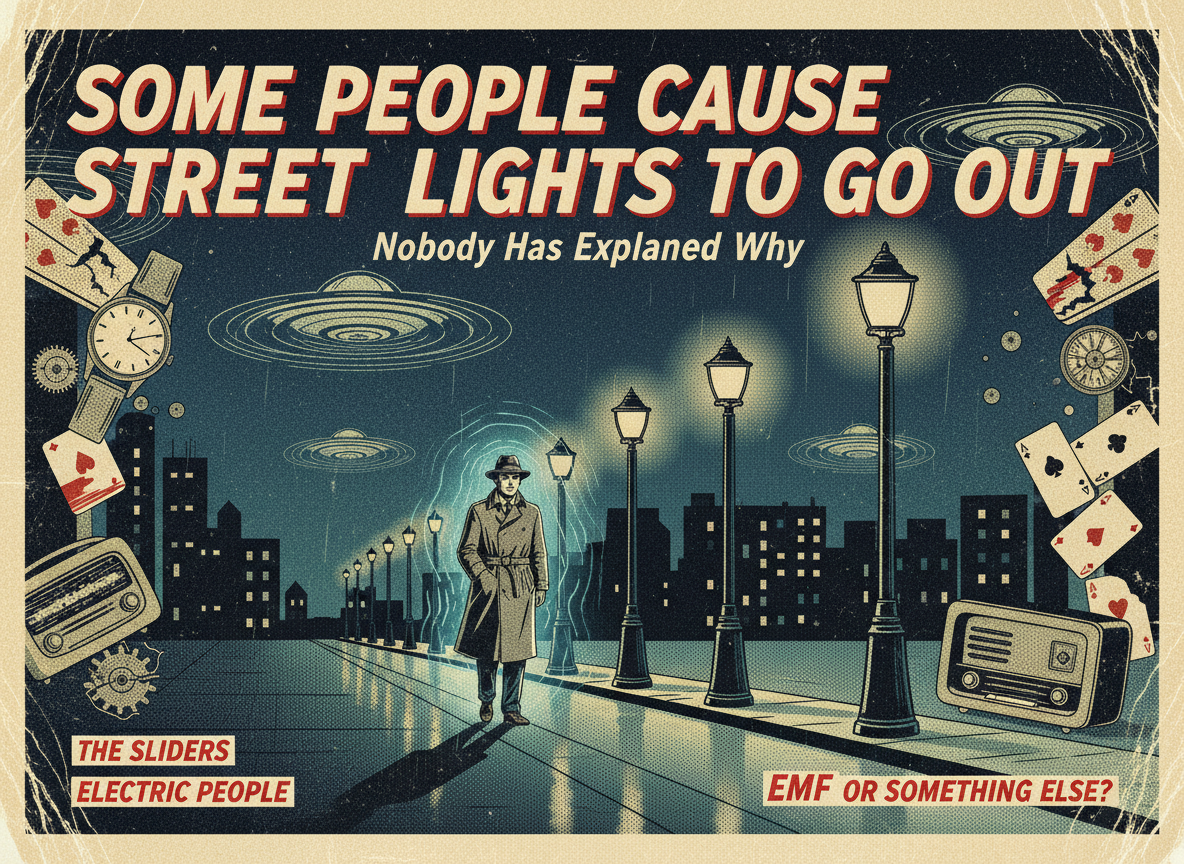
The Mysterious Universe podcast released a new episode this week covering SLIders, the term coined for people who report consistent, unexplained interference with electrical systems, particularly street lights. The phenomenon has been documented for decades, tied to emotional states, linked to UAP encounter accounts, and has never been reproduced under controlled conditions. Whether it is EMF anomaly, confirmation bias, or something that sits between the two, the cases are real and the data set is growing.
The term SLIder was coined by British paranormal researcher Hilary Evans. It stands for Street Light Interference. The phenomenon begins simply: a person notices that street lights switch off when they walk beneath them. They notice it happens more than once. They begin to document it. Then they notice it happens with other electrical systems too. Watches stop. Credit cards demagnetize. Household appliances trigger without being touched. Light bulbs blow at an unusual rate. Electronics glitch in their presence in ways that do not happen for other people in the same room.
The Mysterious Universe podcast published a new episode this week examining the phenomenon through the lens of Marcus Lowth’s book The Electric People, connecting SLI accounts to broader EMF anomalies, UAP encounter reports, and the question of whether the human body under emotional or psychological stress can produce measurable electrical interference with external systems.
What the Cases Show
Evans documented hundreds of SLIder accounts before his death in 2011, establishing the Street Lamp Interference Data Exchange to collect testimony. The consistency across reports from independent witnesses on multiple continents is what gives the phenomenon its research value, not any single dramatic case.
SLIders consistently report that the effect is involuntary. They cannot produce it on demand in a laboratory environment. It tends to occur when they are in an emotionally heightened state, under stress, or engaged in intense thought. One British SLIder, interviewed by CNN, described it as happening “when I’m really mulching something over, really chewing something over in my head, and then it happens.”
The electrical interference is not limited to street lights. Documented cases include an engineer in Woodville, Washington, who was stopped and searched by police because they suspected he was deliberately interfering with the streetlights along his regular route. A woman in Athens, Greece, reportedly caused a restaurant’s entire electrical system to fail when she asked the staff to turn down the music and they refused.
What the Skeptical Arguments Miss
The standard skeptical response to SLI is confirmation bias: people notice when a light goes out as they pass and do not notice the far more frequent occasions when the same light stays on. Street lights turn off and on constantly on their sodium vapor cycles. People see patterns because the human brain is a pattern-recognition system.
This is a reasonable objection and likely accounts for many SLI reports. It does not account for the cases involving other electrical systems, the engineer searched by police, the demagnetized credit cards, or the documented instances where researchers present with a SLIder observed the effect independently. Hilary Evans’ conclusion was careful: “It’s quite obvious from the letters I get that these people are perfectly healthy, normal people. It’s just that they have some kind of ability, just a gift they’ve got. It may not be a gift they would like to have.”
The UAP Connection
The Mysterious Universe episode draws a thread that fringe researchers have noted for years: electrical interference is a consistent feature of UAP encounter accounts. Engines stopping. Lights failing. Radios cutting out. Electronic equipment going haywire in proximity to an unidentified object. The question the episode raises is whether SLIders and UAP-associated EMF disruption are pointing toward the same underlying phenomenon from different directions, one external to the person and one that appears to originate from within them.
No controlled study has resolved it. The data set is large enough and consistent enough that dismissing it entirely requires actively choosing not to look.
Sources: Mysterious Universe — Episode 35.11, Human Static — Hilary Evans, SLIders: The Enigma of Streetlight Interference — UFO Insight — SLIders: The People Who Can Control Electricity

Something Is Moving Through Ohio: Eight Witnesses, Two Creatures, and the Biggest Bigfoot Flap in Fifty Years
A concentrated cluster of sightings along a wooded northeast Ohio greenbelt has cryptozoologists calling it the most significant Sasquatch event since the…

An Entire Island Near Fiji Is Made of 1,200-Year-Old Shellfish Scraps. Lapita People Built It Without Meaning To.
In Chandeleur Sound — wait, wrong story. In Chandeleur Sound in the Gulf of Mexico, there is controversial granite. In the southwestern…

A Retired Architect Has Spent 50 Years Trying to Prove There Is a 12,000-Year-Old Lost City Under the Gulf of Mexico. The Academic World Has Not Confirmed It. Nobody Has Definitively Disproven It.
George Gelé is 50 years into a personal investigation he has largely funded himself. The site of his obsession is Chandeleur Sound…

Ohio's Serpent Mound Was Built Twice, Altered in Antiquity, and Once Had Horns. The Debate Over Who Built It and Why Has Never Been Settled.
The Serpent Mound in Adams County, Ohio — the largest serpent effigy earthwork in North America — was first documented in 1848…