Original Story
An Entire Island Near Fiji Is Made of 1,200-Year-Old Shellfish Scraps. Lapita People Built It Without Meaning To.
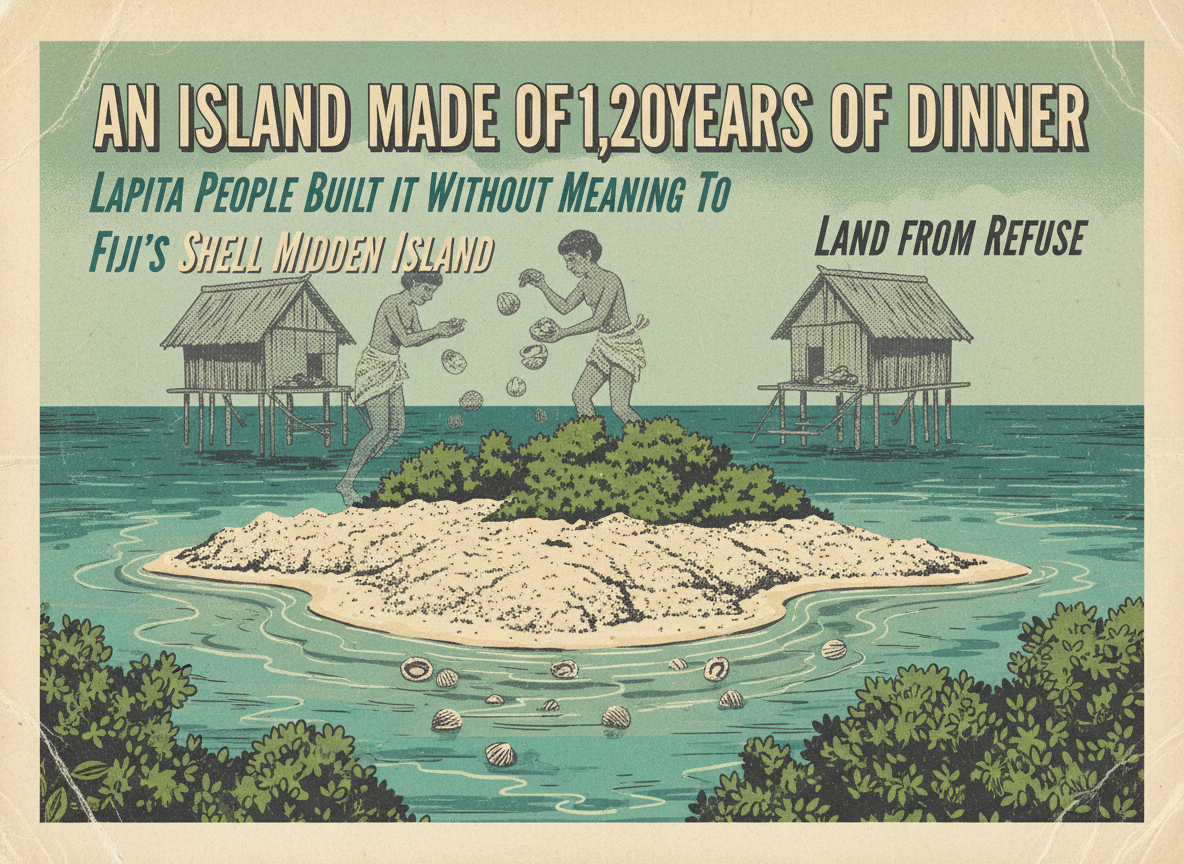
In Chandeleur Sound — wait, wrong story. In Chandeleur Sound in the Gulf of Mexico, there is controversial granite. In the southwestern Pacific, near Vanua Levu in Fiji, there is something that is not controversial at all, and is somehow stranger: an entire island, 3,000 square meters, rising barely 60 centimeters above sea level, made entirely of shellfish the Lapita people ate over the course of roughly three centuries. They did not build an island. They ate their meals and threw the shells overboard. The island built itself. Researchers from Fiji and Australia confirmed it in a study published in the journal Geoarchaeology — the first shell midden island ever found in the South Pacific east of Papua New Guinea. The Lapita were the first settlers of Fiji. They are also now, inadvertently, its architects.
Every civilization leaves traces. Most of those traces — pottery, tools, burial sites, structural remains — require active effort. The people who made them had to choose to make them. The island near Culasawani on the western coast of Vanua Levu is different. Nobody chose to build it. It is 1,200 years of dinner.
In January 2017, researchers conducting geoarchaeological surveys near Vanua Levu spotted an unassuming flat formation surrounded by mangroves in the coastal shallows. At high tide it rises about 60 centimeters above sea level. Its total surface area is approximately 3,000 square meters. It doesn’t look like much from the water.
Radiocarbon dating returned an age of approximately 1,190 years, placing its formation during the period associated with post-Lapita settlement of Fiji — roughly 760 CE. The Lapita people were the archaeological culture responsible for first settling Fiji and much of the Pacific, and their descendants were the builders of the early Fijian civilization that followed. Researchers found fragments of undecorated earthenware pottery consistent with pre-modern Fijian ceramics. No fish bones. No stone tools.
Two Theories — One Answer
When the team from Fiji and Australia began their analysis, they identified two competing explanations for what they were looking at.
The first was the obvious one: this is a shell midden — a term archaeologists use for the accumulated food refuse of human occupation. Shellfish meat was removed and consumed. The shells were discarded in the same location, repeatedly, over a period of extended occupation, piling up higher and higher until the pile exceeded the waterline and became, by definition, land.
The second explanation was a tsunami deposit. High-energy wave events can displace enormous quantities of shell material from shallow-water beds and pile it in improbable configurations. If a large tsunami had scoured the surrounding seafloor and deposited shell debris at this location, it might produce a similar-looking formation without any human cause.
The researchers tested the tsunami hypothesis directly. A tsunami deposit would produce a sedimentary layer that thinned progressively as it moved away from the deposition point — the physical signature of a wave dissipating its energy. The team looked at sedimentary layers beyond the island in the direction a tsunami wave would have traveled. There was no progressive thinning. There was no extending shell layer at all.
The shells were from commonly consumed shellfish species. They were concentrated specifically at this location. They had accumulated in a pattern consistent with repeated human disposal in the same place over generations.
The island is a midden. The midden became an island.
What This Means
The researchers’ preferred reconstruction is that a community of early post-Lapita settlers occupied this area around 760 CE, living on stilt structures above the coastal shallows — a settlement pattern documented elsewhere in the Lapita tradition. Over decades or centuries of occupation, shellfish processing produced an accumulating refuse pile beneath and around the stilts. The pile grew. When the community eventually abandoned the site, the shell deposit remained and continued to consolidate. Sediment from inland deforestation — caused by human activity further up the watershed — contributed a binding layer. The mangrove forest that now surrounds the island grew in afterward, on the foundation the shell pile provided.
“The most important aspect of this study is the possibility that it has identified a shell-midden island, fortuitously created through the combined effect of relative sea-level fall and vertical shell-midden accumulation,” the researchers wrote.
It is the first such island ever confirmed in the South Pacific east of Papua New Guinea. Vanua Levu, the second largest island in the Fiji archipelago, has historically been less studied than other parts of Fiji. Other formations in the same area are now candidates for similar analysis.
Somewhere in the Pacific, there may be more land like this. Geography produced not from tectonic movement or volcanic deposition, but from shellfish, eaten meal by meal, discarded into water, and piled up across centuries until the pile became a place.
Sources: Popular Mechanics — Scientists Discovered an Entire Island Made of Ancient Humans’ Leftover Food (April 2026) — Yahoo News / Popular Mechanics republication (April 2026) — Geoarchaeology journal — Researchers from University of the South Pacific and Australian institutions

Something Is Moving Through Ohio: Eight Witnesses, Two Creatures, and the Biggest Bigfoot Flap in Fifty Years
A concentrated cluster of sightings along a wooded northeast Ohio greenbelt has cryptozoologists calling it the most significant Sasquatch event since the…
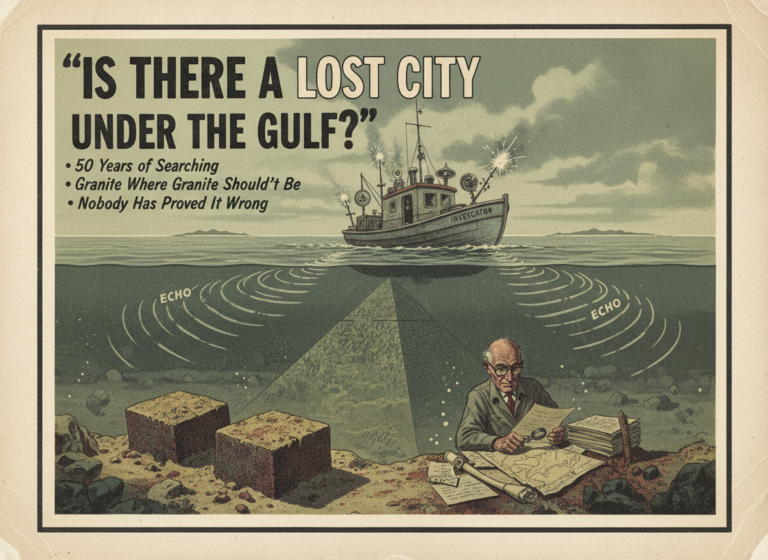
A Retired Architect Has Spent 50 Years Trying to Prove There Is a 12,000-Year-Old Lost City Under the Gulf of Mexico. The Academic World Has Not Confirmed It. Nobody Has Definitively Disproven It.
George Gelé is 50 years into a personal investigation he has largely funded himself. The site of his obsession is Chandeleur Sound…
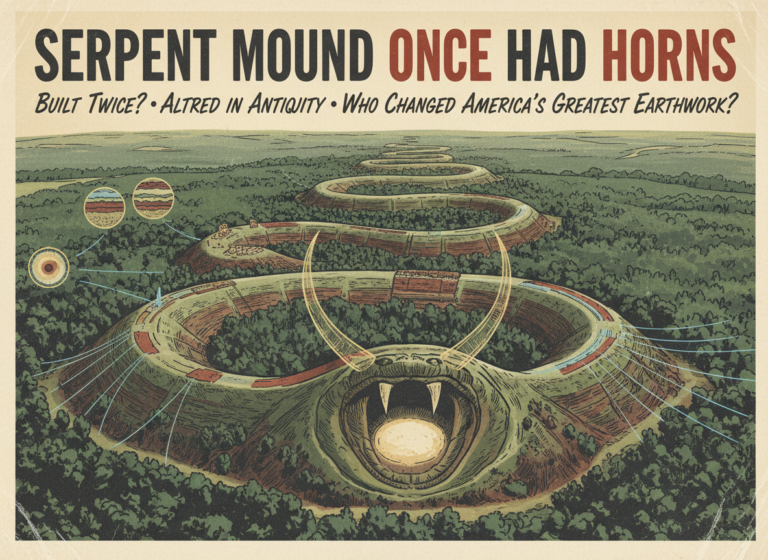
Ohio's Serpent Mound Was Built Twice, Altered in Antiquity, and Once Had Horns. The Debate Over Who Built It and Why Has Never Been Settled.
The Serpent Mound in Adams County, Ohio — the largest serpent effigy earthwork in North America — was first documented in 1848…

A Scientist Says Your Vivid Recurring Dreams May Not Be Yours. They May Belong to Another Version of You.
David Leong is an epistemologist at Charisma University in Turks and Caicos. His research article, covered this week by Popular Mechanics and…