Original Story
Ohio’s Serpent Mound Was Built Twice, Altered in Antiquity, and Once Had Horns. The Debate Over Who Built It and Why Has Never Been Settled.
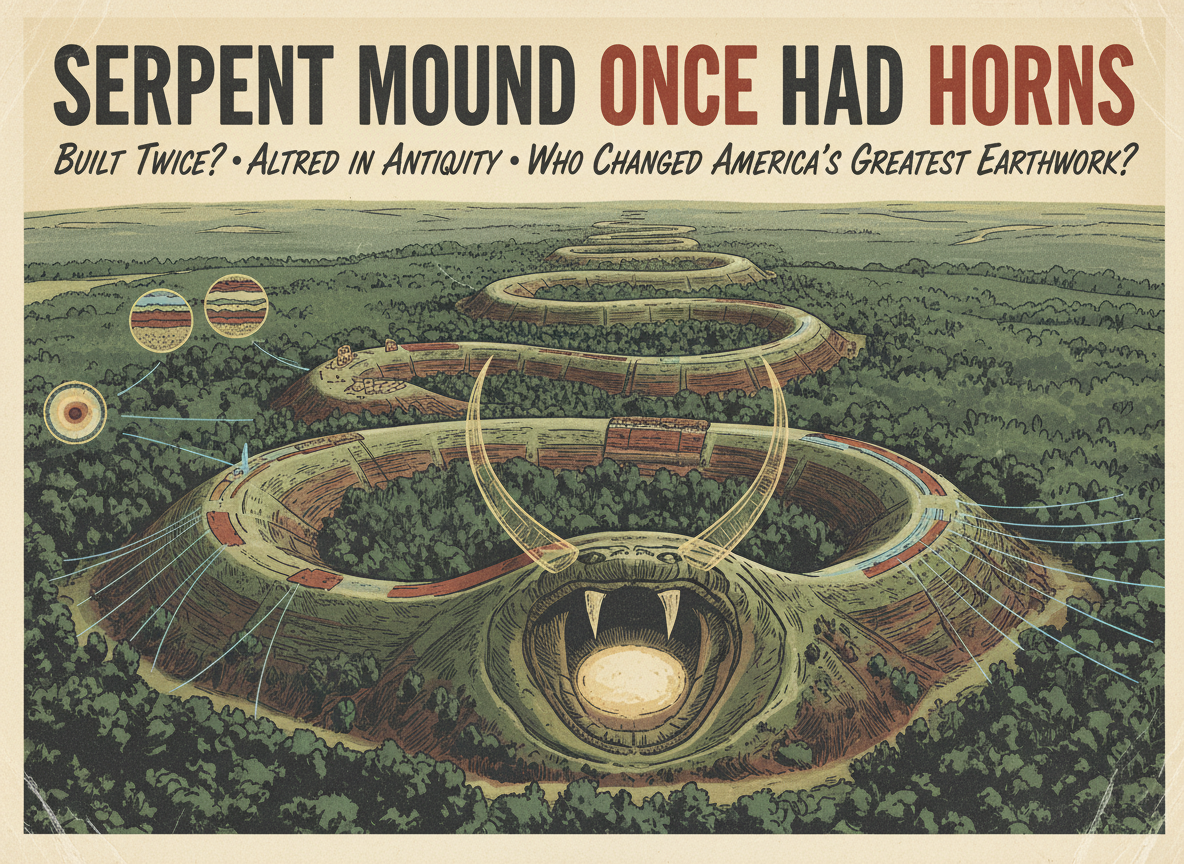
The Serpent Mound in Adams County, Ohio — the largest serpent effigy earthwork in North America — was first documented in 1848 and has been the subject of serious archaeological investigation for nearly 180 years. In that time, researchers have argued over its age, its builders, its astronomical significance, and its original appearance. A 1991 radiocarbon dating study said it was built by the Fort Ancient culture, placing it around 1000 CE. New core samples taken in 2011 contradicted that, returning dates consistent with the earlier Adena culture — more than 1,400 years older. The current scientific consensus, expressed by researcher and Adena specialist Jason Pentrail in a new interview with The Debrief, is that the Serpent Mound was almost certainly Adena in origin, later repaired and used by the Fort Ancient. Ground-penetrating radar has also revealed a missing coil — and the 1919 record of Charles Willoughby documents horns that are no longer there.
The Serpent Mound stretches more than 1,300 feet across a ridge above Brush Creek in Adams County. Seen from the air — which is the only way to take it in entirely — it is an undulating serpent whose tail coils at one end and whose jaws gape open at the other, encircling a large, regular oval feature. The site sits inside a massive ancient meteorite impact crater. Its alignments with astronomical events, particularly the summer solstice sunrise, have been noted and studied for decades.
Ephraim Squier and Edwin Davis first formally documented it in 1848, noting the regular oval within the jaws and describing burned stones at its center. In the 170-plus years since, every assumption about the mound has been revised at least once.
The Dating Wars
For most of the 20th century, the Serpent Mound was attributed to the Adena culture — a tradition of mound-building people who inhabited the Ohio Valley roughly between 1000 BCE and 100 CE. The basis for this attribution was geographic: a confirmed Adena burial mound sits in close proximity to the Serpent effigy, and the association seemed logical.
In 1991, when avocational archaeologist Robert Fletcher collected samples for the first radiocarbon dating ever undertaken at the site, the results landed in a completely different era. The dates pointed to the Fort Ancient culture — a later tradition dating between approximately 1000 and 1750 CE. If accurate, this placed the Serpent Mound’s construction more than a thousand years after the Adena, and the site’s attribution was formally revised.
“That’s when things really got controversial,” says Jason Pentrail, an environmental scientist, archaeology researcher, and author of Adena: Mound Builders of the Ohio Valley, speaking to The Debrief. “People who had always believed it was Adena pushed back hard.”
The controversy deepened in 2011 when a multidisciplinary team conducted new coring of the mound, combined with magnetometer surveys and LiDAR imaging. These core samples — taken from the deepest, least-disturbed layers, from multiple locations — returned dates consistent with an Adena-period construction.
“Those cores came back with much earlier dates that would place it perfectly in the Adena time period,” Pentrail told The Debrief. The research team, including Ohio archaeologists Jarrod Burks and William Romain, concluded in their published paper that the mound was “first built ~1,400 years earlier and contemporary with an Adena occupation.”
The resolution Pentrail now accepts: an Adena original that was later repaired, used, and possibly modified by the Fort Ancient people. The earlier radiocarbon dates reflected Fort Ancient-era soil disturbances — tree roots, erosion repairs, surface rebuilding — that had mixed into the stratigraphic record. The deeper cores were not contaminated by that mixing.
The Missing Parts
What makes the story stranger is what the mound no longer has.
Ground-penetrating radar surveys have identified what appears to be an additional coil in the serpent’s body — a loop that exists in the subsurface but has been erased from the surface, removed at some point in antiquity for reasons that are not understood.
Even more striking is the documentation of the horns.
In 1919, archaeologist Charles Willoughby described the restoration work carried out at the site in 1887 under Frederick Ward Putnam, who led the first major effort to preserve the mound. Willoughby noted that Putnam’s restoration focused only on the head with open jaws and the large oval feature. But Willoughby also recorded something that Putnam’s work had not addressed: two projections at the base of the head — appendages present in the original pre-restoration surveys — that were “relatively higher and more conspicuous than they appear at present.”
These features — visible in Willoughby’s 1918 illustration of the site as a pair of small horn-like protrusions just behind the serpent’s open jaws — are not visible in the mound today. Subtle ground features at those locations are still detectable by trained observers, but the physical prominences are gone.
“What looks to be the case is that it leads back to a very old story that, really, is an international phenomenon,” Pentrail told The Debrief. “The great horned serpent is well established in parts of South America, in Asia, and throughout Europe.”
Whether the horns were removed in antiquity — before Putnam’s 1887 work — or were simply not recreated during restoration is unresolved. What is known is that what visitors see today is not what was originally built. The Serpent Mound has been edited. Nobody knows who did it or why.
Sources: The Debrief — Ohio’s Serpent Mound Still Fuels Debate, as Haunting Questions Remain About America’s Most Mysterious Earthwork (March 31, 2026) — Ohio History Connection — Serpent Mound site information — Jason Pentrail, Adena: Mound Builders of the Ohio Valley — Burks, Romain et al., multidisciplinary reevaluation study 2011

Something Is Moving Through Ohio: Eight Witnesses, Two Creatures, and the Biggest Bigfoot Flap in Fifty Years
A concentrated cluster of sightings along a wooded northeast Ohio greenbelt has cryptozoologists calling it the most significant Sasquatch event since the…

An Entire Island Near Fiji Is Made of 1,200-Year-Old Shellfish Scraps. Lapita People Built It Without Meaning To.
In Chandeleur Sound — wait, wrong story. In Chandeleur Sound in the Gulf of Mexico, there is controversial granite. In the southwestern…

A Retired Architect Has Spent 50 Years Trying to Prove There Is a 12,000-Year-Old Lost City Under the Gulf of Mexico. The Academic World Has Not Confirmed It. Nobody Has Definitively Disproven It.
George Gelé is 50 years into a personal investigation he has largely funded himself. The site of his obsession is Chandeleur Sound…

A Scientist Says Your Vivid Recurring Dreams May Not Be Yours. They May Belong to Another Version of You.
David Leong is an epistemologist at Charisma University in Turks and Caicos. His research article, covered this week by Popular Mechanics and…