Original Story
Life’s Instruction Manual Was Found on an Asteroid — And It Didn’t Come From Earth
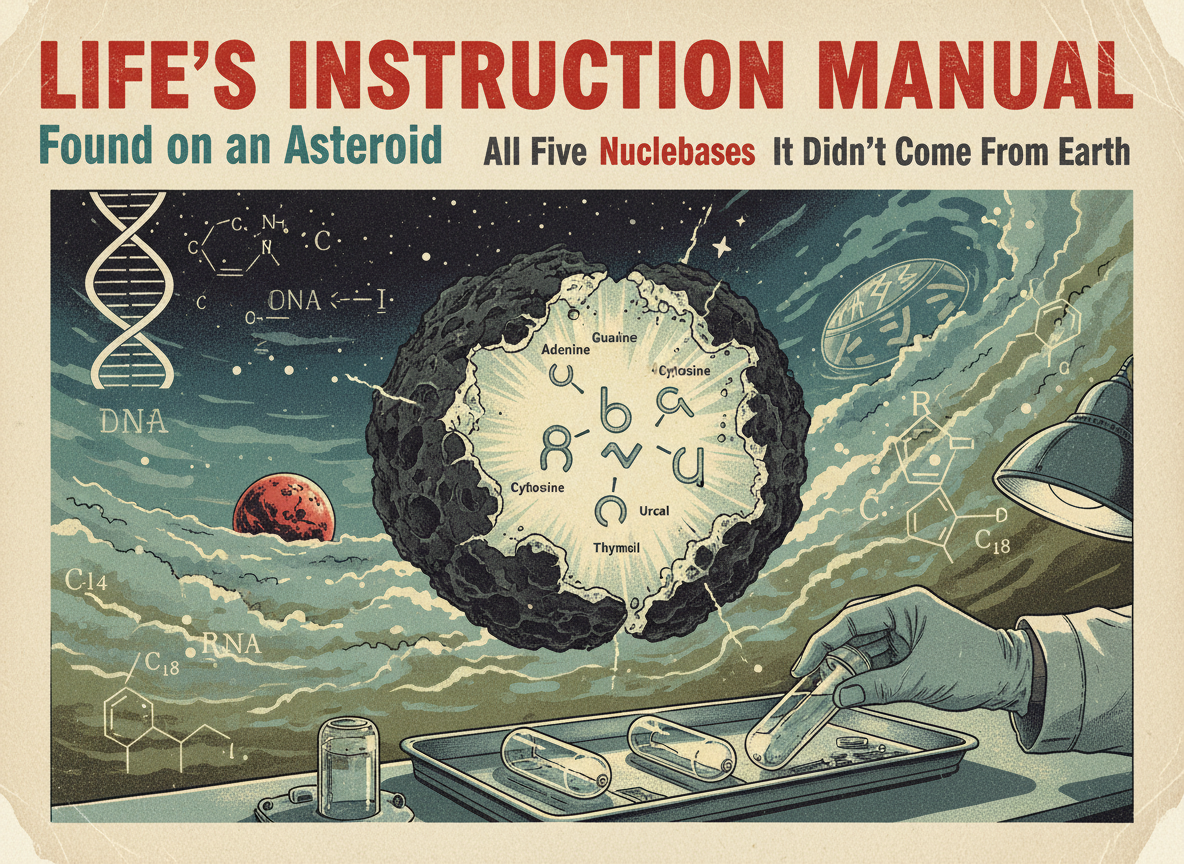
Researchers at Hokkaido University have confirmed that samples from the asteroid Ryugu contain all five nucleobases — the molecular letters of DNA and RNA. Every genetic building block life uses to store and transmit information was sitting on a rock that formed 4.6 billion years ago, before Earth existed. It was not contamination. The isotopes confirm it formed in space.
The Hayabusa2 spacecraft launched in December 2014, traveled 300 million kilometers to rendezvous with a 900-meter-wide asteroid called Ryugu, fired a projectile into its surface, collected the debris, and returned it to Earth in December 2020. Scientists have been analyzing what came back ever since. This week, researchers at Hokkaido University published their findings in Nature Astronomy: the Ryugu samples contain all five canonical nucleobases — adenine, guanine, cytosine, thymine, and uracil — the complete molecular alphabet of DNA and RNA.
This is the genetic instruction set for all life on Earth, found intact on a rock that predates the Earth itself.
Why This Is Different From Previous Findings
Nucleobases had previously been detected in meteorites — fragments of asteroids that survived the fall through Earth’s atmosphere. The problem with meteorites is contamination. Once a rock hits the ground, Earth’s own biology starts working on it immediately. Ruling out terrestrial contamination is difficult and sometimes impossible.
Ryugu is different. The samples were collected directly from the asteroid’s surface in deep space, sealed in a sterile container, and returned to Earth under controlled conditions. Researchers conducted their analysis in a cleanroom with strict contamination protocols. Isotopic analysis of the nucleobases confirmed they were indigenous to the asteroid — formed in space, not picked up on the way down or after landing.
The result is the cleanest confirmation yet that life’s building blocks exist in the solar system independent of life itself. They were made without biology. They were preserved for 4.6 billion years. And they came home inside a Japanese spacecraft.
What the Chemistry Shows
The five nucleobases split into two categories: purines (adenine and guanine) and pyrimidines (cytosine, thymine, and uracil). The Ryugu samples contained roughly equal amounts of both. This is notable because previous findings from the asteroid Bennu and from meteorites like the Murchison showed skewed ratios — more purines here, more pyrimidines there. Ryugu’s near-equal balance is unusual.
The researchers found that the ratios appear to correlate with ammonia concentration — more ammonia corresponds to more pyrimidines. No known chemical formation pathway predicts this relationship. Lead researcher Toshiki Koga noted that this may point to “a previously unrecognized pathway for nucleobase formation in early solar system materials.” The chemistry of how life’s ingredients were assembled in space is not fully understood. Ryugu just opened a new line of investigation.
What the Fringe Has Always Said
The panspermia hypothesis — the idea that the building blocks of life, or life itself, were distributed across the solar system and possibly the galaxy by asteroids, comets, and interstellar debris — has been fringe-adjacent for decades. It was the kind of idea that respectable scientists treated with polite skepticism while quietly thinking about it.
The evidence is accumulating faster than the skepticism can keep up. All five nucleobases on Bennu. All five nucleobases on Ryugu. The same building blocks in meteorites from across the solar system. The ratio of purines to pyrimidines varying by ammonia concentration in ways nobody predicted. Life’s molecular vocabulary appears to be a solar system phenomenon, not an Earth phenomenon.
The question that fringe research has been asking for years — whether Earth is the origin of life or simply the destination — just got harder to dismiss.

Kennedy Pushed Hard on Dimona. Then He Was Killed. The Documents Are Real — the Question Is What They Mean.
The JFK-Dimona thread is back in the feed today via Conspiracy Unearthed. The documented history of what Kennedy was actually doing about…
The Man Who Builds Autonomous Fighter Jets Says UFOs Probably Come From the Past — and He's Thought About the Physics
Palmer Luckey founded Oculus, sold it to Facebook for $2 billion, then built Anduril Industries — one of the most significant autonomous…
39 Shows in the Directory — Your Guide to the Fringe Feed Podcast Index
The Fringe Feed indexes 39 active fringe podcast shows across six categories. 🛸 If You're Here for UAP and Disclosure UFO Chronicles…
What's in the News Feed — Wednesday, March 18, 2026
Fresh stories from across the aggregated fringe web — every headline linked to the original source. The Wednesday feed refreshed strong. A…