Original Story
Israel’s “Wheel of Ghosts” Has Been a Mystery Since 1968. AI Just Found 28 More of Them Hidden in Plain Sight.

Rujm el-Hiri — the Wheel of Ghosts — is a massive stone structure in the Golan Heights built from 40,000 tons of rock. It was first discovered in 1968 and has puzzled archaeologists ever since. Its date, purpose, and builders are all contested. What has seemed certain is that it was unique. A paper published in PLOS One on March 18, 2026 removes that certainty: using satellite imagery from 20 years of archives combined with AI processing, an international research team has found 28 additional structures sharing its characteristics within a 16-mile radius. Sites in Galilee and Lebanon also resemble it. The structure that was singular is now the most prominent member of an entire unknown tradition.
Rujm el-Hiri translates from Arabic as “stone heap of the wild cat.” The Hebrew name, Gilgal Refaim, means “Wheel of the Ghosts” or “Wheel of the Giants.” It sits in the Golan Heights, visible from the air as a series of concentric stone circles surrounding a central burial chamber, all encircled by an outer ring nearly 160 meters across. The whole structure contains an estimated 40,000 tons of stone. Archaeologists date its construction to somewhere between 3,500 and 6,500 years ago — a 3,000-year window that reflects genuine uncertainty about who built it and when.
Its purpose has been debated along the standard lines reserved for mysterious ancient sites: ceremonial space, burial complex, astronomical observatory. Ancient alignments with the solstice sunrise have been proposed. All of these interpretations shared a foundational assumption that has now been demolished: that the Wheel of Ghosts was an anomaly, a singular site with no parallels in the region.
What the Satellites Found
A multidisciplinary international team of physicists and archaeologists combined two decades of satellite imagery from multiple platforms — including Google Earth Pro and CNES/Airbus archives covering 2004 through 2024 — with AI image processing to strip away the obscuring effects of shadows, seasonal vegetation, and surface degradation.
What emerged in the processed imagery was not one site. It was 29, all within a 16-mile radius of the Wheel of Ghosts. Twenty-eight previously undetected structures sharing its circular form and stone construction, all hidden from ground-level observation and overlooked by aerial photography for nearly six decades after the original was first identified.
The Wheel of Ghosts remains the largest and best-preserved. The 28 newly found sites are smaller, more heavily degraded, and less elaborate — which is precisely why they escaped detection. Without the AI’s ability to process 20 years of multi-season imagery and strip away surface interference, they would likely have remained invisible.
Why No One Could See Them
The Golan Heights is not an unmapped wilderness. It has been photographed from the air and surveyed on the ground repeatedly. The reason these sites went undetected for six decades is partly their condition — degraded stone structures blending into rocky terrain over thousands of years of weathering, seasonal vegetation growth, and shade from varying sun angles obscure surface features that are only detectable when multiple data layers are analyzed together across time.
The AI processing used in this research represents the methodology of the next phase of archaeological discovery: not fieldwork first, but satellite first. The study authors note this approach removes the need for expensive, time-consuming expeditions to regions that may yield nothing, allowing research teams to prioritize ground investigation where remote sensing has already identified candidates.
Haaretz reporting on the same paper notes that additional sites in Galilee and Lebanon also resemble Rujm el-Hiri. If confirmed through ground investigation, the scale of this unknown architectural tradition across the southern Levant is considerably larger than the 16-mile cluster suggests.
What Nobody Knows
Every substantive question about the Wheel of Ghosts remains open. The 3,000-year construction window attached to the original site cannot yet be narrowed without knowing which human group built it, and that remains unknown. The new paper’s discovery that 28 similar structures exist in the same region changes the problem without solving it. A single unexplained monument is an anomaly. Twenty-nine unexplained monuments, all sharing formal characteristics, across a tight geographic cluster, are evidence of an organized tradition — one that left behind no written record, no confirmed cultural attribution, and no agreed-upon purpose.
Extensive on-the-ground research is now required to determine whether all 29 sites were built by the same culture, in the same period, for the same purpose. The paper published in PLOS One is the beginning of that investigation, not its conclusion.

A Bronze Age Spanish Treasure Sat in a Museum for 60 Years. Two Pieces of It Were Made from a Meteorite. Nobody Knew.
The Treasure of Villena — 66 objects found in 1963 near Alicante, Spain, dating to between 1400 and 1200 BCE — includes…
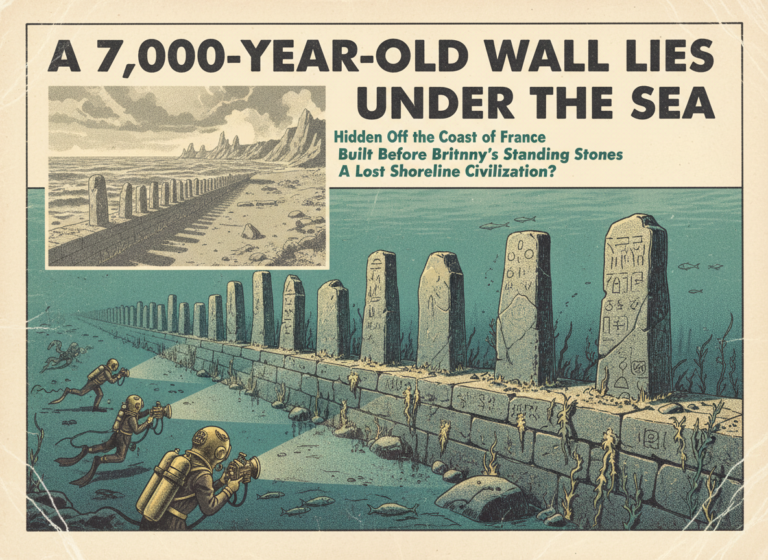
There Is a 7,000-Year-Old Stone Wall Sitting on the Ocean Floor off the Coast of France. Nobody Knew It Was There Until 2017.
A 120-meter granite wall built approximately 7,000 years ago has been confirmed beneath nine meters of water off the western tip of…

A New Theory Says Consciousness Is Not Produced by Neurons. It Comes from a Hidden Wave in the Brain That Has Never Been Detected.
A peer-reviewed paper published in Frontiers in Psychology in early 2026 proposes that conscious experience does not arise from neural computation at…

The Lost Colony of Roanoke Was Never Lost. An Amateur Archaeologist Just Proved It With Metal Flakes the Size of Rice Grains.
For more than 400 years, the fate of the 118 English colonists who disappeared from Roanoke Island in 1590 has been one…