Original Story
A New Theory Says Consciousness Is Not Produced by Neurons. It Comes from a Hidden Wave in the Brain That Has Never Been Detected.
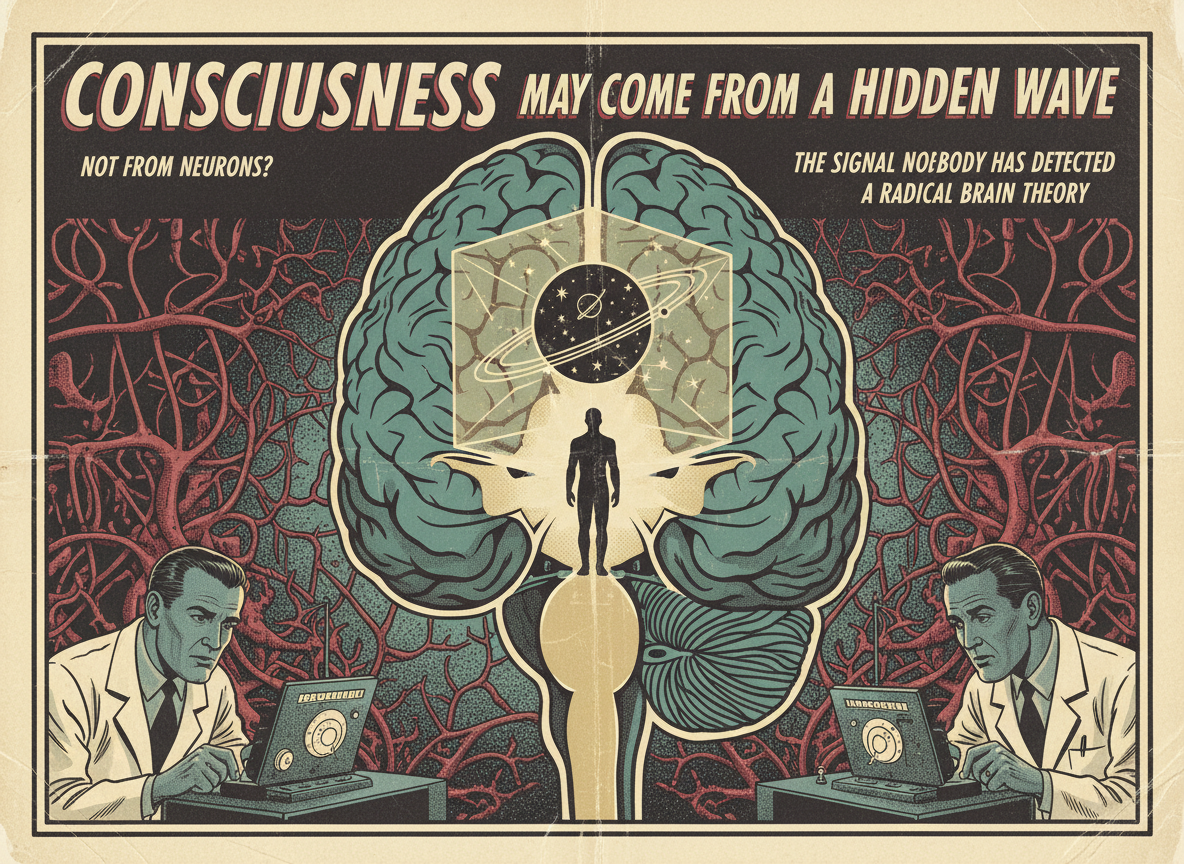
A peer-reviewed paper published in Frontiers in Psychology in early 2026 proposes that conscious experience does not arise from neural computation at all. Instead, it argues that the source of consciousness is a wave excitation in the thalamus — a structure deep at the center of the brain — that stores a holographic model of three-dimensional space using the same mathematical framework as a Fourier transform. The wave drives consciousness. Neurons are secondary. The wave itself has never been detected. The theory predicts it should be findable. If it is, the implications extend beyond neuroscience into every model of mind, artificial intelligence, and the nature of awareness itself.
Every major theory of consciousness for the past several decades has operated on the same basic premise: the brain computes, and consciousness is what the computation feels like from the inside. Neurons fire in patterns. Those patterns produce experience. The specific mechanism is debated — global workspace theory, integrated information theory, predictive processing — but the underlying assumption is consistent. Neural activity is the source of mind.
Robert Worden, a researcher at the Active Inference Institute, published a challenge to that assumption in Frontiers in Psychology in January 2026. His paper, “The Projective Wave Theory of Consciousness,” argues that neural computation cannot explain consciousness because it faces an unsolvable decoding problem. All information in a neural computer must be physically encoded. But consciousness contains direct, un-encoded information about the structure of local space — the seamless three-dimensional experience of being in a world. There is nowhere in the encoding system to store that. So either the theory is wrong, or the source of consciousness is not encoded computation.
Worden’s alternative: it is a wave.
What the Wave Is
The proposal is specific. Worden argues that the thalamus — the egg-shaped structure at the brain’s center, already known to be a critical relay station for sensory information — hosts a wave excitation that stores an analogue model of surrounding three-dimensional space. The model is encoded not as discrete neural signals but as a Fourier transform of physical space: a holographic representation of the world, continuously updated, generated by the wave’s own dynamics.
Neurons couple to the wave, feeding it sensory information and reading from it to drive behavior. But the wave itself is the source of conscious experience. Not the neurons. The wave.
The thalamus, Worden notes, has structural properties that make this plausible in ways that are otherwise difficult to explain. Its nuclei are clustered in a near-spherical arrangement with weak connections between them — an architecture inefficient for standard neural wiring but well-suited to hosting a stable wave that can operate in all spatial directions simultaneously. Worden suggests the wave might represent an exotic physical state, possibly analogous to a Bose-Einstein condensate.
Why It Has Not Been Found
The wave has never been detected. Worden addresses this directly. Current brain imaging tools are not sensitive to the type of wave he is proposing. Standard electroencephalography and fMRI measure different signals. The wave, if it exists, would require either new instrumentation or targeted use of emerging tools — including transcranial focused ultrasound, which MIT researchers published a roadmap for in February 2026 as a method for accessing deep brain structures non-invasively for the first time.
This is what makes the theory scientifically valuable rather than merely speculative: it is falsifiable. If experiments look for this wave and do not find it, the theory is wrong. If they do find it, the implications extend well beyond neuroscience. A non-computational basis for consciousness would challenge every existing AI framework. It would provide new grounding for decades of research into meditation, altered states, anesthesia, and near-death experiences. It would demand a different account of what is lost when a brain goes quiet — and what, precisely, survives.
“The projective wave theory is not just a theory of consciousness,” Worden writes. “It is a cognitive theory of how the brain works, and it differs radically from current pure neural theories.”
Sources: The Debrief — New Theory Suggests Consciousness May Come from a Hidden Wave in the Brain — Frontiers in Psychology — The Projective Wave Theory of Consciousness, Worden 2026 — Daily Neuron — Your Brain as a Hologram: A Wave Theory of Consciousness

A Bronze Age Spanish Treasure Sat in a Museum for 60 Years. Two Pieces of It Were Made from a Meteorite. Nobody Knew.
The Treasure of Villena — 66 objects found in 1963 near Alicante, Spain, dating to between 1400 and 1200 BCE — includes…

There Is a 7,000-Year-Old Stone Wall Sitting on the Ocean Floor off the Coast of France. Nobody Knew It Was There Until 2017.
A 120-meter granite wall built approximately 7,000 years ago has been confirmed beneath nine meters of water off the western tip of…
Israel's "Wheel of Ghosts" Has Been a Mystery Since 1968. AI Just Found 28 More of Them Hidden in Plain Sight.
Rujm el-Hiri — the Wheel of Ghosts — is a massive stone structure in the Golan Heights built from 40,000 tons of…

The Lost Colony of Roanoke Was Never Lost. An Amateur Archaeologist Just Proved It With Metal Flakes the Size of Rice Grains.
For more than 400 years, the fate of the 118 English colonists who disappeared from Roanoke Island in 1590 has been one…