Original Story
The Romans Had a Machine Gun. The Scars It Left Are Still on Pompeii’s Walls.
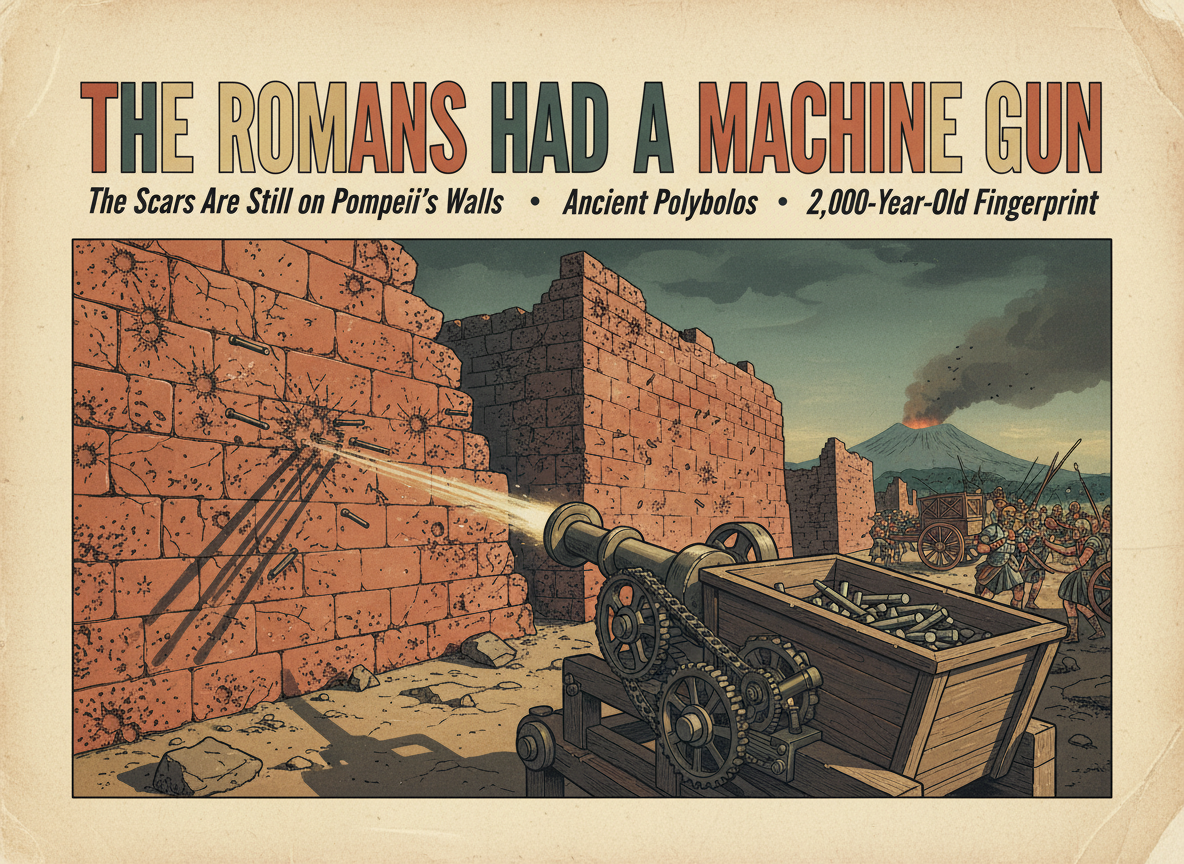
A peer-reviewed study published in Heritage documents fan-shaped impact clusters on Pompeii’s northern walls that match no known standard Roman projectile. After five years of 3D scanning, digital reconstruction, and reverse engineering, the research team from the University of Campania and the University of Bologna concluded the marks are consistent with one weapon: the polybolos, an ancient Greek automatic repeating dart-thrower invented in 3rd-century BC Rhodes. The device used a chain-drive magazine to fire metal-tipped bolts in rapid succession without manual reloading. It is the earliest known application of a chain-drive mechanism in history.
Pompeii is known as the city the volcano froze. Less discussed is what happened to it 150 years before Vesuvius: the siege of 89 BC, when Roman general Lucius Cornelius Sulla brought his legions against Pompeii’s 40-foot defensive walls during the Social War, a civil conflict between Rome and its Italian allies who wanted full citizenship or independence.
The northern stretch of wall between the Vesuvio and Ercolano gates bore the brunt of that assault. The terrain there sloped gently toward the city, making it the most vulnerable point in Pompeii’s defenses. That section of wall was then buried under volcanic ash in 79 AD, survived Roman restoration projects, survived Allied bombing in World War Two, and survived a century of archaeological intervention. It is still there.
So are the marks.
What the Study Found
The research team, led by Adriana Rossi of the University of Campania Luigi Vanvitelli alongside Silvia Bertacchi and Veronica Casadei from the University of Bologna, spent five years on the wall damage before publishing their findings in the journal Heritage in February 2026.
They were not looking at the larger, circular impact craters already documented from ballista stones and sling projectiles. They focused on a different category of mark: small, square-shaped cavities approximately 25 to 30 millimeters across, appearing not in isolation but in fan-shaped clusters of four or five impacts, arranged along a narrow curved arc, with short and regular spacing between them.
That pattern does not match any standard Roman artillery. Stone balls leave circular craters. Sling bullets leave oval ones. These marks are angular, grouped, and arc-shaped in a way that implies multiple projectiles fired in rapid succession along nearly identical trajectories.
Using high-resolution 3D scanning, laser photogrammetry, and structured-light imaging to model the wall surface digitally, the team ran reverse-engineering simulations to work backward from the damage to the weapon that caused it. Their conclusion: a polybolos.
What the Polybolos Was
The polybolos, whose name translates from Greek as “multi-thrower,” was invented by Dionysius of Alexandria, a Greek engineer working at the arsenal of Rhodes in the 3rd century BC. It was a torsion-powered repeating ballista. Unlike standard catapults, it featured a wooden hopper magazine holding several dozen bolts and a mechanical chain drive that automatically positioned each bolt into the firing groove after each shot, allowing rapid continuous fire without manual reloading.
Philo of Byzantium described the weapon’s specific tactical limitation: “The missiles will not have a spread, since the aperture has been laid on a single target and produces a trajectory more or less along one segment of a circle; nor will they have a very elongated dropping zone.”
That limitation is precisely what Rossi’s team found on Pompeii’s walls. The fan-shaped clusters, tightly grouped along a narrow arc, match Philo’s description of the polybolos’s concentrated fire pattern exactly. What Philo recorded as a tactical flaw left a two-thousand-year-old fingerprint in volcanic stone.
The Rhodian Connection
The historical context strengthens the case. Before the siege of Pompeii, Sulla served as governor of Cilicia, a Roman province adjacent to Rhodes, the center of Hellenistic military engineering excellence. It is entirely plausible that Sulla’s forces carried or adapted polybolos technology acquired during his time in the region.
The study does not claim final proof. No physical remains of the weapon have been found at Pompeii. The wall surface has been altered by centuries of weathering, repairs, and volcanic deposits. But the researchers argue the formal and functional compatibility between the documented damage and Philo’s ancient descriptions provides solid inferential support for the hypothesis.
With roughly a third of Pompeii still unexcavated beneath volcanic material, the team is continuing analysis on additional wall sections. The city may yet yield more evidence of a weapon that should not have existed for another two thousand years.
Sources: The Debrief — Ancient Machine Gun May Have Been Used in Pompeii Siege — Greek Reporter — Romans Used Ancient Greek Machine Gun During Siege of Pompeii — Heritage Journal — Use of Polybolos on the City Walls of Ancient Pompeii (DOI: 10.3390/heritage9030096)

A Bronze Age Spanish Treasure Sat in a Museum for 60 Years. Two Pieces of It Were Made from a Meteorite. Nobody Knew.
The Treasure of Villena — 66 objects found in 1963 near Alicante, Spain, dating to between 1400 and 1200 BCE — includes…

There Is a 7,000-Year-Old Stone Wall Sitting on the Ocean Floor off the Coast of France. Nobody Knew It Was There Until 2017.
A 120-meter granite wall built approximately 7,000 years ago has been confirmed beneath nine meters of water off the western tip of…

Israel's "Wheel of Ghosts" Has Been a Mystery Since 1968. AI Just Found 28 More of Them Hidden in Plain Sight.
Rujm el-Hiri — the Wheel of Ghosts — is a massive stone structure in the Golan Heights built from 40,000 tons of…

A New Theory Says Consciousness Is Not Produced by Neurons. It Comes from a Hidden Wave in the Brain That Has Never Been Detected.
A peer-reviewed paper published in Frontiers in Psychology in early 2026 proposes that conscious experience does not arise from neural computation at…