Original Story
Peru’s Face Peelers Are Still Out There — And a Researcher Is Going Back In Armed With Thermal Cameras
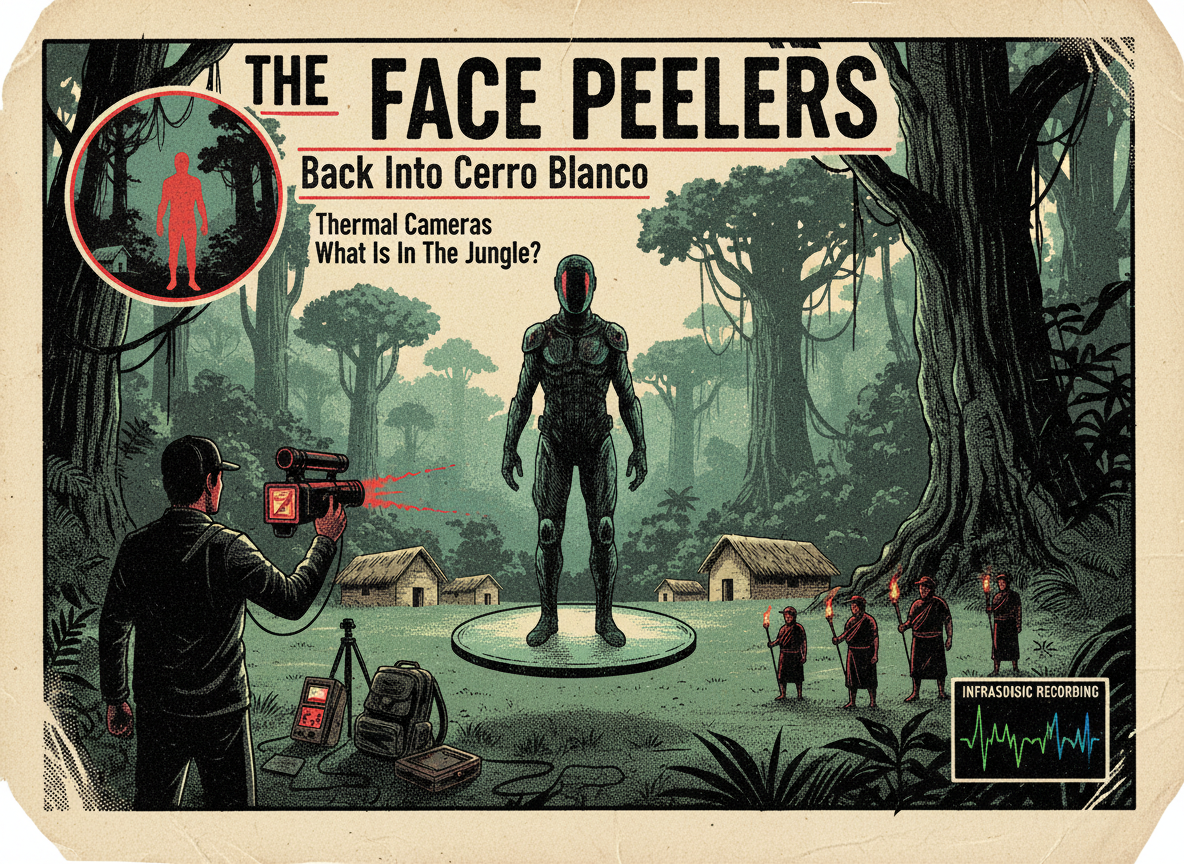
The attacks on Andean villages started in 2023. The official explanation never fully held up. Now Tim Alberino is heading back to Cerro Blanco this summer — and this time he’s bringing instrumentation.
The story began the way the strangest stories always begin: with a community that had no reason to lie and every reason to stay quiet getting loud enough that it couldn’t be ignored.
In the summer of 2023, indigenous villages in the remote highlands of the Alto Nanay district of northeastern Peru — accessible only by a 10-hour river journey from Iquitos — began reporting attacks by beings they called Los Pelacaras. The Face Peelers. Seven-foot-tall figures in dark, metallic suits, hovering on disc-shaped platforms a meter off the ground. Bullets passed through them. They moved in silence. They struck at night. A 15-year-old girl named Talia received a precise surgical incision to the neck that left investigators without a clean explanation. The Ikitu village of San Antonio de Pintuyacu burned five acres of jungle to clear sightlines. The attacks continued.
The Peruvian National Prosecutor’s Office eventually offered an official explanation: illegal gold mining cartels using jetpack technology to intimidate and displace indigenous communities from resource-rich territories. The explanation covered some of the facts and none of the most troubling ones.
What the Official Story Doesn’t Account For
Jetpacks exist. Illegal gold mining cartels in the Amazon are real, documented, and brutal. The Peruvian government’s explanation is not implausible on its face.
What it struggles to explain is the consistency of the witness accounts across villages with no communication with each other. The beings described by the Ikitu match, in precise detail, accounts from separate communities separated by days of river travel. The hovering platforms. The elongated heads. The yellow eyes. The faint, persistent hum before each encounter. The weapons that produced no apparent effect.
It also doesn’t explain the deeper history. Los Pelacaras is not a modern invention. The tradition of tall, predatory beings in the Andean and Amazonian highlands — appearing under names including pishtaco, karasiri, nakaj, and sacamantecas across dozens of indigenous groups who developed these traditions independently — predates any gold mining operation by generations. Paranormal researcher Tim Alberino, who has spent years documenting the case, appeared earlier this year on The Resilient Show to describe what he calls the terrifying truth behind the encounters. He outlined a case connecting the Face Peeler reports to a broader pattern of UAP activity in the region, noting that Peru has documented anomalous aerial phenomena going back to at least 1979, when multiple commercial pilots independently reported a silent hovering object over Cusco.
The Summer Expedition
Alberino has announced plans to return to Cerro Blanco — an area in the Peruvian highlands with its own deep history of anomalous activity — in the summer of 2026. He is bringing thermal cameras, EMF meters, and audio recording equipment capable of capturing infrasonic frequencies.
The attacks have not stopped. The Ikitu are still running nightly patrols. The Peruvian military investigated and found no resolution they were willing to make public. Whether the Face Peelers are criminal actors with advanced technology, an undocumented biological phenomenon, or something operating entirely outside established categories — the answer is somewhere in the jungle.
Alberino intends to go find it.

Kennedy Pushed Hard on Dimona. Then He Was Killed. The Documents Are Real — the Question Is What They Mean.
The JFK-Dimona thread is back in the feed today via Conspiracy Unearthed. The documented history of what Kennedy was actually doing about…

Life's Instruction Manual Was Found on an Asteroid — And It Didn't Come From Earth
Researchers at Hokkaido University have confirmed that samples from the asteroid Ryugu contain all five nucleobases — the molecular letters of DNA…

The Man Who Builds Autonomous Fighter Jets Says UFOs Probably Come From the Past — and He's Thought About the Physics
Palmer Luckey founded Oculus, sold it to Facebook for $2 billion, then built Anduril Industries — one of the most significant autonomous…

39 Shows in the Directory — Your Guide to the Fringe Feed Podcast Index
The Fringe Feed indexes 39 active fringe podcast shows across six categories. 🛸 If You're Here for UAP and Disclosure UFO Chronicles…