Original Story
Nick Pope Is Gone, and the Field He Helped Build Has Never Mattered More
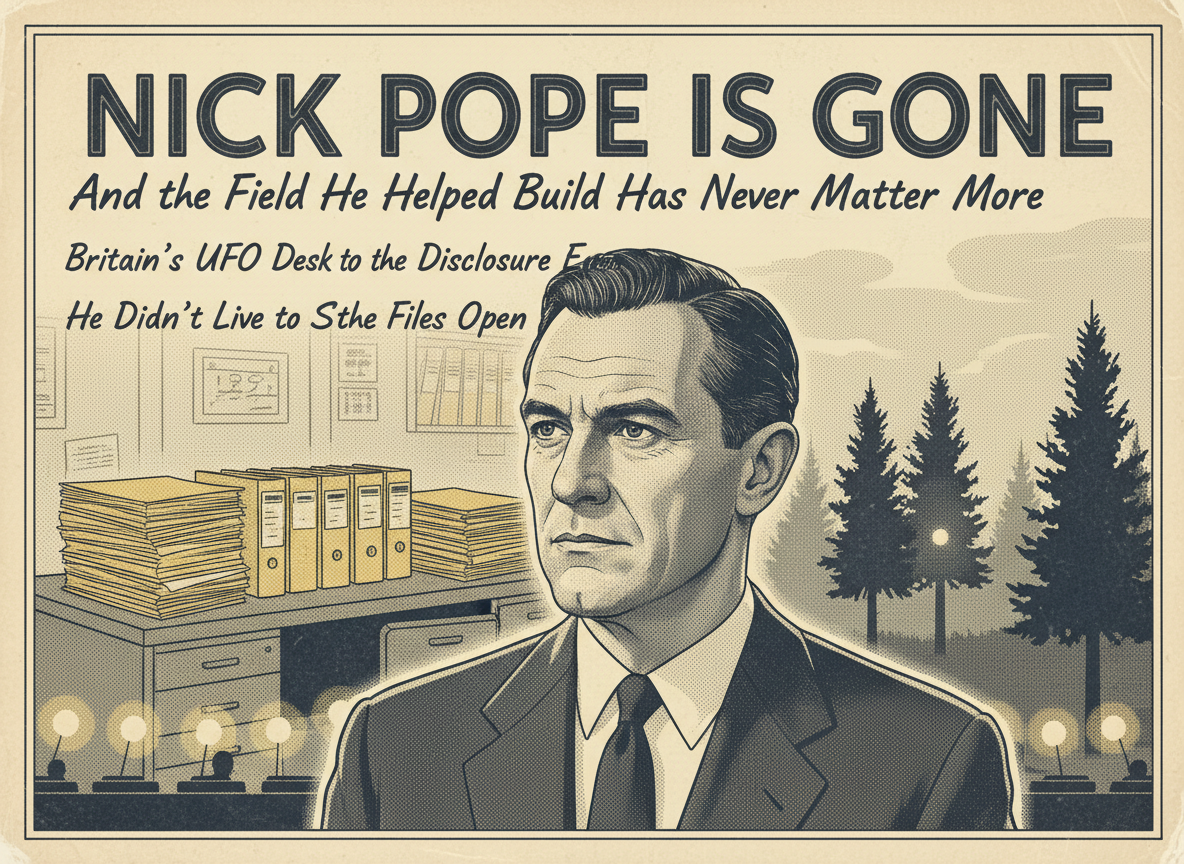
The man who ran Britain’s government UFO desk, gave the phenomenon its credibility bridge to the mainstream, and spent his final weeks doing interviews from his deathbed, died April 6, 2026. He was 60. The timing could not be more ironic.
Nick Pope died on April 6, 2026, at his home in Tucson, Arizona. He was 60 years old. His wife, anthropologist Elizabeth Weiss, announced it the same day on Facebook and X: “My heart is breaking. Nick passed away this afternoon at our home. The last few weeks of his life, even as he suffered, he managed to do a few interviews from home. I was so lucky to have met and to have married Nick. He was a wonderful husband. I loved him dearly.”
He had announced his Stage 4 esophageal cancer diagnosis on February 12, 2026, in a post to his 135,000 followers on X that was as measured and unsentimental as everything else he ever wrote. The cancer had metastasized to his liver. He was clear about what that meant. “I can’t beat it,” he wrote. What he did between February 12 and April 6 was, depending on how you look at it, either characteristic or extraordinary. He gave interviews. He kept talking. He stayed in the argument until there was nothing left of him to argue with.
Ross Coulthart, the investigative journalist who has become one of the most prominent voices in the UAP disclosure movement, responded within hours of the news. “Terribly sad to hear of Nick Pope’s passing,” he wrote. “Nick was a kind and intelligent person who threw his every ounce of energy into informing the world about the UAP secrets to which he was a witness. Vale Nick.”
The Ancient Aliens production team, on whose show Pope was a fixture for over a decade, wrote that he was “a beloved member of the Ancient Aliens family” who “challenged us to look beyond what we know and question what may be possible.” The post drew nearly 12,000 reactions and close to a thousand comments.
Pope’s final message to the world was a line from his February diagnosis post, describing the arc of a life in a single sentence: “What an amazing adventure I’ve had.”
The UFO Desk
Nick Pope joined the UK Ministry of Defence in 1985. He spent 21 years there, working across defense policy, counter-terrorism, and a range of other areas that he summarized in his career retrospective as everything from “financial policy to counter-terrorism.” The assignment that defined his public life came between 1991 and 1994, when he was placed in a section known internally as Secretariat Air Staff 2a, the office responsible for reviewing reports of unidentified aerial phenomena and assessing whether they posed any national security risk.
He would later describe this as running Britain’s official UFO desk. The MoD pushed back on that framing after he left government, with a Freedom of Information release noting that the description was “a term entirely of his own invention” and that his media presence generated significant additional workload for the staff handling UFO queries. Pope was aware of the criticism and addressed it directly over the years, maintaining that whatever the bureaucratic title said, the function was real, the cases were real, and the questions they raised had never been properly answered.
What made Pope different from the generation of UFO researchers who came before him was the credential. He was not an enthusiast who became obsessed with the subject from outside government. He was an insider who had reviewed the files, assessed the sightings, and left his post convinced that something was happening in British airspace that nobody in Whitehall had a satisfying explanation for. That institutional positioning, combined with an ability to speak plainly and without the conspiratorial overreach that plagued much of the UAP commentary space, gave him a platform that most people in the field could never access.
His 1996 book “Open Skies, Closed Minds” was the first time a sitting or former government official had produced a credible, readable account of official UFO investigation that treated the phenomenon seriously without tipping into the sensational. It sold well and it established the template for everything Pope would do for the next three decades.
Rendlesham and the Cases That Defined His Career
Among the cases Pope researched most thoroughly was the Rendlesham Forest incident, a series of events that occurred over several nights in late December 1980 near RAF Woodbridge and RAF Bentwaters in Suffolk, England. U.S. Air Force personnel stationed at the bases reported encountering a triangular craft with colored lights in the forest outside the perimeter fence. One officer, Lt. Col. Charles Halt, later confirmed in a signed memo that he had personally witnessed unexplained lights and an object that moved with extraordinary speed through the trees.
Pope co-authored “Encounter in Rendlesham Forest” with John Burroughs and Jim Penniston, two of the servicemen directly involved in the incident. The book remains one of the most detailed accounts of any government-acknowledged UFO encounter in the UK record. Penniston, who claims to have touched the craft and received what he described as a binary code transmission, has maintained his account consistently for decades. Burroughs later pursued a legal case against the MoD regarding health effects he attributed to radiation exposure during the incident.
Pope’s engagement with Rendlesham was characteristic of how he approached the subject: take the witnesses seriously, document the case thoroughly, and do not overstate what the evidence supports. He believed something significant happened in that forest. He also believed the official response, a combination of denial and deflection, was inadequate. Those two positions were not contradictory to him. They were both just accurate.
How He Changed the Conversation
The scale of Pope’s influence is hard to overstate, but the mechanism is not complicated. He appeared in hundreds of episodes of Ancient Aliens on the History Channel, a show that has aired since 2010 and which introduced the subject to audiences who had never previously engaged with UFO research. Whatever the show’s limitations as a scholarly enterprise, it reached people. Pope reached them through it. And when those viewers later encountered more serious reporting on UAP, the congressional hearings, the Navy footage releases, the whistleblower testimony, they were not starting from zero. They had a framework, however basic, because someone they recognized had given it to them.
Beyond television, Pope wrote for mainstream newspapers, gave lectures across the UK and United States, consulted on science fiction films, and maintained a media presence that kept UAP in the public conversation even during the long years between the decline of the first wave of UFO enthusiasm in the 1990s and the second wave that began with the New York Times’ 2017 investigation into the Pentagon’s Advanced Aerospace Threat Identification Program.
That 2017 story, which broke open the modern UAP era, confirmed many of the things Pope had been saying for two decades. There was a government program investigating these objects. Military pilots had encountered things they could not explain. The footage was real. The encounters were real. Pope had said all of this, and had been variously dismissed, tolerated, and eventually vindicated by the simple passage of time and the accumulation of evidence.
The Disclosure Moment He Did Not Live to See
The deepest irony of Nick Pope’s death is its timing.
He died on April 6, 2026. Six days earlier, on March 31, Rep. Anna Paulina Luna had sent a formal letter to the Department of War demanding 46 classified military UAP videos by April 14. The list includes footage of spherical objects entering the ocean near a U.S. submarine, formations over Iran, and the cockpit and sensor footage from the 2023 Lake Huron shootdown, where the pilot described an octagonal object unlike anything in his experience. That footage has been classified for three years.
On February 19, President Trump had signed an executive order directing federal agencies to begin releasing their files on UFOs and extraterrestrial life, the broadest disclosure directive any sitting president had ever issued. The Office of the Director of National Intelligence had posted that files would “soon” be declassified. Pete Hegseth had said the Department of War would comply. The April 14 deadline set by Luna’s Task Force was still six days away when Pope died.
Pope spent the last eight weeks of his life watching the movement he had built, from the margins of a government desk job in 1991 to the floor of the United States Congress in 2026, arrive at what looks, from the outside, like its culmination. Whether the videos get released, whether the files materialize, whether the answer turns out to be something transformative or something mundane, the conversation is happening at a level that would have been unimaginable when Pope first sat down at Secretariat Air Staff 2a.
He did not live to find out what is in those 46 videos.
In his final public statement in February, alongside the cancer announcement, Pope described his life with a precision that felt like a summary he had been preparing for years: “What an amazing adventure I’ve had. A 21-year career at the UK Ministry of Defense, where I got involved in subjects ranging from financial policy to counter-terrorism. The true highlight is life with my wonderful wife, Elizabeth. Per aspera ad astra.”
Through hardship to the stars.
For Nick Pope, that was not a cliche. It was the most accurate description available of everything he spent his life trying to do.
Sources: ParaRational, Nick Pope: Britain’s Real-Life Fox Mulder Dies at 60, Parade, Ancient Aliens Star Nick Pope Dies After Cancer Diagnosis, NewsNation, Nick Pope, Famed UFO Expert, Dies, IBTimes UK, UFO Expert Nick Pope, Who Knew Secrets, Dies After Stage 4 Cancer Battle, Art Threat, Nick Pope, Famed UFO Expert, Dies After Battle with Cancer
A Surf Cam in Western Australia Caught Something Large Moving Through the Water. Nobody Agrees on What It Is.
Swellnet operates a network of surf monitoring cameras along the Australian coastline. Their camera positioned at Scarborough, Western Australia, was rolling on…
Luis Elizondo Survived a Near-Fatal Motorcycle Crash on St. Patrick's Day. He Had Less Than 50% Chance of Living.
Luis Elizondo, the former Pentagon intelligence officer who ran the Advanced Aerospace Threat Identification Program and became the most prominent public face…
A Game Camera in an Alabama Backyard Photographed a 4-by-8-Foot Glowing Orb Standing Among Deer for Hours. The Deer Didn't Flinch.
A property owner in Wilmer, Alabama, submitted a series of game camera photographs to the National UFO Reporting Center (NUFORC) in late…
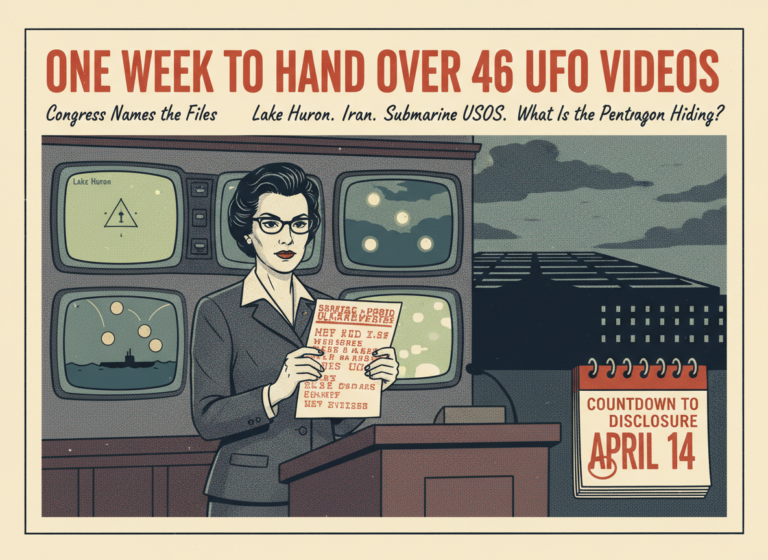
Congress Gave the Pentagon One Week to Hand Over 46 Classified UFO Videos, and the Clock Is Running
Rep. Anna Paulina Luna's Task Force set an April 14 deadline for the Department of War to surrender five years of secret…