Original Story
A New Study Just Said the Most Important Archaeological Site in the Americas Is Probably 10,000 Years Too Old. The Man Who Found It Disagrees.
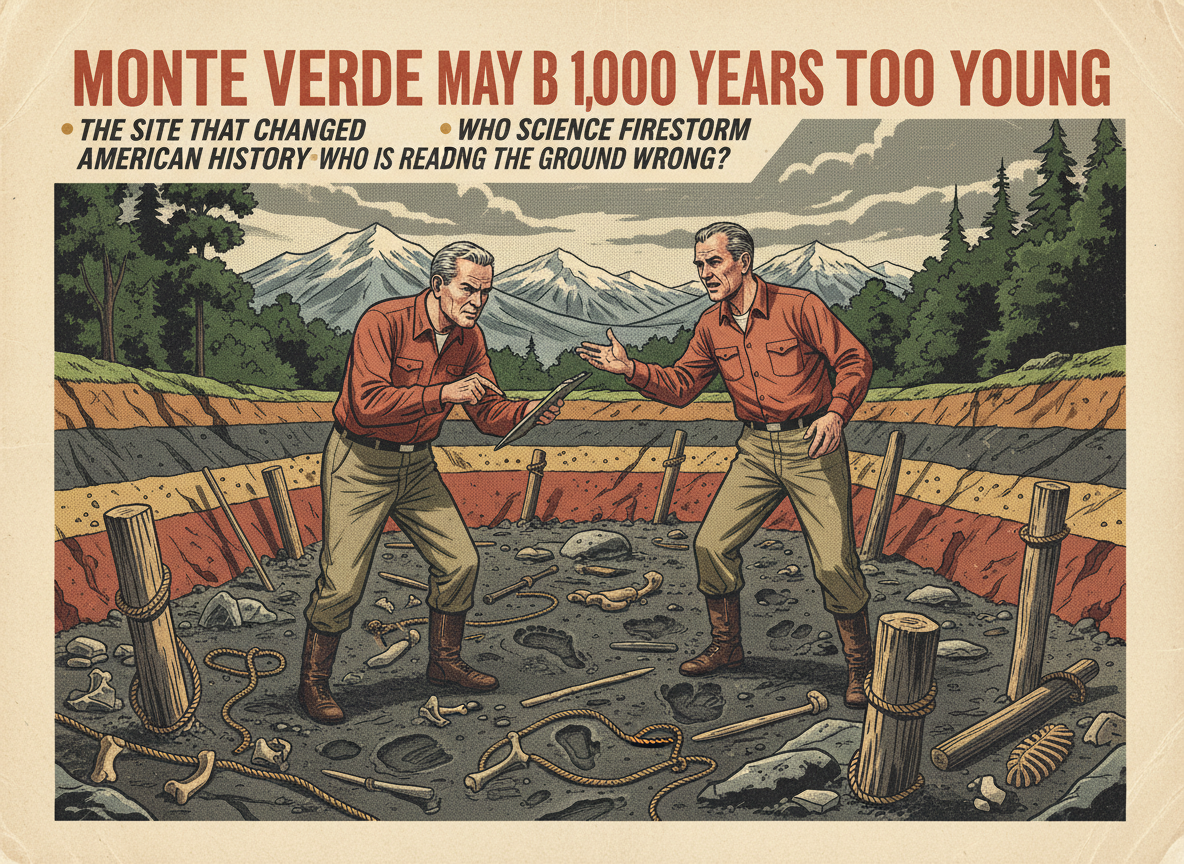
A study published in Science on March 19 argues that Monte Verde — the southern Chilean archaeological site that for 30 years has underpinned the case that humans were in South America 14,500 years ago — may in fact be only 4,200 to 8,200 years old. If the claim holds, it would collapse the main pre-Clovis evidence and force a complete rewrite of how and when the Americas were first settled. The archaeologist who spent his career excavating it calls the study a misreading of the landscape. National Geographic is calling it a potential firestorm.
For most of the 20th century, the dominant model in American archaeology was “Clovis First” — the idea that the first humans to arrive in the Americas were the Clovis people, who appear in the North American record around 13,000 years ago. That model began to crack when archaeologist Tom Dillehay of Vanderbilt University started excavating a site in the temperate rainforest of southern Chile called Monte Verde in the 1970s.
What he found there changed the field. Wooden foundations of long rectangular structures subdivided into rooms. Clay-lined fire pits. Hides. Rope. A child-sized footprint. Remains of 60 species of edible and medicinal plants, including seaweed brought from the coast. Butchered bones from extinct megafauna: elephant-like gomphotheres, paleocamelids. And radiocarbon dates consistently pointing to 14,500 years ago — more than 1,000 years before Clovis, from the tip of South America. The site was so well preserved because it had been sealed under a bog.
By 1997, a group of 12 respected archaeologists visited the site and concluded it was genuine pre-Clovis occupation. Monte Verde became a cornerstone.
What the New Study Claims
The new study, led by archaeologist Todd Surovell of the University of Wyoming and published in Science on March 19, argues that the dates assigned to Monte Verde are wrong. The team sampled sediments from nine locations along the Chinchihuapi Creek that runs through the site and analyzed how the landscape changed over millennia. They identified a layer of volcanic ash which they determined originated from an eruption of the Michinmahuida volcano approximately 11,000 years ago — and which appears stratigraphically below the cultural deposits at Monte Verde. That placement, if accurate, means the cultural material cannot be older than 11,000 years. The team’s radiocarbon dating and optically stimulated luminescence dating of the sediments indicated occupation between 4,200 and 8,200 years ago — placing Monte Verde firmly in the post-Clovis period.
Their explanation for the older dates previously obtained: organic material was washed downstream by the creek from older deposits into lower sediment layers, making it appear ancient when it was not. They argue the site was never pre-Clovis. It just looked that way because of landscape dynamics.
“The interpretation that it is one of the oldest sites in the Americas has become a universally accepted fact,” Surovell acknowledged. “I anticipate our work to be not only impactful but controversial.”
Why Many Archaeologists Are Not Convinced
Dillehay’s response was pointed. The new study, he said, “disregards a vast body of well-dated cultural evidence.” He and his colleagues spent decades excavating, documenting, and verifying the stratigraphy of the site. Their data set is extensive and peer-reviewed.
Outside researchers have raised specific technical objections. Archaeologist Jon Erlandson of the University of Oregon said the Surovell team cannot prove that the 11,000-year-old volcanic ash layer was directly beneath the artifacts and features Dillehay excavated. “I’m not convinced,” he said. Others note the study sampled sediments adjacent to the site rather than within the primary cultural deposits.
The dispute now sits at the center of one of the most consequential open questions in New World prehistory. If Monte Verde is as young as Surovell’s team claims, the strongest evidence for a pre-Clovis coastal migration to the Americas collapses and the timeline has to be rebuilt from other, less complete sites. If the original dates hold, one of archaeology’s most disruptive 20th-century discoveries remains intact — and Surovell’s study is, itself, the misreading.
Neither side is claiming certainty. But the argument is very much alive.
Sources: Science News — A new study questions when people first reached South America — US News / AP — New Study Challenges Site Key to How Humans Got to the Americas — National Geographic — When Did Humans Arrive in the Americas? — Wikipedia — Monte Verde (updated March 2026)

A Bronze Age Spanish Treasure Sat in a Museum for 60 Years. Two Pieces of It Were Made from a Meteorite. Nobody Knew.
The Treasure of Villena — 66 objects found in 1963 near Alicante, Spain, dating to between 1400 and 1200 BCE — includes…
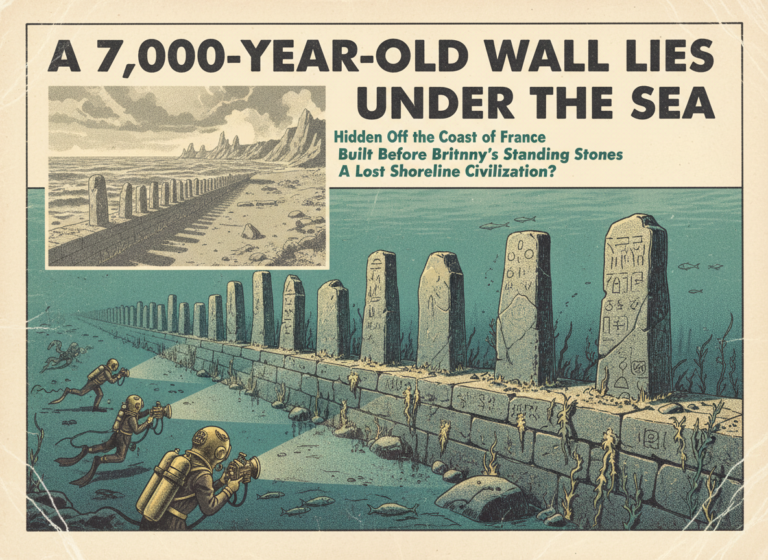
There Is a 7,000-Year-Old Stone Wall Sitting on the Ocean Floor off the Coast of France. Nobody Knew It Was There Until 2017.
A 120-meter granite wall built approximately 7,000 years ago has been confirmed beneath nine meters of water off the western tip of…

Israel's "Wheel of Ghosts" Has Been a Mystery Since 1968. AI Just Found 28 More of Them Hidden in Plain Sight.
Rujm el-Hiri — the Wheel of Ghosts — is a massive stone structure in the Golan Heights built from 40,000 tons of…

A New Theory Says Consciousness Is Not Produced by Neurons. It Comes from a Hidden Wave in the Brain That Has Never Been Detected.
A peer-reviewed paper published in Frontiers in Psychology in early 2026 proposes that conscious experience does not arise from neural computation at…