Original Story
The Mobile, Alabama Leprechaun Is Turning 20. It Never Really Left.
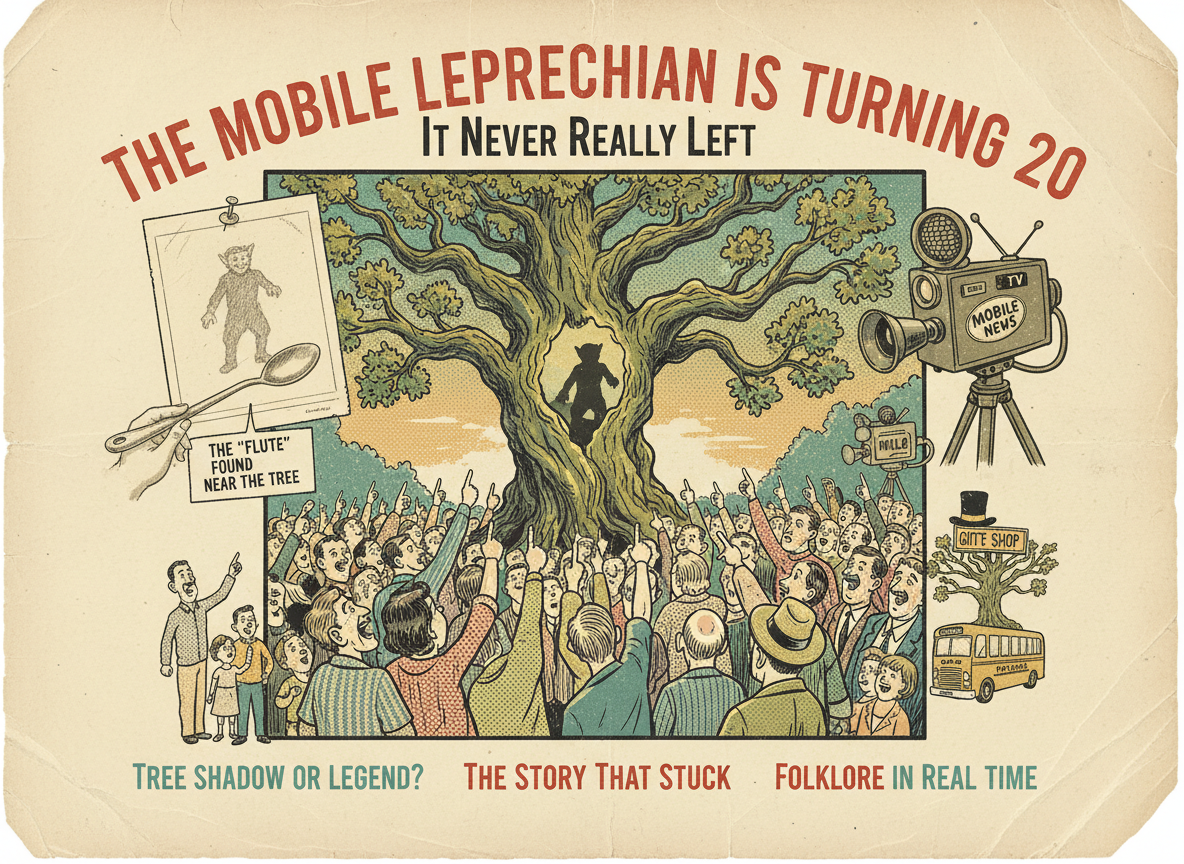
In March 2006, a man in Mobile, Alabama pointed at a shadow in a tree and told the press it was a leprechaun. The clip went everywhere. Twenty years later, people travel from across the country to see the tree. The story never needed to be true to become permanent — and that is actually the more interesting part.
The clip spread before viral was a word people used for anything other than illness. Within days, Mobile residents were holding follow-up press conferences. An amateur sketch artist produced a rendering of the creature that looked, charitably, like a gremlin with a hat. Someone found a bent spoon nearby and presented it to the media as a leprechaun flute. A self-described local historian appeared on camera to document the area’s long history of leprechaun sightings, traced back to a gold coin found decades earlier.
Nobody appeared to be kidding.
The New York Times covered the 20th anniversary this week, on St. Patrick’s Day, and what the piece documents is genuinely interesting from a folkloric standpoint. The shadow, almost certainly a knot or break in the bark viewed under specific lighting conditions, has become a civic institution. People travel from across the country to stand near that tree. The city has embraced it. The leprechaun is Mobile’s mascot now.
What the Original Witnesses Experienced
The technical term for what happened in 2006 is pareidolia: the tendency of the human brain to extract meaningful patterns from random visual data. Faces in clouds, figures in stone, animals in carpet grain. The brain is a pattern-recognition system optimized for survival, which means it errs toward seeing something rather than nothing. A shadow at the right angle, under the right lighting, will read as a figure to a perceptual system built to catch predators in peripheral vision.
That is the prosaic explanation. It is probably the correct one.
Why the Story Did Not Stop There
The Anomalist’s coverage this week raises the more interesting question. The Mobile leprechaun did not stay a punchline. It became a durable community event. People with no stake in the original claim make the trip to stand near the tree. The story has accumulated meaning that has nothing to do with whether a small mythological Irish figure actually lives in Alabama.
This is how folklore has always worked. The mechanism by which a shadow becomes a creature, becomes a local legend, becomes a tourist attraction, becomes a 20-year tradition is not specific to premodern societies or to particularly credulous people. It operates identically in the age of smartphones and cable news. The Mobile leprechaun entered the system in 2006 and the system did exactly what it has always done with anomalous sightings: it generated a story, grew the story, and made the story stick.
What is worth asking is not whether the original witnesses were right or wrong. They were almost certainly looking at a tree. The question is what the durability of that story tells us about why anomalous sightings persist at all, why communities form around them, and why debunking rarely ends the conversation. The cognitive hardware that produced the original leprechaun clip is identical to the hardware that produces Bigfoot sightings, UFO reports, and ghost encounters. The social hardware that turned a tree shadow into a 20-year civic tradition is the same hardware that has sustained every other unexplained phenomenon long past any individual sighting.
Mobile did not get a leprechaun in 2006. It got a story. Twenty years later, the story is still running.

A Bronze Age Spanish Treasure Sat in a Museum for 60 Years. Two Pieces of It Were Made from a Meteorite. Nobody Knew.
The Treasure of Villena — 66 objects found in 1963 near Alicante, Spain, dating to between 1400 and 1200 BCE — includes…
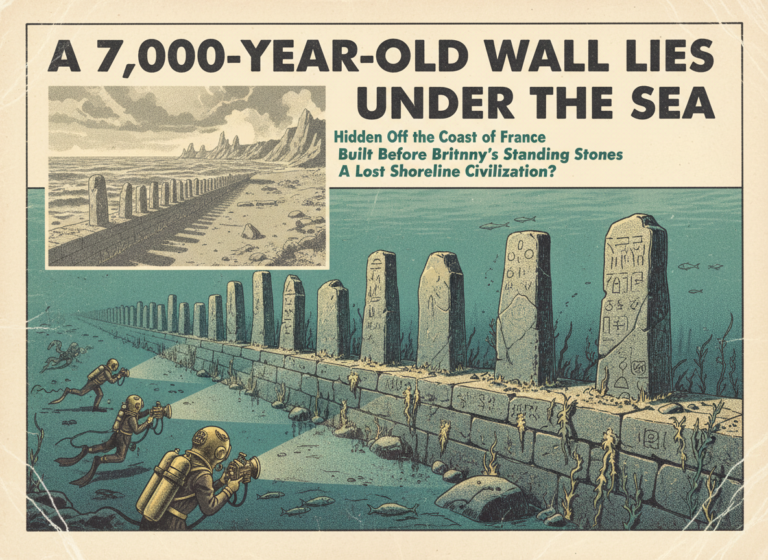
There Is a 7,000-Year-Old Stone Wall Sitting on the Ocean Floor off the Coast of France. Nobody Knew It Was There Until 2017.
A 120-meter granite wall built approximately 7,000 years ago has been confirmed beneath nine meters of water off the western tip of…
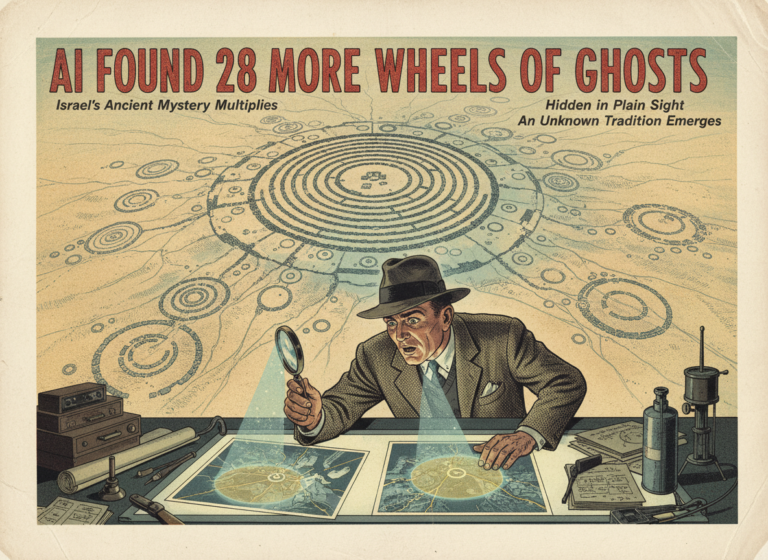
Israel's "Wheel of Ghosts" Has Been a Mystery Since 1968. AI Just Found 28 More of Them Hidden in Plain Sight.
Rujm el-Hiri — the Wheel of Ghosts — is a massive stone structure in the Golan Heights built from 40,000 tons of…
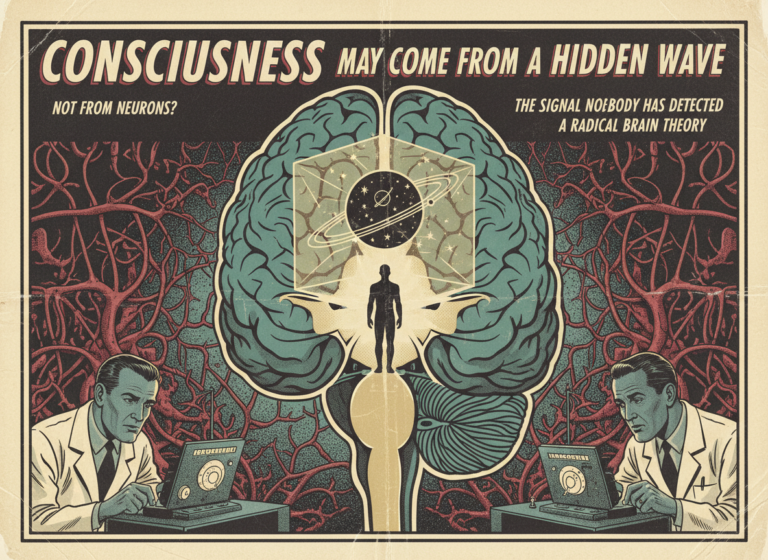
A New Theory Says Consciousness Is Not Produced by Neurons. It Comes from a Hidden Wave in the Brain That Has Never Been Detected.
A peer-reviewed paper published in Frontiers in Psychology in early 2026 proposes that conscious experience does not arise from neural computation at…