Original Story
The MJ-12 Documents Just Got Harder to Dismiss — And Nobody in Washington Is Saying a Word About It
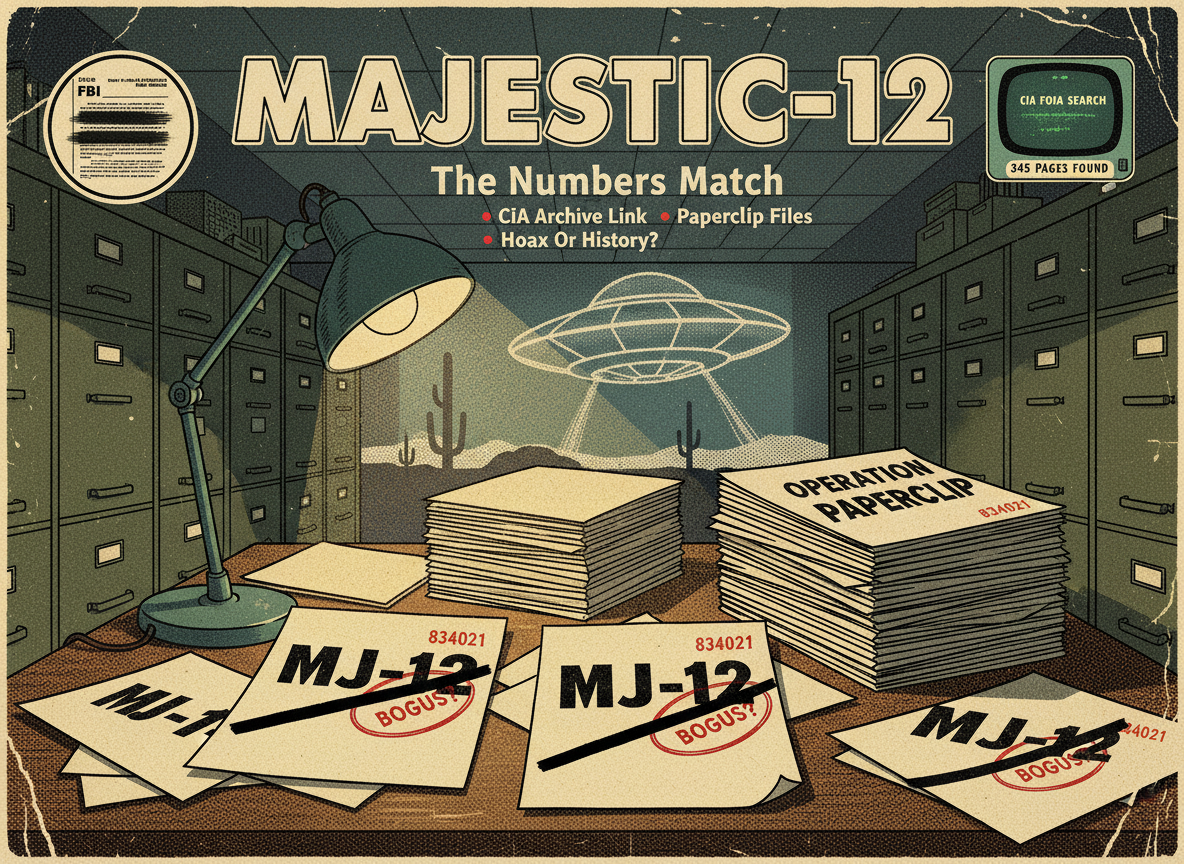
A civilian researcher working through declassified CIA files has found document identifiers that tie three of the most controversial papers in UFO history to official government archives. The FBI called them bogus. The new evidence says otherwise.
For forty years, the Majestic-12 documents have sat at the center of one of the most heated arguments in UFO research — real enough to generate congressional attention and FBI investigations, disputed enough that mainstream scholars dismissed them as an elaborate Cold War hoax. That argument just got significantly more complicated.
In February 2026, a Substack researcher operating under the name MJ12 Logic published findings that, if they hold up to scrutiny, represent a meaningful breakthrough. Working through the CIA’s Freedom of Information Act portal, the researcher noticed that at least three of the recovered Majestic-12 documents carry a stamped identifier — the number “834021” — in their lower right corners. Curious about whether that number appeared anywhere in authenticated government files, they ran a search through the CIA’s declassified archive.
What came back was not nothing. The search returned 345 pages of Operation Paperclip intelligence documents — only declassified in June 2022 — that carry the same identifier. Paperclip was the postwar program through which the U.S. government recruited German scientists, many of them former Nazi researchers, into American aerospace and weapons programs. It was also operational during the exact period the MJ-12 documents describe as the formation of the secretive group.
The Problem With the Forgery Argument
The researcher also identified matching Executive Registry numbers on additional MJ-12 pages that correspond to authenticated CIA intelligence reports from the same era. The implication is direct: if the Majestic-12 documents were fabricated in the mid-1980s, whoever created them had either access to classified government filing systems that didn’t exist yet in the public record, or an extraordinary run of luck in inventing bureaucratic identifiers that would match real documents decades later.
The history of the MJ-12 documents is worth recounting. In 1984, filmmaker Jamie Shandera received an anonymously mailed roll of 35mm film that, when developed, contained an eight-page document structured as a briefing for President Eisenhower. The document described a secret committee — twelve members drawn from the top tier of American military, scientific, and intelligence leadership — formed by President Truman following the Roswell crash of 1947 to manage the recovery and study of non-human craft and their occupants.
The FBI investigated and declared the documents “completely bogus.” Skeptics pointed to typewriter fonts inconsistent with the claimed dates and a Truman signature that appeared to have been lifted from an unrelated document. The research community remained bitterly divided.
What the New Evidence Actually Shows
The new findings, covered this week by Whitley Strieber’s Unknown Country, don’t prove the documents are genuine. They do, however, substantially complicate the forgery hypothesis. The conclusion of MJ12 Logic’s analysis: it is virtually impossible to reconcile the new cross-references with the idea that Majestic-12 was paperwork invented in the 1980s. The researcher adds that this may represent the kind of disclosure to expect going forward — not from the government, but from dedicated civilian researchers working the open-source archive one document at a time.
Whether the government says anything about it remains, as ever, an open question. The documents are already back in circulation. The conversation has already restarted. And the files that were not supposed to connect are connecting.
Kennedy Pushed Hard on Dimona. Then He Was Killed. The Documents Are Real — the Question Is What They Mean.
The JFK-Dimona thread is back in the feed today via Conspiracy Unearthed. The documented history of what Kennedy was actually doing about…
Life's Instruction Manual Was Found on an Asteroid — And It Didn't Come From Earth
Researchers at Hokkaido University have confirmed that samples from the asteroid Ryugu contain all five nucleobases — the molecular letters of DNA…
The Man Who Builds Autonomous Fighter Jets Says UFOs Probably Come From the Past — and He's Thought About the Physics
Palmer Luckey founded Oculus, sold it to Facebook for $2 billion, then built Anduril Industries — one of the most significant autonomous…
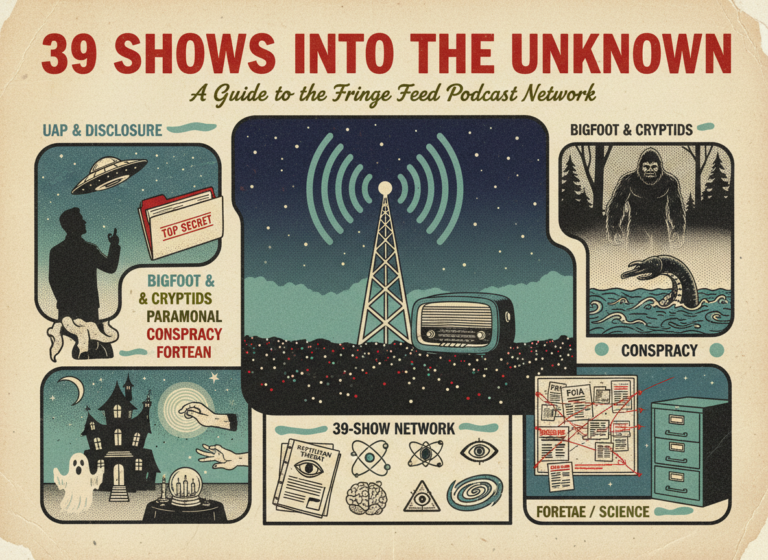
39 Shows in the Directory — Your Guide to the Fringe Feed Podcast Index
The Fringe Feed indexes 39 active fringe podcast shows across six categories. 🛸 If You're Here for UAP and Disclosure UFO Chronicles…