Original Story
The Last Grand Master of the Knights Templar Burned in 1314 With a Curse on His Lips — Both Men He Cursed Were Dead Within a Year
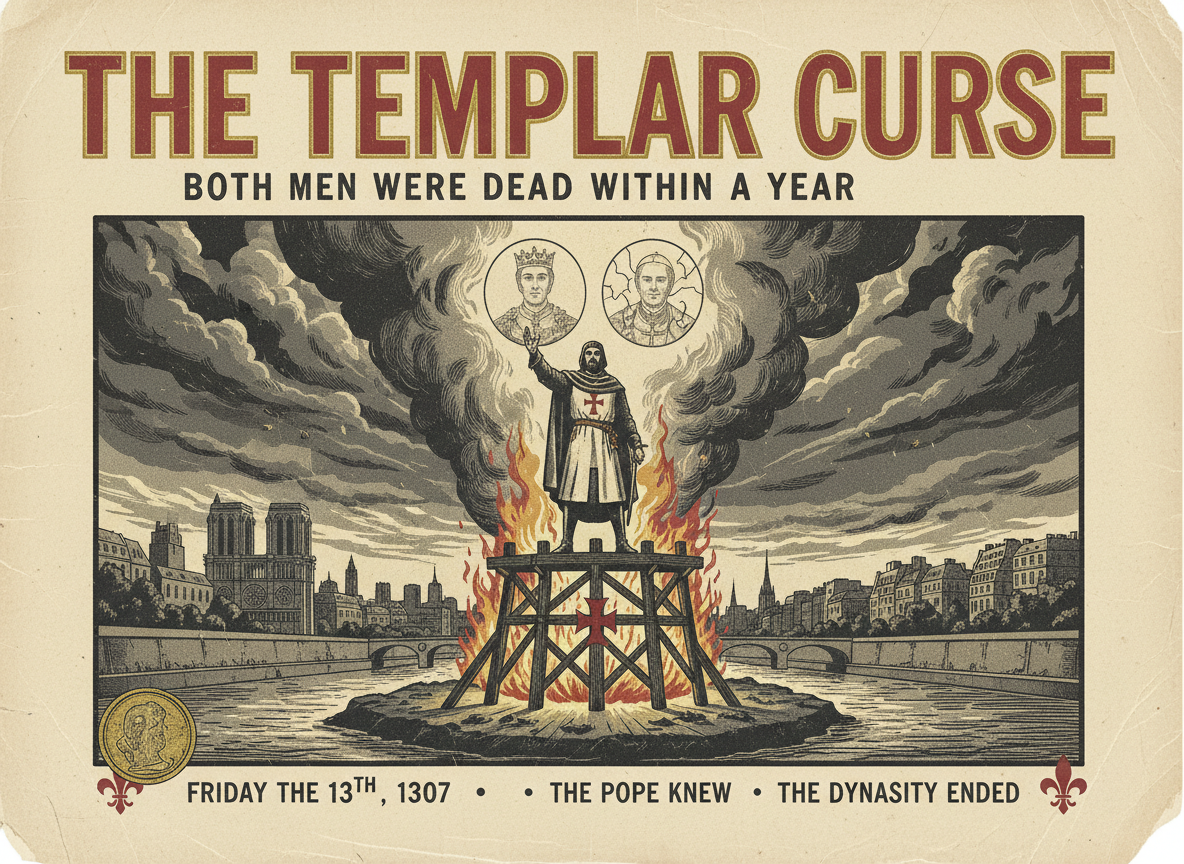
King Philip IV owed them money. Pope Clement V did what Philip asked. Jacques de Molay retracted his confession, declared his innocence from the pyre, and named his killers. The history of what happened next is documented. It is also genuinely strange.
The arrest warrant was executed before dawn on Friday, October 13, 1307 — a date that has carried its own mythology ever since. French King Philip IV, deeply in debt to the Knights Templar and maneuvering to dissolve an order that had outlived its original purpose in the Holy Land, orchestrated a coordinated sweep across France that pulled Templar knights from their beds and into custody in a single night. The charges were heresy, sodomy, and the desecration of the cross. Most historians regard them as manufactured. At the time, they were enough.
The Templars had been the dominant military and financial force of the Crusading era. Founded in 1119 by Hugh de Payens to protect Christian pilgrims traveling through Jerusalem, the order grew over two centuries into a network of nearly 2,000 castles, estates, and financial houses that operated the medieval world’s first functioning international banking system. When the Crusades collapsed and the Holy Land was lost, the Templars became a liability — powerful, wealthy, and no longer obviously necessary. Philip IV of France saw an opportunity.
What the Pope Knew
Here is the part the popular mythology tends to omit: Pope Clement V privately exonerated the Knights Templar.
The evidence is in the Vatican’s own archives. A document known as the Chinon Parchment, discovered in 2001 after centuries of misfiling, records that in 1308 — a year after the mass arrests — Clement absolved the Templar leadership of heresy in a secret hearing at the Château de Chinon. The order was not guilty of what they were publicly accused of. Clement knew this. He dissolved the order anyway at the Council of Vienne in 1312, under ongoing pressure from Philip, and handed most of the Templars’ assets to the rival Knights Hospitaller rather than returning them to their owners.
The Curse
On March 18, 1314, Jacques de Molay, the last Grand Master of the Knights Templar, was brought to a scaffold on the Île des Juifs in Paris alongside Geoffroy de Charney. Both men retracted the confessions they had made under torture. Both declared themselves innocent. Both were burned alive the same day.
According to accounts recorded by multiple contemporaries, de Molay spoke from the flames. He named Pope Clement V and King Philip IV. He summoned them before God’s tribunal within the year.
Pope Clement V died on April 20, 1314 — 33 days after de Molay’s execution. Contemporary accounts vary on the precise circumstances of his death; some include an account of lightning striking the church where his body lay in state, causing a fire that damaged his remains.
King Philip IV died on November 29, 1314 — seven months after de Molay — in a hunting accident. He was 46 years old. His three sons, who succeeded him in turn, all died without male heirs within 14 years. The Capetian dynasty, which had ruled France for over three centuries, ended with them. The throne passed to the House of Valois.
What History Actually Says
The documented facts here are not fringe. They are in the mainstream historical record. Philip IV died young, unexpectedly, and within the year. His sons’ failure to produce heirs ended a royal line that had ruled continuously since 987 CE. Clement V, who had served as a tool of Philip’s political agenda and who privately knew the Templars were innocent, died weeks after the execution.
Whether de Molay’s words from the fire constituted a supernatural curse, a dying man’s documented prediction that happened to come true, or a coincidence that medieval contemporaries interpreted through the framework of divine justice is a question each reader gets to answer for themselves. What is not in dispute is the sequence of events, the documented private absolution, and the end of the French royal line within 14 years of the burning.
The Templars were guilty of nothing. The Pope who knew it is dead. The king who arranged it is dead. The dynasty he was protecting is gone.
Kennedy Pushed Hard on Dimona. Then He Was Killed. The Documents Are Real — the Question Is What They Mean.
The JFK-Dimona thread is back in the feed today via Conspiracy Unearthed. The documented history of what Kennedy was actually doing about…
Life's Instruction Manual Was Found on an Asteroid — And It Didn't Come From Earth
Researchers at Hokkaido University have confirmed that samples from the asteroid Ryugu contain all five nucleobases — the molecular letters of DNA…

The Man Who Builds Autonomous Fighter Jets Says UFOs Probably Come From the Past — and He's Thought About the Physics
Palmer Luckey founded Oculus, sold it to Facebook for $2 billion, then built Anduril Industries — one of the most significant autonomous…

39 Shows in the Directory — Your Guide to the Fringe Feed Podcast Index
The Fringe Feed indexes 39 active fringe podcast shows across six categories. 🛸 If You're Here for UAP and Disclosure UFO Chronicles…