Original Story
Someone Is Broadcasting Coded Numbers in Farsi Over Shortwave Radio — And Nobody Can Agree Who or Why
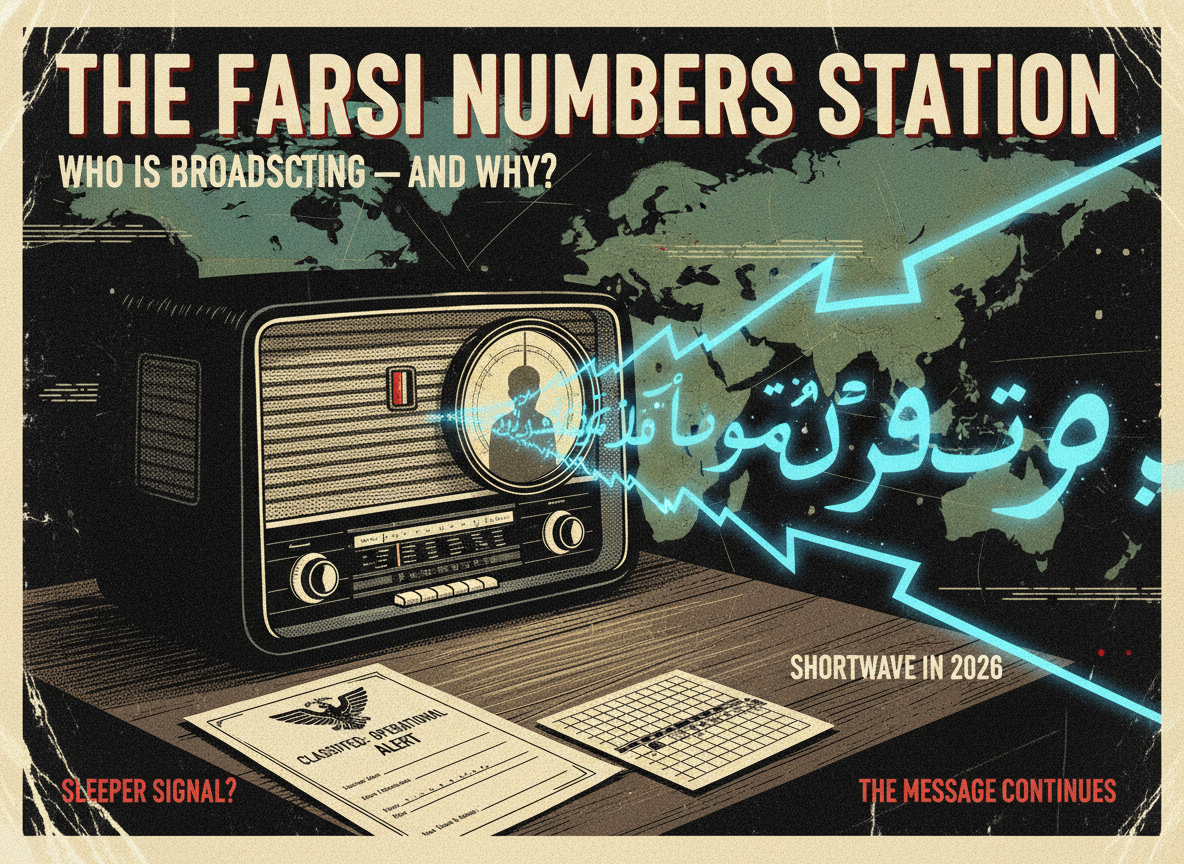
Hours after U.S. and Israeli strikes hit Iran in late February, a mysterious shortwave signal began transmitting twice a day. A man’s voice. Random numbers in Farsi. Three repetitions of the word “attention.” A federal alert went out to American law enforcement. The global radio community has been trying to crack it ever since.
The signal appeared on February 28, 2026 — almost to the hour after the United States and Israel began their joint bombing campaign against Iran. Twice a day, in the early morning and early evening on Coordinated Universal Time, a man’s voice comes through on a scratchy shortwave frequency, reading groups of seemingly random numbers in Farsi. After each sequence, the word tavajjoh — “attention” — is spoken three times. Then silence. Then it begins again.
This is a numbers station. And numbers stations, as intelligence professionals and Cold War historians will tell you, exist for one reason: to send coded instructions to agents in the field who cannot be reached through any other means.
The global community of amateur radio sleuths who track and document these transmissions gave this one the designation V32. Within days of its first broadcast, the signal had been logged across Europe and the Middle East. Within a week, according to reporting by Radio Free Europe/Radio Liberty, someone had begun jamming it — using the same frequencies and techniques deployed against Radio Farda, VOA Farsi, Iran International, and BBC Farsi. Jamming a numbers station requires state-level resources.
What the U.S. Government Said
A federal alert reviewed by ABC News was circulated to American law enforcement agencies after the signal was detected. The alert, based on what it described as “preliminary signals analysis,” warned that the transmission was “likely of Iranian origin” and had been relayed across multiple countries. The alert’s most significant line: it is possible the transmissions could “be intended to activate or provide instructions to prepositioned sleeper assets operating outside the originating country.”
The U.S. government was careful. “While the exact contents of these transmissions cannot currently be determined,” the alert stated, “the sudden appearance of a new station with international rebroadcast characteristics warrants heightened situational awareness.” Law enforcement was instructed to increase monitoring of suspicious radio-frequency activity. No specific or imminent threat was identified.
Who’s Actually Behind It
Here is where the story gets genuinely complicated. Initial analysis by the radio community pointed toward the signal originating in central Europe — which would suggest it was being transmitted toward Iran, targeting Iranian assets inside the country rather than activating Iranian sleeper agents abroad. This interpretation was reinforced when Iranian state apparatus began jamming it. Why would Iran jam a signal it was generating?
Jonathan Hackett, a former U.S. Marine Corps intelligence officer with experience at the Defense Intelligence Agency and the National Security Agency, told The National that the Iranian-origin theory “would not make sense.” His assessment: the station is probably American or Israeli, designed to activate or protect assets inside Iran during the opening phase of the war.
Akin Fernandez, considered one of the world’s leading experts on numbers stations and the founder of the Conet Project that has documented them for decades, offered a third possibility: it may be a psychological operation. A station broadcasting visibly, on a single frequency, without the reliability features that would actually ensure a recipient could decode the message, launched on the first day of a war — could be designed to terrify the Iranian government into believing it has a deep network of infiltrated sleeper cells waiting to move. Whether or not the cells exist.
Why Shortwave in 2026
The obvious question: in an era of encrypted messaging apps, quantum key distribution, and satellite communications, why is anyone using shortwave radio to talk to spies?
Fernandez has a precise answer. “So-called modern methods of communication are not as effective and not as private as a short-wave transmission on numbers stations.” A one-time pad broadcast over shortwave is mathematically unbreakable. The sender and recipient share an identical sequence of random numbers generated once and discarded after use. No server logs, no metadata, no traffic analysis, no intercepts that mean anything without the pad. The only people who can read the message are the ones who already have the key. And they don’t need a smartphone or an internet connection to receive it.
The signal is still broadcasting.

Kennedy Pushed Hard on Dimona. Then He Was Killed. The Documents Are Real — the Question Is What They Mean.
The JFK-Dimona thread is back in the feed today via Conspiracy Unearthed. The documented history of what Kennedy was actually doing about…

Life's Instruction Manual Was Found on an Asteroid — And It Didn't Come From Earth
Researchers at Hokkaido University have confirmed that samples from the asteroid Ryugu contain all five nucleobases — the molecular letters of DNA…

The Man Who Builds Autonomous Fighter Jets Says UFOs Probably Come From the Past — and He's Thought About the Physics
Palmer Luckey founded Oculus, sold it to Facebook for $2 billion, then built Anduril Industries — one of the most significant autonomous…
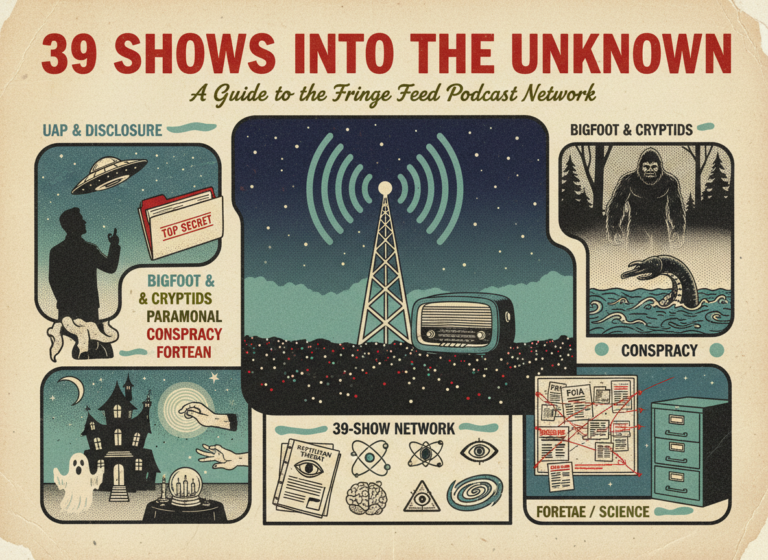
39 Shows in the Directory — Your Guide to the Fringe Feed Podcast Index
The Fringe Feed indexes 39 active fringe podcast shows across six categories. 🛸 If You're Here for UAP and Disclosure UFO Chronicles…