Original Story
Romans Were So Obsessed With a Plant They Ate It Into Extinction. It Was a Contraceptive, an Aphrodisiac, and Possibly Worth Its Weight in Denarii.
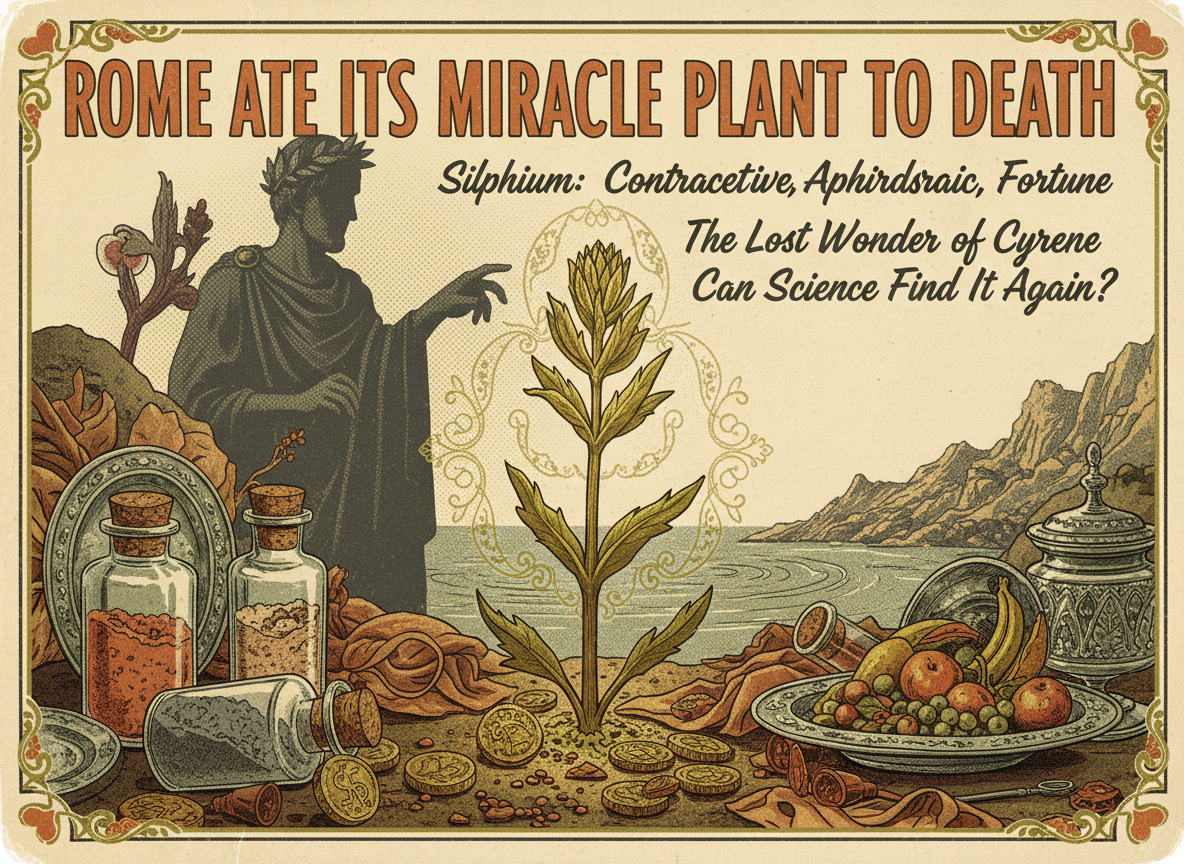
Silphium was a plant that grew on a narrow strip of coastal land near the ancient Greek colony of Cyrene, in what is now Libya. It was harvested for roughly six centuries, used as food, medicine, perfume, and most crucially as a contraceptive and abortifacient. Roman writers described it as more valuable than silver. The Emperor Nero reportedly received as tribute the last known stalk of silphium ever recorded. By the first century CE it was effectively gone. In the 2,000 years since, no botanist, archaeologist, or plant hunter has successfully identified what silphium actually was. New research from the Unexplained Mysteries forum thread and broader academic literature, surfacing this week, is bringing the plant back into public discussion — and a recent candidate identification, first proposed in 2021, is gaining fresh attention as the most credible answer yet.
The obsession was real and documented by people who had no particular reason to exaggerate it. Pliny the Elder wrote that silphium was worth its weight in denarii. Julius Caesar is said to have kept a significant reserve of it among the state treasury. The plant was so central to Cyrenean economy that it appeared on their coins — a stylized seed or leaf that has persisted as one of the most recognizable botanical images from the ancient world, and which some historians have argued is the origin of the modern heart symbol, based on the shape of the rendered seed.
The plant had multiple recorded uses. As a food flavoring it was comparable in status to saffron. As a medicine it was applied to a range of ailments from fever to plague. But its most valued and most discussed application was gynecological: Roman and Greek medical texts describe silphium as an effective contraceptive and abortifacient, used by women to prevent or terminate pregnancies. If accurate, this would make it one of the few documented plant-based contraceptives in the ancient world — a claim that has attracted significant academic interest, though the absence of the plant itself has made verification impossible.
Why It Disappeared
Silphium apparently could not be cultivated. Every attempt to grow it outside its native range failed. The plant grew only on a specific stretch of coastal terrain near Cyrene, and harvesting appears to have gradually exceeded the wild population’s capacity to regenerate. Ancient writers describe a decline in quality and availability across several centuries before it finally vanished. Pliny attributed the disappearance to overgrazing and overharvesting. The last confirmed stalk was reportedly presented to Nero, who ate it as a curiosity.
The narrowness of its geographic range combined with its inability to be transplanted made silphium uniquely vulnerable — the ancient world’s version of an irreplaceable resource with no redundancy and unlimited demand.
The Candidate That Won’t Go Away
In 2021, Turkish botanist Mahmut Miski proposed that silphium had been incorrectly declared extinct — and that the plant known as Ferula drudeana, a member of the same genus as the plant most commonly associated with silphium, might be a direct surviving relative or even the plant itself. Ferula drudeana grows in a single location in Turkey, is rare, and had not been studied in depth.
Miski’s proposal generated immediate academic interest and scrutiny. The candidate is not without problems: the geographic location does not match Cyrene, and ancient descriptions of silphium’s appearance are not precise enough to definitively confirm or deny a match. But the hypothesis has not been disproven, and it aligns with certain ancient accounts more closely than any other proposed candidate.
The broader significance is what makes the story persistent: if silphium was genuinely effective as a contraceptive — and ancient writers treated this efficacy as established fact, not speculation — then identifying even a related plant could open a research pathway to a botanical contraceptive with 2,000 years of historical use data behind it. That is a sufficiently unusual possibility that researchers keep returning to it.
For now, silphium remains officially extinct, its exact identity unknown, its properties unverified, and its last living specimen consumed by a Roman emperor as a novelty. It is one of the few cases in history where an entire civilization’s most prized resource was used to nothing.
Sources: Unexplained Mysteries forum — Romans Were Obsessed With a Plant Said to Be a Contraceptive and Aphrodisiac, Then It Went Extinct (April 2026) — Live Science — Silphium: The Ancient Wonder Drug That Went Extinct (ongoing) — Wikipedia — Silphium (updated 2026) — [Miski, M. (2021). Ferula drudeana as Silphium candidate. Turkish Journal of Botany.]
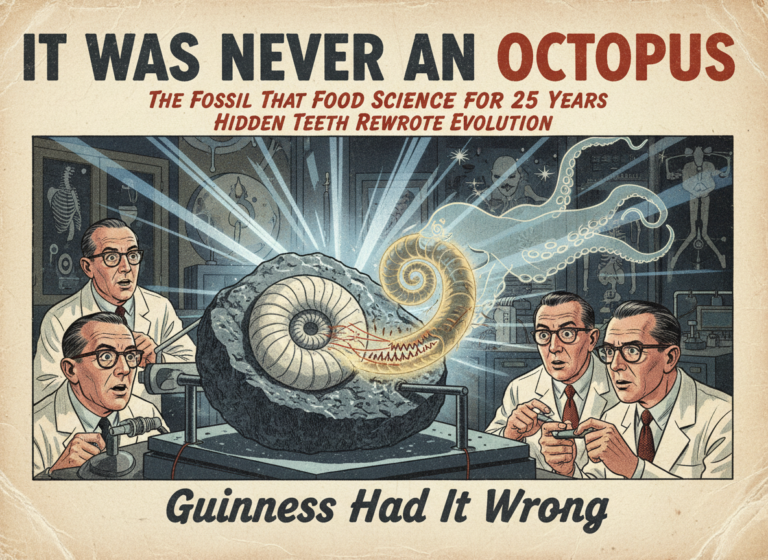
The World's Most Famous Octopus Fossil Has Been in the Guinness Book of Records for 25 Years. Scientists Just Confirmed It Was Never an Octopus.
Pohlsepia mazonensis was identified as an octopus in the year 2000. Its discovery from a siderite nodule at the Mazon Creek site…

A Uniformed US Army Officer Briefed Matt Gaetz on a Secret Program. Captured Aliens Were Breeding With Humans.
Former Representative Matt Gaetz appeared on the Benny Johnson podcast on March 31, 2026, and described receiving a formal briefing from a…

Drones Are Flying Over Sensitive Military Bases Across the US. The Pentagon Says They Are Not Foreign.
In late 2024 and into 2026, a sustained wave of drone sightings over US military installations, power infrastructure, and restricted airspace has…

Mohenjo-Daro Is 700 Years Older Than We Thought. One of the Greatest Cities in Human History Just Rewrote Its Own Timeline.
Mohenjo-Daro — the UNESCO World Heritage site on the banks of the Indus River in Pakistan, a city that once housed 40,000…