Original Story
A Scientist Says Your Vivid Recurring Dreams May Not Be Yours. They May Belong to Another Version of You.
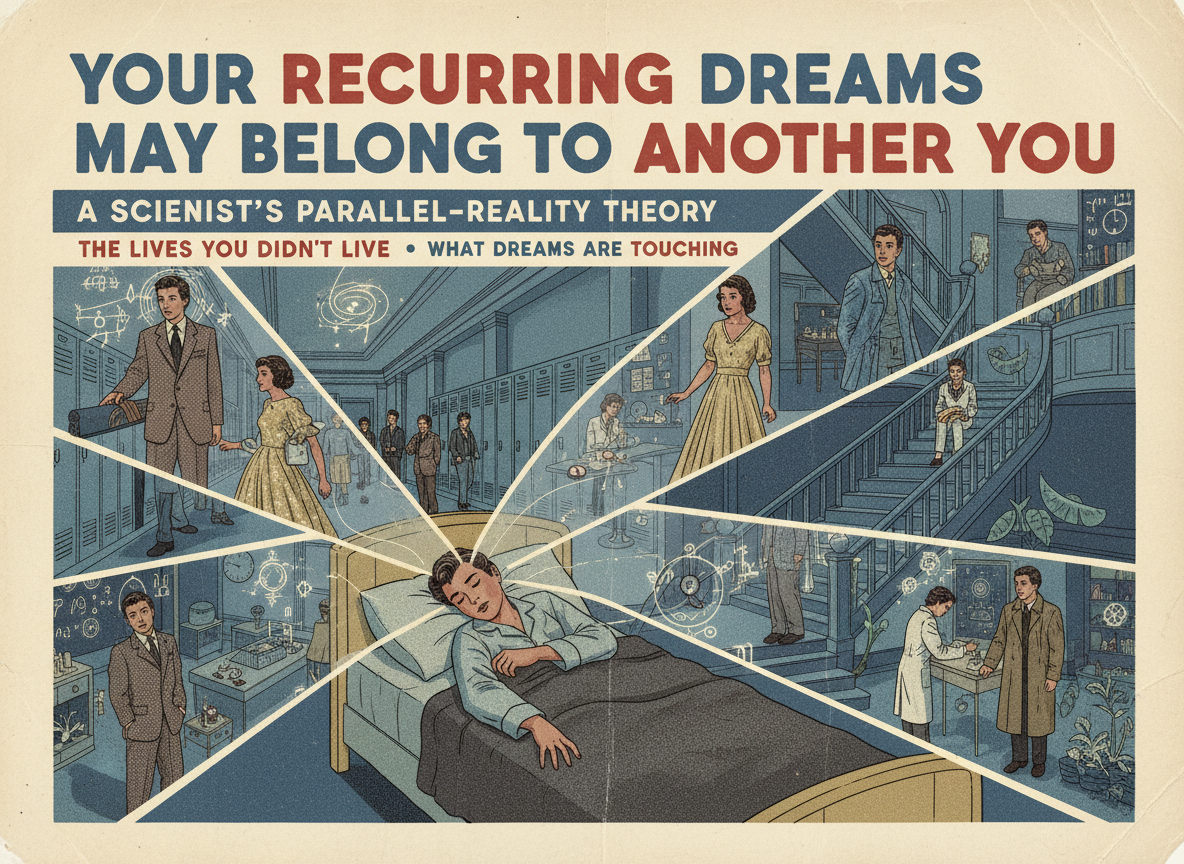
David Leong is an epistemologist at Charisma University in Turks and Caicos. His research article, covered this week by Popular Mechanics and surfacing on April 1 in Unexplained Mysteries, advances a specific and testable-adjacent hypothesis: when we sleep, our physical senses are dampened to a degree that allows consciousness to perceive information from branching quantum realities — alternate timelines that play out the consequences of choices we didn’t make. Under the many-worlds interpretation of quantum mechanics, every possible permutation of events does play out somewhere. Leong’s proposal is that vivid, recurring dreams — the ones that stay, the ones that feel undeniably real — may be the mind’s most direct contact with those other paths. The theory cannot currently be proven. That is not, he argues, the same as saying it is wrong.
Every night, the average person dreams between six and ten times. Most of those dreams dissolve within minutes of waking — fragments without narrative, impressions without story. But some dreams don’t dissolve. They stay. They repeat. They carry the physical sensation of having been somewhere real: wind, temperature, the specific weight of a place. You can remember the layout of a building you’ve never entered. You keep finding yourself in a high school you graduated from twenty years ago, sitting in a class you never failed.
David Leong, an honorary professor of epistemology at Charisma University, wants to propose a reason for that persistence.
The Many-Worlds Framework
Leong’s hypothesis is built on the many-worlds interpretation (MWI) of quantum mechanics, first formulated by physicist Hugh Everett in 1956. MWI holds that quantum events do not resolve into a single outcome — instead, every possible outcome of every quantum event happens, branching the universe into parallel versions of itself with each interaction. The number of these branching worlds is effectively infinite.
This is not a fringe interpretation of quantum physics. It is among the most widely held views in the field, supported by physicists including David Deutsch, Max Tegmark, and Sean Carroll. Its central claim — that the apparent “collapse” of quantum possibilities into a single observed state is an artifact of the observer’s position, not an objective physical event — has serious mathematical grounding. What it lacks is a mechanism for any observer in one branch to access another.
This is exactly where Leong makes his move. During waking life, he argues, our consciousness is anchored by sensory input — the constant stream of physical data from eyes, ears, proprioception — which keeps attention tightly bound to this particular branch of reality. When we sleep, that stream goes quiet. Physical senses dampen. The logical framework of waking cognition relaxes. Something else, he suggests, may become perceptible.
“Dreams may be windows into distinct realities governed by their own laws,” Leong told Popular Mechanics, “in which the mind, unfettered by the constraints of wakefulness, can explore and interact with new forms of existence.”
What This Would Mean for Recurring Dreams
The most specific — and most fringe-compelling — part of Leong’s framework is what it implies about particular types of dreams.
Under his model, a dream does not have to originate in your memory, emotional processing, or subconscious. It can originate in a parallel version of your life: an alternate timeline where a different choice led to a different consequence. The dream that keeps placing you back in a high school you long since left may not be anxiety about stagnation. It may be the lived experience of a version of you who, for reasons that branched off decades ago, never left.
Similarly, a dream about falling — one of the most universal dream experiences — may not be the brain’s vestibular system misfiring during REM transition. It may be contact with a self who fell. A version of you who stepped off the curb at the wrong moment, made the climb that ended badly, was in the building when the thing happened.
Leong is careful about the limits of the hypothesis. It cannot currently be proven. The mechanism by which consciousness would selectively perceive information from alternate quantum branches rather than simply generating dream content internally is not specified. Quantum mechanics does not currently provide a channel for cross-branch information exchange, and consciousness itself remains poorly understood at the physical level.
What the hypothesis does do is assign specific significance to the category of vivid, recurring, emotionally charged dreams that standard neuroscience has difficulty fully accounting for. Whether that significance is quantum-mechanical or psychological is, for now, an open question.
You have been somewhere. That somewhere felt real. Science does not yet have a complete answer for why.
Sources: Unexplained Mysteries — When we dream, could we be interacting with a parallel universe? (April 1, 2026) — Popular Mechanics — Your Consciousness Enters Other Dimensions While You Dream — Interesting Engineering — Your consciousness could travel multiverse when you dream: Scientists

The Shroud of Turin Carries 40% Indian DNA, and Now Nobody Knows What It Is
A new metagenomic study from the University of Padova has found that nearly 40 percent of the human genetic material on Christianity's…

Prehistoric Humans May Have Interbred With Two Separate Archaic Species. The Genetic Evidence Is in Living People's DNA Right Now.
A 2026 study has found evidence that the ancestors of modern humans interbred with not one but two separate archaic hominin species…
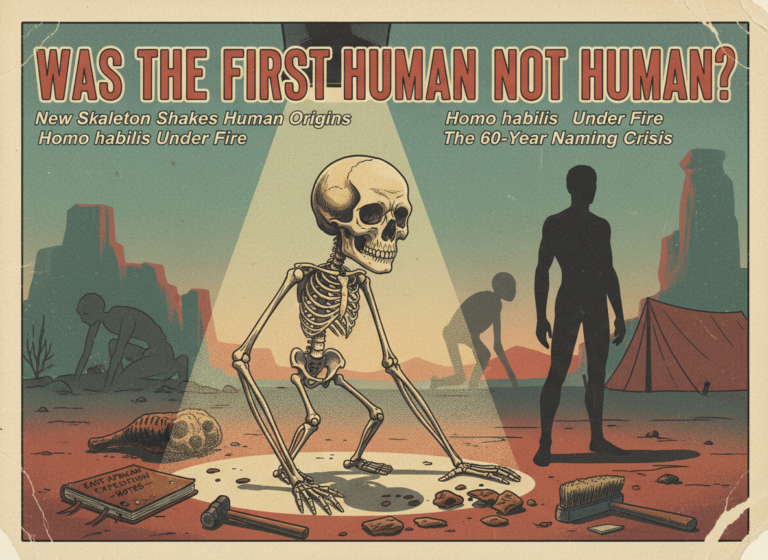
The First Human Has Been Named for 60 Years. A New Skeleton Suggests It Might Not Be Human at All.
Homo habilis — "handy man" — has held its place as the earliest named member of the human genus since 1964. The…

The Man Running FEMA's Disaster Response Says He Has Been Teleported Multiple Times. Once to a Church. Once to a Waffle House. He's Standing by It.
Gregg Phillips leads FEMA's Office of Response and Recovery — overseeing billions in disaster funds and directing the agency's response to fires,…