Original Story
A Retired Architect Has Spent 50 Years Trying to Prove There Is a 12,000-Year-Old Lost City Under the Gulf of Mexico. The Academic World Has Not Confirmed It. Nobody Has Definitively Disproven It.
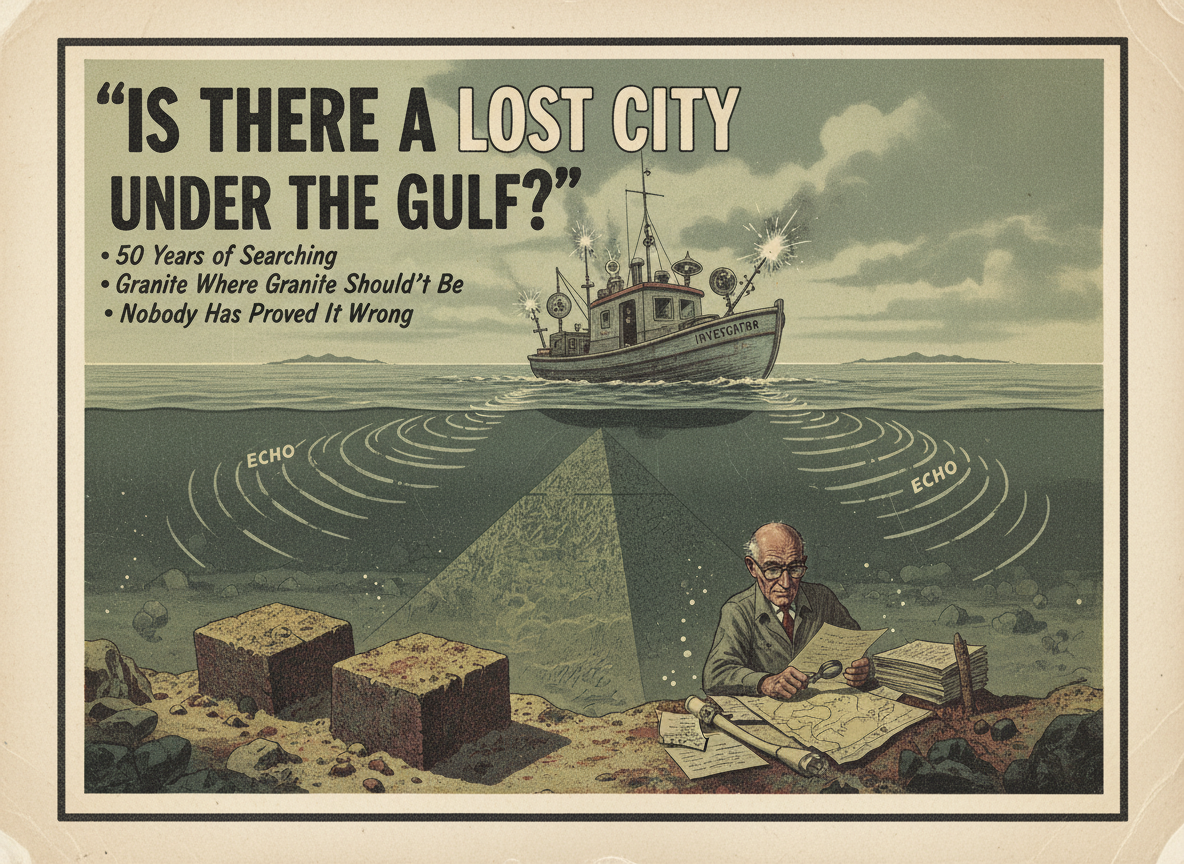
George Gelé is 50 years into a personal investigation he has largely funded himself. The site of his obsession is Chandeleur Sound in the Gulf of Mexico, about 50 miles east of New Orleans near a chain of uninhabited barrier islands. He calls what he believes is buried there “Crescentis.” He claims 44 trips, decades of underwater sonar imaging, and the testimony of local fishermen whose compasses spin when their boats cross a particular point in the water. He says there is a 280-foot pyramid under the sediment. He says it emits electromagnetic energy. He says the granite blocks found there — and granite does not occur naturally in Louisiana or Mississippi — prove a lost civilization assembled them during the last Ice Age, when this area was dry land. The academic mainstream says the granite is probably French or Spanish ship ballast. One LSU archaeologist says it may be from an aborted artificial reef project. No peer-reviewed paper has confirmed Gelé’s claims. No peer-reviewed paper has proven the granite blocks have a mundane origin either.
The story begins with fishermen.
For as long as local shrimpers and fishing crews have worked Chandeleur Sound, they have occasionally hauled up something unexpected in their nets: squared granite blocks, sometimes with what look like machined edges. Granite is not native geology to Louisiana or Mississippi. It doesn’t belong in the seafloor sediment of the Gulf of Mexico’s nearshore shelf. When fishermen asked where it came from, nobody had a satisfying answer.
George Gelé, a retired architect from New Orleans, started asking the same question in 1974. He had the technical background to read structural shapes in sonar imagery, and he had the persistence — 44 documented trips to the site over four decades — to build a body of data. What his sonar images show, he says, are hundreds of structures buried beneath the sediment in a rough grid pattern, with one anomaly rising above the rest: a 280-foot formation he interprets as a pyramid, located at a specific coordinate he has mapped.
The electromagnetic claim is the one that gets the most attention. Local shrimper Ricky Robin, who accompanied Gelé on four trips, described his compass spinning completely around at the location Gelé identified as the pyramid’s apex. “Everything will go out on your boat, all your electronics,” Robin told WWL-TV. “Like as if you were in the Bermuda Triangle.”
The Case For Crescentis
The core of Gelé’s argument is geological. Granite does not occur naturally in the Mississippi-Louisiana coastal sediment. For large quantities of cut granite to exist on the Gulf floor in this area, something or someone had to put it there.
Gelé’s interpretation: 12,000 years ago, at the end of the last Ice Age, the Gulf of Mexico’s water levels were dramatically lower. The area now covered by Chandeleur Sound was dry land — coastal plain. A civilization operating in that period could have quarried granite further inland, transported it down what would become the Mississippi River corridor, and used it to build permanent structures on what was then dry ground. Sea levels rose. The land drowned. Crescentis sank.
He points to the geometry: some of the structures he identifies on sonar align with each other. He points to what he calls a rain gutter on one of the recovered granite pieces — “This is architecture,” he told WWL-TV, “this is not ballast.” He has argued that the pyramid’s coordinates bear a geographic relationship to the Great Pyramid at Giza, though this claim is the one that has attracted the most skepticism.
The Case Against
There are three counter-explanations in circulation, none of which has been fully proven either.
The most widely cited is a 1980s Texas A&M study suggesting the granite masses are ballast stones — rocks carried aboard French and Spanish ships entering shallow coastal waters and dumped overboard when vessels needed to lighten their load approaching New Orleans. The LSU archaeology professor Rob Mann offered a third option: a failed 20th-century artificial reef project that used granite.
Gelé addressed the ballast theory directly in a 2014 presentation, acknowledging it as a possibility before returning to his own interpretation. The problem with the ballast explanation is scale — the quantity and distribution of granite that Gelé documents is difficult to account for through incidental jettisoning from colonial-era ships.
None of these explanations has been put through the rigorous process that would resolve the question: a properly funded, peer-reviewed underwater archaeological survey of the site using modern multibeam sonar, sub-bottom profiling, and targeted excavation. That survey has not happened. Gelé lacks the institutional resources to conduct it. Academic archaeologists have not chosen to prioritize the site.
Crescentis is therefore in an unusual epistemic position: too anomalous to dismiss completely, too undocumented to confirm. The fishermen’s compasses still spin.
Sources: The Daily Beast — Researcher Discovers Underwater City Off Coast of Louisiana (March 2026) — UNILAD — Amateur archaeologist claims to have found 12,000-year-old underwater city off US coast (March 2026) — The Archaeologist — Mysterious ruins off Louisiana coast spark theories of 12,000-year-old lost city (March 2026) — Ancient Origins — 12,000-Year-Old Lost City Off New Orleans Coast — WWL-TV — Amateur archeologist may have found an ancient city off the coast of St. Bernard

Something Is Moving Through Ohio: Eight Witnesses, Two Creatures, and the Biggest Bigfoot Flap in Fifty Years
A concentrated cluster of sightings along a wooded northeast Ohio greenbelt has cryptozoologists calling it the most significant Sasquatch event since the…

An Entire Island Near Fiji Is Made of 1,200-Year-Old Shellfish Scraps. Lapita People Built It Without Meaning To.
In Chandeleur Sound — wait, wrong story. In Chandeleur Sound in the Gulf of Mexico, there is controversial granite. In the southwestern…
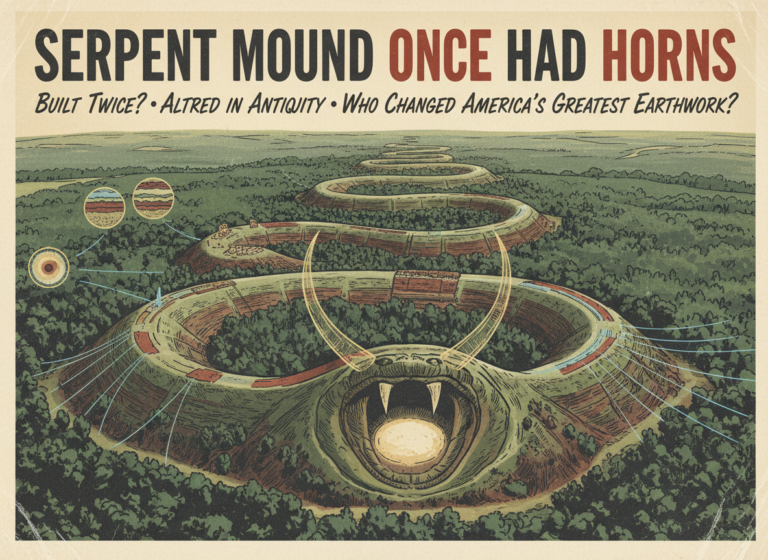
Ohio's Serpent Mound Was Built Twice, Altered in Antiquity, and Once Had Horns. The Debate Over Who Built It and Why Has Never Been Settled.
The Serpent Mound in Adams County, Ohio — the largest serpent effigy earthwork in North America — was first documented in 1848…

A Scientist Says Your Vivid Recurring Dreams May Not Be Yours. They May Belong to Another Version of You.
David Leong is an epistemologist at Charisma University in Turks and Caicos. His research article, covered this week by Popular Mechanics and…