Original Story
The Grave Robbers Got There First — But They Left Behind Something 2,600 Years Couldn’t Destroy
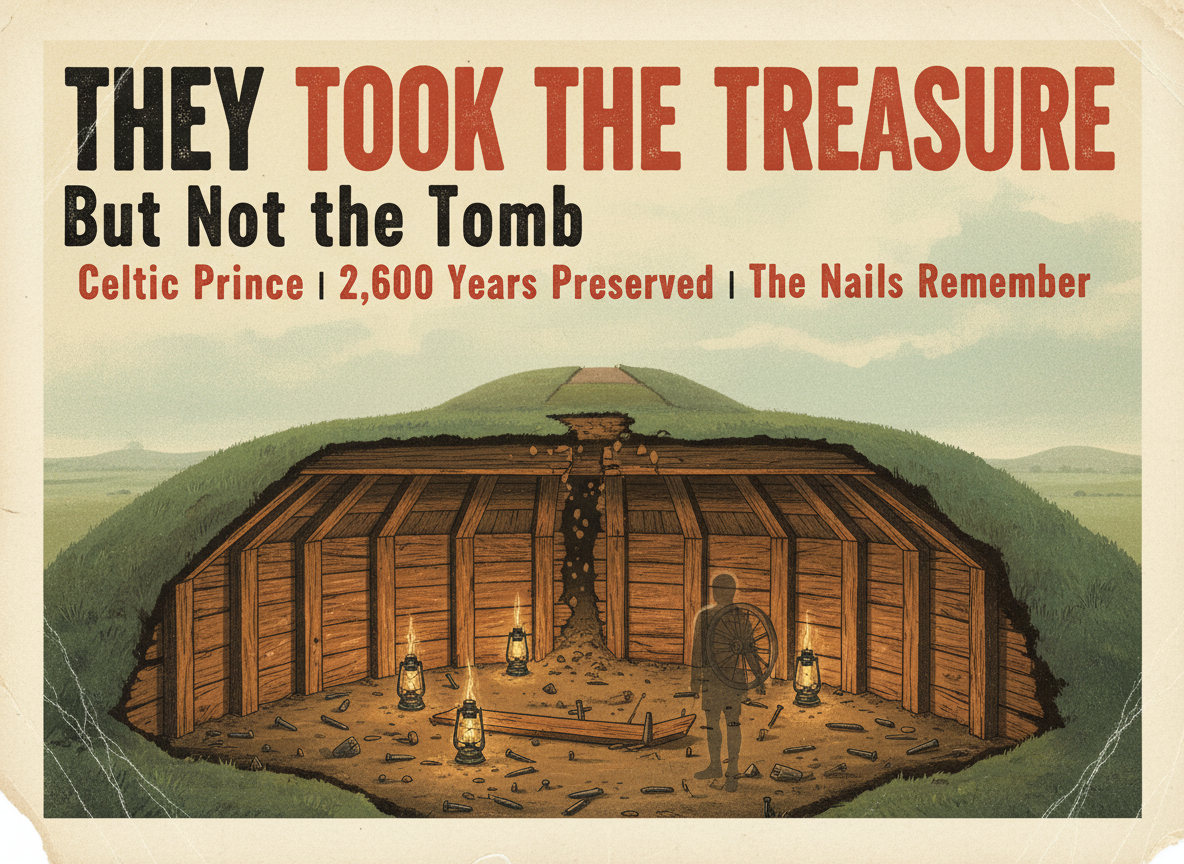
Archaeologists in southern Germany opened a Celtic prince’s burial chamber this week and found it had already been looted. What the thieves left behind turned out to be more valuable than anything they took.
Somewhere around 585 BCE, a young man — probably between 15 and 20 years old, probably of high enough status that the Celts of southwestern Germany built him a monument the size of a small stadium — was sealed into an oak chamber in the Danube plain near the town of Riedlingen. The chamber was constructed from solid timber, the ceiling held by a central crossbeam, the walls interlocked at the corners with a precision that has survived two and a half millennia. He was buried with what appears to have been a four-wheeled chariot. The mound built over his head measured 65 meters across and rose at least six meters into the sky.
Then the robbers came.
They found a hole measuring 40 by 45 centimeters — barely large enough for a human body to squeeze through — and got in anyway. They took the metals. They took whatever was worth carrying. They worked with what the lead excavating archaeologist, Dirk Krausse of the State Office for Monument Preservation in Baden-Württemberg, describes as systematic and meticulous efficiency. When they left, the chamber was stripped.
What the Thieves Couldn’t Take
Organic material. Wood. The structural bones of the burial itself.
Under normal conditions, wood buried underground survives for decades at best. What the looters apparently did not understand — and what made the Riedlingen discovery, formally published in the March 2026 edition of the journal Archäologie in Deutschland, the most significant Celtic archaeological find in recent memory — is that the groundwater saturation of the Danube plain had done something extraordinary. It removed the oxygen from the soil around the chamber. Without oxygen, the microbial decay that should have consumed the oak timbers over 2,600 years simply did not happen.
When Krausse’s team reached the chamber in 2024 after three years of excavating the burial mound, they found the ceiling intact, the walls standing, the floor preserved. The wood was not merely present — it was in condition allowing dendrochronology, the precise dating of individual tree rings. A wooden tool left behind by the original Celtic builders at the time of construction dated to 585 BCE. The tomb has a verified construction year that most buildings standing today cannot match.
What It Tells Us
The burial mound at Riedlingen is one of the few remaining examples of what archaeologists call a “princely burial mound.” The Celts of southwestern Germany, between 620 and 450 BCE, reserved these massive monuments for their highest-ranking individuals. The site sits only four miles from Heuneburg, widely considered the oldest urban settlement north of the Alps. The individual buried at Riedlingen was almost certainly part of the same elite world that made Heuneburg possible.
The bronze and iron nails the looters knocked loose in their rush to exit are now among the most important artifacts recovered from the site. They are consistent with the fittings of a four-wheeled chariot — a burial feature documented in other elite Celtic tombs, including the famous Hochdorf prince’s burial. The chariot itself is gone. But the nails remember it.
Excavations are ongoing. The wood is being salvaged for full conservation and eventual museum reconstruction. The questions about who exactly was buried here — his name, his lineage, what he ruled — will take years to work out. But the chamber survived 2,600 years of everything the earth could throw at it. The answers will come.

Kennedy Pushed Hard on Dimona. Then He Was Killed. The Documents Are Real — the Question Is What They Mean.
The JFK-Dimona thread is back in the feed today via Conspiracy Unearthed. The documented history of what Kennedy was actually doing about…
Life's Instruction Manual Was Found on an Asteroid — And It Didn't Come From Earth
Researchers at Hokkaido University have confirmed that samples from the asteroid Ryugu contain all five nucleobases — the molecular letters of DNA…

The Man Who Builds Autonomous Fighter Jets Says UFOs Probably Come From the Past — and He's Thought About the Physics
Palmer Luckey founded Oculus, sold it to Facebook for $2 billion, then built Anduril Industries — one of the most significant autonomous…

39 Shows in the Directory — Your Guide to the Fringe Feed Podcast Index
The Fringe Feed indexes 39 active fringe podcast shows across six categories. 🛸 If You're Here for UAP and Disclosure UFO Chronicles…