Original Story
The 9,000-Year-Old German Shaman Was Buried With Flowers — And Scientists Just Found the Proof
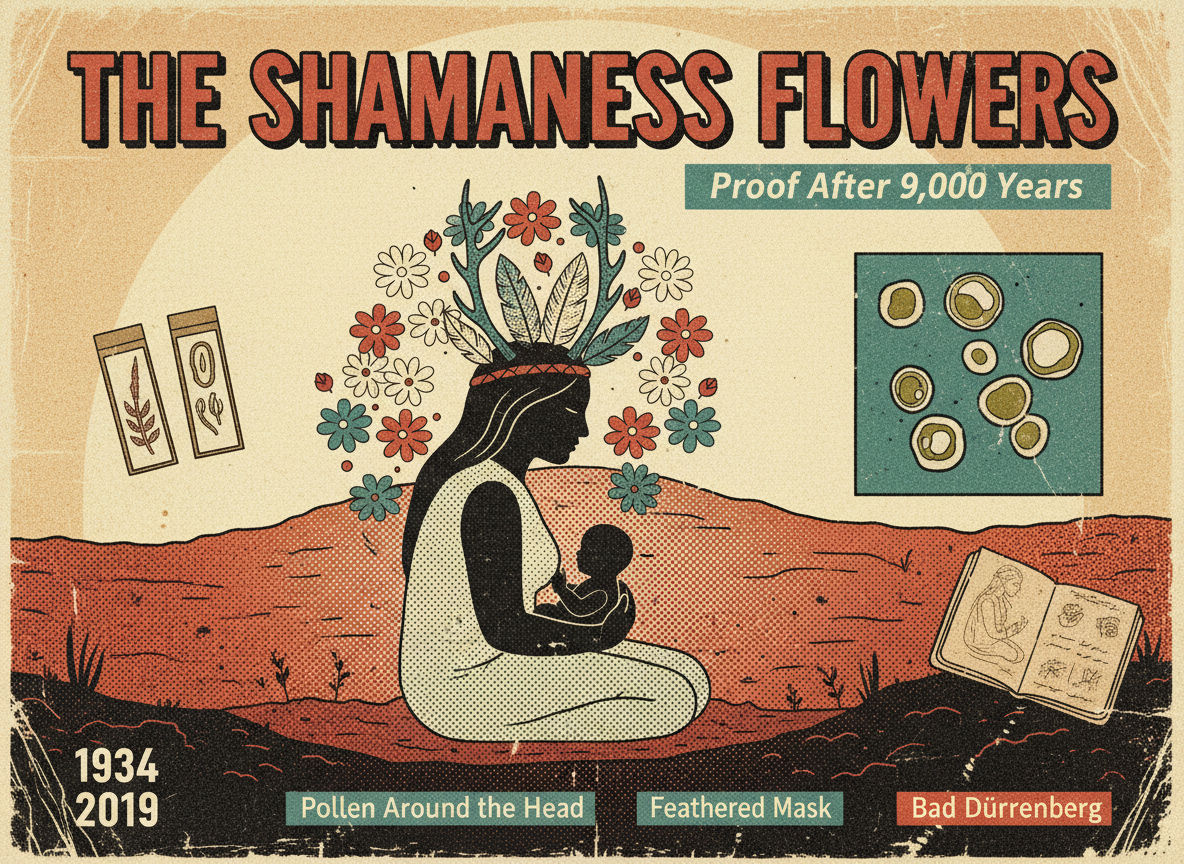
The Bad Dürrenberg burial was excavated in a single afternoon in 1934. Part of the grave was never touched. When researchers finally got back to it in 2019, they found things that had been waiting in the soil for nine millennia. This week the flowers showed up.
In May 1934, workers laying a water pipe in the spa garden of Bad Dürrenberg, Germany, broke through into a burial pit that had been sealed for nine thousand years. What they found — a woman between 30 and 40 years old, buried in a seated position with an infant across her lap, surrounded by a roe deer antler headdress, 50 pierced animal teeth, and grave goods that archaeologists would later interpret as the full kit of a Mesolithic ritual specialist — had to be excavated in a single afternoon. No photographs were taken. The only records were written descriptions and sketches.
The shaman of Bad Dürrenberg, as she came to be known, became one of the most studied prehistoric burials in Central Europe. And she keeps giving up new information. This week, the most recent findings from a multi-year reinvestigation of the burial were published — revealing, through pollen analysis, that the woman was buried with flowers deliberately arranged around her head.
What the Pollen Found
When researchers began a new round of excavations at the site in December 2019 — possible because the original trench had been narrow enough to leave significant portions of the burial pit untouched for nearly 90 years — they removed sections of the red-ochre-filled soil as intact blocks for laboratory study. Under microscopic analysis, pollen from multiple flowering plants was identified in the sediment: meadowsweet, mullein, buttercup, and devil’s-bit scabious. All known for striking, visible color. All concentrated near the area of the woman’s head.
Elisabeth Endtmann, the pollen analyst from the State Office for Geology and Mining of Saxony-Anhalt who led this portion of the investigation, noted two possible explanations. Either the flowers were placed deliberately around her head during burial — a ritualized gesture of farewell identical to the flower burials documented at Raqefet Cave in Israel from 13,700 years ago — or the pollen became trapped in her hair during her lifetime. Both interpretations say something significant about how her community regarded her.
What Else the Reinvestigation Found
The flower evidence is the freshest finding, but it arrives alongside a body of discoveries accumulated over six years of laboratory work. Under conditions that would have destroyed them in ordinary soil, microscopic fragments of feather barbules — pieces measuring less than one millimeter — survived in the ochre-saturated burial pit. Analysis by Tuija Kirkinen of the University of Helsinki, an international specialist in prehistoric feather preservation, identified feathers from waterfowl (probably goose), songbirds, and galliform birds such as capercaillie, black grouse, or snow grouse, embedded in the antler structure around her head. The antlers were not simply a headdress. They were a feathered mask.
The woman also had a physical anomaly that likely contributed to her status: two incompletely formed vertebrae in her neck, with associated malformations of the foramen magnum. Researchers believe this structural condition may have caused neuropathological effects — unusual sensations, involuntary eye movements, ataxia — that her community interpreted as evidence of contact with the spirit world. Her body was, in the framework her culture used to understand such things, already marked as different.
Genetic analysis of the burial confirmed she had dark skin, straight dark hair, and blue eyes — a combination common among Western European Mesolithic hunter-gatherers. The infant buried with her is not her son. He is a fourth or fifth degree relative. Why he was chosen to accompany her into the grave has not been determined.
The Exhibition
All of these findings — the flowers, the feathers, the DNA, the physical anthropology — will be presented together for the first time when the State Museum of Prehistory in Halle opens its major exhibition The Shamaness on March 27, 2026. The show runs through November 1 and represents the most complete public account of the Bad Dürrenberg burial assembled to date.
Nine thousand years in the earth. A single panicked afternoon of excavation in 1934. Decades of accumulated science. And still, the woman who was buried with flowers around her head is not done telling us what she knew.

Kennedy Pushed Hard on Dimona. Then He Was Killed. The Documents Are Real — the Question Is What They Mean.
The JFK-Dimona thread is back in the feed today via Conspiracy Unearthed. The documented history of what Kennedy was actually doing about…

Life's Instruction Manual Was Found on an Asteroid — And It Didn't Come From Earth
Researchers at Hokkaido University have confirmed that samples from the asteroid Ryugu contain all five nucleobases — the molecular letters of DNA…

The Man Who Builds Autonomous Fighter Jets Says UFOs Probably Come From the Past — and He's Thought About the Physics
Palmer Luckey founded Oculus, sold it to Facebook for $2 billion, then built Anduril Industries — one of the most significant autonomous…

39 Shows in the Directory — Your Guide to the Fringe Feed Podcast Index
The Fringe Feed indexes 39 active fringe podcast shows across six categories. 🛸 If You're Here for UAP and Disclosure UFO Chronicles…