Original Story
For 2,000 Years Nobody Could Read the Writing on the Walls of Teotihuacan. Two Researchers in Copenhagen Just Changed That.

Teotihuacan is one of the largest cities the ancient world ever produced. At its peak, around 400 CE, it housed more than 100,000 people in central Mexico and exerted cultural influence across Mesoamerica. Its Pyramid of the Sun is the third-largest pyramid on Earth. Its Avenue of the Dead runs two miles through a planned urban grid that archaeologists are still excavating. And for the entire span of modern scholarship, nobody has known who built it, what language they spoke, or what the symbols painted on its walls and fired into its pottery actually say. A study published in Current Anthropology by two researchers at the University of Copenhagen, Dr. Magnus Pharao Hansen and Dr. Christophe Helmke, now proposes a method that may have cracked that silence open. The symbols, they argue, are not decorative. They are writing. And they record a language that became Nahuatl, the language of the Aztecs.
The problem with reading Teotihuacan has always been circular. To read an unknown script, you need to identify the language it encodes. To identify the language, you need to be able to read some of the text. Every previous attempt to break the Teotihuacan writing system ran into this loop and stalled.
Hansen and Helmke’s insight was to approach the problem differently. Rather than working with modern Nahuatl, which is what earlier researchers had tried and failed with, they reconstructed a much older form of the language — a Proto-Uto-Aztecan ancestor that would have been spoken roughly 2,000 years ago, during the period when Teotihuacan was being built and populated. The difference is not subtle. Using modern Nahuatl to read 2,000-year-old Teotihuacan symbols, Helmke explained, would be “a bit like trying to decipher the runes on the famous Danish runestones, such as the Jelling Stone, using modern Danish. That would be anachronistic. You have to try to read the text using a language that is closer in time and contemporary.”
Once they had the reconstructed proto-language, the script began to yield.
How the Writing Works
The Teotihuacan writing system, as Hansen and Helmke describe it, operates on two registers simultaneously. Some symbols are logograms: direct representations where a drawn coyote simply means “coyote.” Others function as a rebus, where the sound of a depicted object — not its meaning — is used phonetically to build more complex or abstract words. This dual system, which they call “double spelling,” requires knowing not just how the symbols look but how the words they represent would have sounded in the ancient language.
The researchers found more than a hundred symbols on Teotihuacan murals and ceramics that follow this pattern consistently. Repeated signs appear in grammatical positions. Symbols recur across different contexts in ways that match linguistic structure, not arbitrary artistic convention. The mural paintings in Teotihuacan’s apartment compounds, long analyzed as religious imagery, contain in this reading actual written statements. The inscriptions on pottery include text. The city, which has been described as archaeologically silent for a century of excavation, was talking the entire time.
What It Would Change If Confirmed
The implications run in multiple directions. The identity question — who were the Teotihuacanos? — has haunted Mexican archaeology since the Spanish first encountered the city’s ruins. Archaeologists had generally assumed that the Nahuatl-speaking peoples of the Aztec Empire arrived in central Mexico long after Teotihuacan’s collapse around 600 CE, making them descendants of unrelated populations. If Hansen and Helmke are correct, the linguistic chain is continuous. Nahuatl speakers may have been present at Teotihuacan from the city’s founding, making the Aztecs not distant inheritors of an unknown civilization but direct cultural descendants of the people who built the Pyramid of the Sun.
“If we are right,” Helmke said, “it could have implications for our entire understanding of Mesoamerican cultures and, of course, point to a solution to the mystery surrounding the inhabitants of Teotihuacan.”
The researchers acknowledge that the corpus of available texts is small, and that confirmation will require more inscribed materials to emerge from ongoing excavations. The method, they say, is a baseline, not a conclusion. Workshops are being organized to bring additional scholars into the process.
For 2,000 years the walls of Teotihuacan held text that no living person could read. That may no longer be true.
Sources: The Debrief — A 2000-Year-Old Lost Script Has Been Deciphered (April 13, 2026) — Current Anthropology — Hansen and Helmke, The Language of Teotihuacan Writing (September 2025) — ZME Science — Researchers Claim They Have Cracked the Code of Teotihuacan’s Mysterious Writing System — Ancient Origins — Ancient Teotihuacan Writing System Cracked By Researchers — Archaeology Magazine — Ancient Teotihuacan Murals Reveal Possible 2,000-Year-Old Uto-Aztecan Language — Ancientist — Researchers May Have Deciphered the Lost Language of Teotihuacan — Anomalist — April 13 update noting The Debrief report (April 13, 2026)

An Oklahoma Woman Was Mauled by Something Nobody Can Identify. Four Surgeries Later, the DNA Results Still Aren't In.
On the morning of March 29, 2026, a 38-year-old mother named Alicia Maxey was found unconscious and badly injured near Blanco in…

The First Official Loch Ness Monster Sighting of 2026 Just Hit the Register. The Witness Drew a Sketch.
On the morning of March 1, 2026, American tourist Tony Inhorn was on a boat near the entrance to the Caledonian Canal…
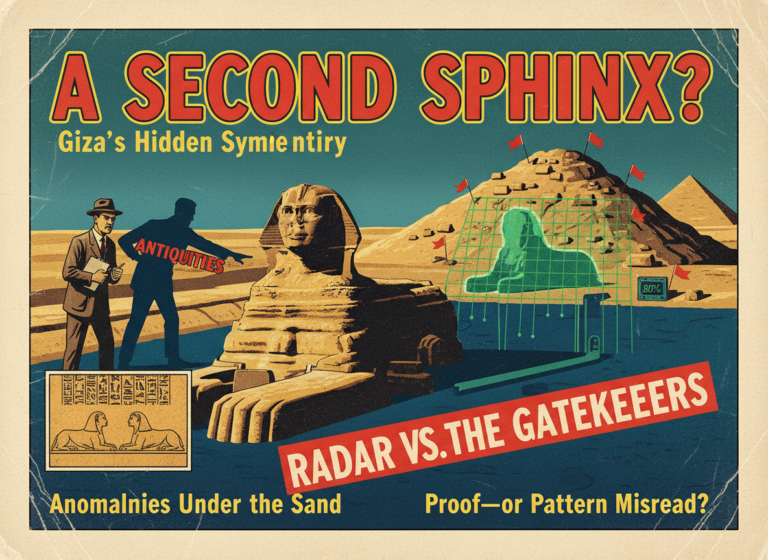
An Italian Radar Engineer Says There Is a Second Sphinx Buried at Giza, and the Evidence Is Not Nothing
Filippo Biondi and his team used satellite-based Synthetic Aperture Radar to scan the Giza Plateau and say they found a buried structure…

Scientists Found a Crocodile Relative That Walked on Two Legs. It Was the Apex Predator of Its Time, and Nobody Knew It Existed.
A newly described prehistoric species — Proexochokefalos steineri — has been identified from fossils found in what is now Poland. It lived…