Original Story
Archaeologists Just Found a 2,000-Year-Old Garden Under the Church Built Over Jesus’s Tomb. The Gospel of John Said It Would Be There.
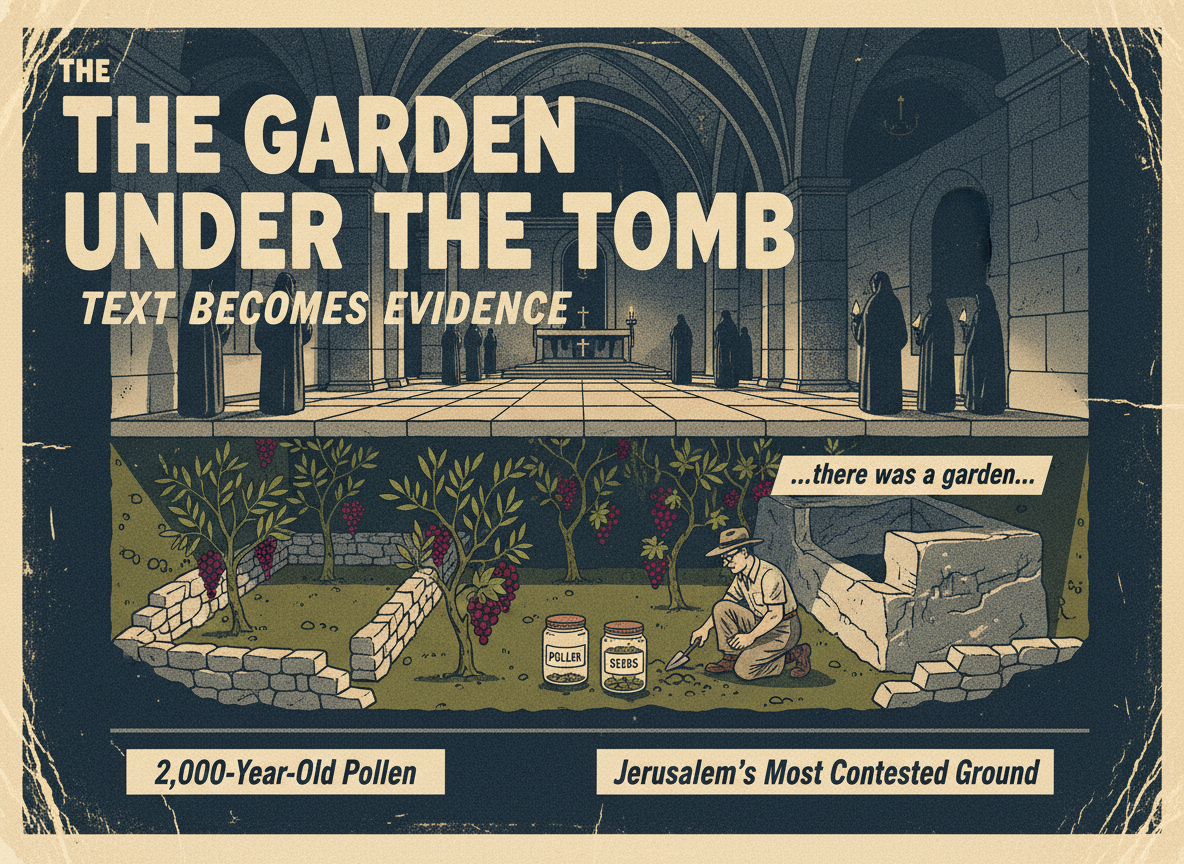
An archaeological excavation running since 2022 beneath the floor of the Church of the Holy Sepulchre in Jerusalem has uncovered something no one had physically confirmed before: the remains of a 2,000-year-old garden. Pollen analysis and archaeobotanical study of soil samples taken from beneath the 19th-century stone floor produced evidence of olive trees and grapevines dating to approximately the first century CE. The Gospel of John, chapter 19 verse 41, states: “At the place where Jesus was crucified, there was a garden, and in the garden a new tomb, in which no one had ever been laid.” For two thousand years that description existed as text. Now it exists as pollen and seed remnants beneath one of the most contested pieces of ground on Earth.
The excavation is led by Professor Francesca Romana Stasolla of Sapienza University of Rome. It began in 2022, made possible by a renovation agreement reached in 2019 between the three religious communities that manage the church — the Orthodox Patriarchate, the Franciscan Custody of the Holy Land, and the Armenian Patriarchate — communities that had been fighting over the building’s governance for decades before a consensus on repairs finally cleared the way for archaeological access.
Getting beneath the floor of the Church of the Holy Sepulchre is not a routine excavation. The site is considered by Christian tradition to encompass both the location of the crucifixion (Golgotha, the “place of the skull”) and the tomb in which Christ was buried, visited by millions of pilgrims annually. The 12th-century structure has been built, destroyed, and rebuilt over a sequence of older structures reaching back to a church Constantine the Great ordered constructed in 335 CE specifically to mark and preserve what he had identified as the site of the tomb. Below the Constantinian foundations lies an Iron Age quarry, in use from approximately 1200 to 586 BCE, which was later repurposed as a burial ground, its rock face cut into multiple tombs.
What the Pollen Found
The archaeobotanical team found what Stasolla described as “low stone walls filled with dirt — consistent with cultivated plots.” Within those plots, pollen and botanical traces pointed specifically to olive trees and grapevines. The species are consistent with the agricultural landscape of first-century Jerusalem, and the stratigraphic context in which the samples were found places them firmly in the pre-Christian era.
Radiocarbon dating of the botanical materials had not been completed at the time of reporting — the excavation has paused for Holy Week and Easter due to the influx of pilgrims — but Stasolla is confident in the contextual dating. “The archaeobotanical findings have been especially interesting for us, in light of what is mentioned in the Gospel of John,” she told the Times of Israel, “whose information is considered written or collected by someone familiar with Jerusalem at the time. The Gospel mentions a green area between the Calvary and the tomb, and we identified these cultivated fields.”
The excavation has also uncovered a circular marble base beneath the edicule — the small shrine encasing what tradition identifies as the actual tomb. The precise age and origin of the marble is under investigation and could clarify the development history of the site across the centuries separating Constantine from the present.
What It Confirms and What It Cannot
This discovery does not establish the historicity of Jesus’s burial at this location. The presence of a garden consistent with the Gospel account is significant corroborative evidence, but the chain between a first-century cultivated plot and the specific events described in the New Testament remains beyond what archaeology can close. What Stasolla and her team have done is physically confirmed that the landscape described by the Gospel of John — cultivated ground adjacent to a rock-cut tomb — existed at this location during the relevant period. That is not a minor thing.
“Whether someone believes or not in the historicity of the Holy Sepulchre, the fact that generations of people did is objective,” Stasolla told the Times. “The history of this place is the history of Jerusalem, and at least from a certain moment, it is the history of the worship of Jesus Christ.”
The Gospel of John described a garden. There was a garden. It is 2,000 years old and it was found under the floor.
Sources: Popular Mechanics — Archaeologists Found a 2,000-Year-Old Garden Beneath a Church. It May Be the Site of Jesus’s Tomb (April 14, 2026) — The Debrief — Is This the Tomb of Jesus? A 2000-Year-Old Site Beneath Jerusalem’s Church of the Holy Sepulchre Reveals Its Ancient Secrets — Ancient Origins — Ancient Garden Found at Jesus’s Burial Site, Verifying Biblical Account — Archaeology Magazine — Ancient Garden Found at Jesus Christ’s Burial Site — Hungarian Conservative — Ancient Garden Discovered Beneath Jerusalem’s Church of the Holy Sepulchre (March 2026) — Unexplained Mysteries forum — Archaeologists Found a 2,000-Year-Old Garden Beneath a Church (April 14-15, 2026)

For 2,000 Years Nobody Could Read the Writing on the Walls of Teotihuacan. Two Researchers in Copenhagen Just Changed That.
Teotihuacan is one of the largest cities the ancient world ever produced. At its peak, around 400 CE, it housed more than…
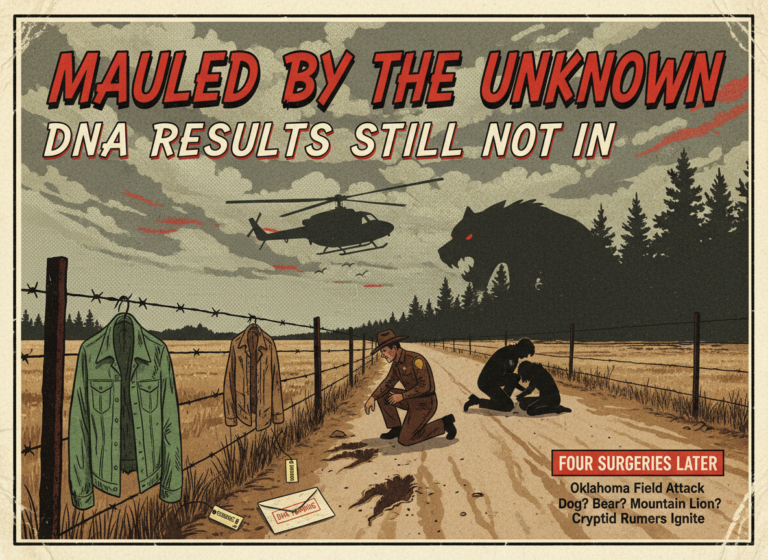
An Oklahoma Woman Was Mauled by Something Nobody Can Identify. Four Surgeries Later, the DNA Results Still Aren't In.
On the morning of March 29, 2026, a 38-year-old mother named Alicia Maxey was found unconscious and badly injured near Blanco in…

The First Official Loch Ness Monster Sighting of 2026 Just Hit the Register. The Witness Drew a Sketch.
On the morning of March 1, 2026, American tourist Tony Inhorn was on a boat near the entrance to the Caledonian Canal…
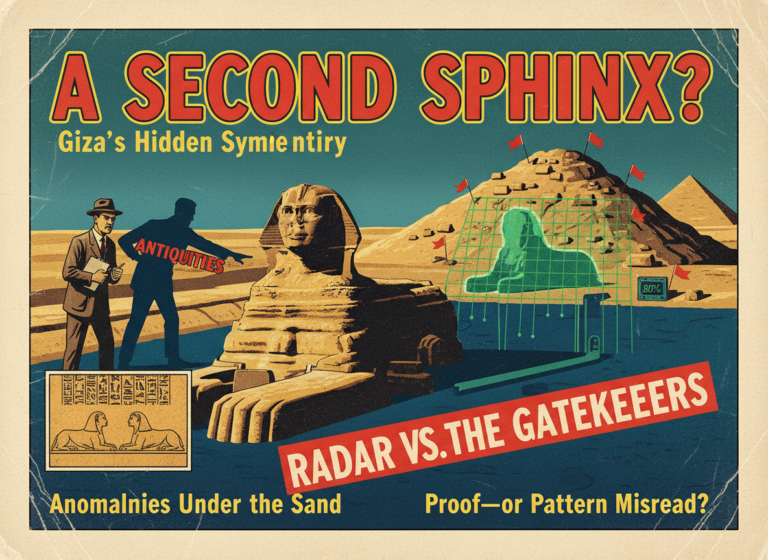
An Italian Radar Engineer Says There Is a Second Sphinx Buried at Giza, and the Evidence Is Not Nothing
Filippo Biondi and his team used satellite-based Synthetic Aperture Radar to scan the Giza Plateau and say they found a buried structure…