Original Story
A 250-Million-Year-Old Embryo Sat in a Rock for 17 Years Before Anyone Could Prove What It Was. It Just Answered One of Evolution’s Oldest Questions.
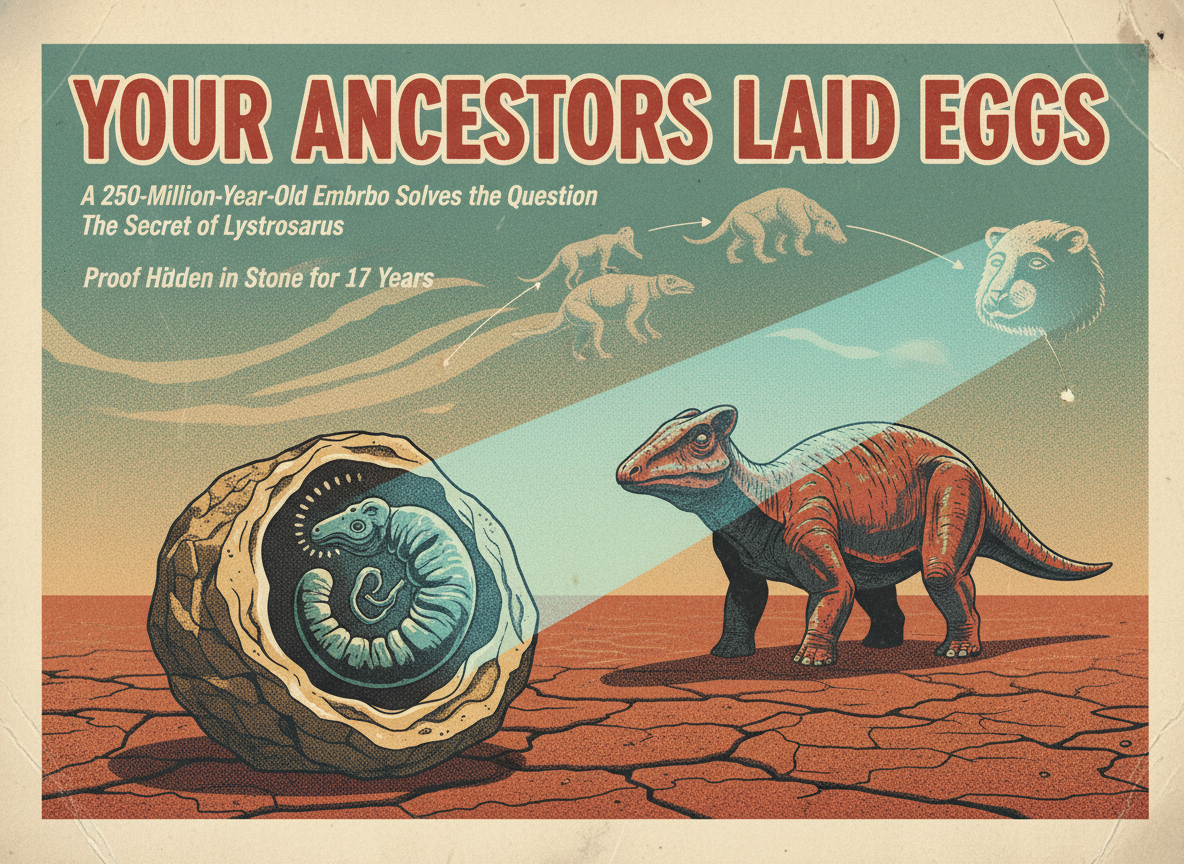
In 2008, paleontologist John Nyaphuli found a small nodule in South Africa’s Karoo Basin during a field excavation led by Professor Julien Benoit of the University of the Witwatersrand. When the nodule was prepared, it revealed a curled-up embryo. The researchers knew it was Lystrosaurus, the pig-sized, turtle-beaked, tusked therapsid that survived the End-Permian mass extinction 252 million years ago — the event that killed roughly 90 percent of all species on Earth. They suspected the embryo had died inside an egg. But without a shell present in the fossil, and without imaging technology capable of resolving the delicate bone structures that would prove it, the question could not be answered. It sat in the National Museum in Bloemfontein for nearly two decades. Then the European Synchrotron Radiation Facility in Grenoble came online with a new generation of imaging capability. The answer, published in PLOS One on April 9, 2026, is yes: your ancestors laid eggs.
Lystrosaurus is one of the most successful animals that ever lived, measured purely by dominance. In the immediate aftermath of the Great Dying, it constituted an estimated 95 percent of all land vertebrates in some regions. Nothing else had survived in comparable numbers. For years, researchers understood that Lystrosaurus thrived because it was hardy, adaptable, and reproduced quickly. They just could not confirm how it reproduced. No therapsid egg had ever been conclusively identified in 150 years of South African paleontology.
The answer required a machine that had not existed when the fossil was found.
The European Synchrotron Radiation Facility produces X-rays billions to trillions of times more intense than hospital equipment, allowing researchers to see inside dense rock at resolutions previously impossible. When Professor Benoit and Dr. Vincent Fernandez of the ESRF finally scanned the Bloemfontein specimen, they found the critical detail: the mandibular symphysis, the joint where the two halves of the lower jaw fuse, had not yet completed fusion. In modern turtles and birds, this junction fuses before hatching, ensuring the beak is strong enough to function immediately. In the Lystrosaurus specimen, it had not fused. The jaw was structurally incapable of feeding. The animal was still inside an egg.
“When I saw the incomplete mandibular symphysis, I was genuinely excited,” Benoit said. “The mandible is made up of two halves that must fuse before the animal can feed. The fact that this fusion had not yet occurred shows that the individual would have been incapable of feeding itself.”
What the Egg Reveals About Survival
The eggs were soft-shelled, not hard. This is why none had been found in the previous 150 years of searching: soft-shelled eggs rarely fossilize. This specimen survived only because it was preserved inside a siderite nodule — an iron-rich concretion that formed around it before the organic material could fully decay. The shell itself was gone. Only the embryo’s bones remained, and only the synchrotron could read them.
The size of the eggs carries its own meaning. For the body size of Lystrosaurus, the eggs were relatively large. In modern biology, large eggs are associated with yolk-heavy development: the embryo receives all its nutrients from the egg itself and arrives in the world at an advanced state of development, capable of moving, feeding, and evading predators without parental care. This is called precocial development, and it is the opposite of how most modern mammals reproduce.
The researchers conclude that Lystrosaurus almost certainly did not produce milk for its young. It laid large eggs, hatched strong independent offspring, and reproduced rapidly. In the drought-scoured, heat-devastated world following the End-Permian extinction, this combination proved to be exactly what survival required. The larger the egg, the less water it loses through its leathery shell — a critical advantage when the landscape offers almost none.
The Deeper Question
The discovery resolves a question that has been open for two centuries: did the ancestors of mammals lay eggs? The answer is yes, they did, and now there is a fossil to prove it. Lystrosaurus is a synapsid, the lineage that eventually gave rise to all modern mammals including humans. Somewhere along the 250-million-year path between Lystrosaurus and the first true mammals, live birth emerged as the dominant reproductive strategy. But the starting point — the default mode of the ancestors — was an egg, soft-shelled, yolk-heavy, deposited in the ground, and abandoned to hatch on its own.
The platypus and the echidna still lay eggs today, alone among modern mammals. They are not exceptions. They are the oldest pattern, still running in living form.
Sources: PLOS One — Benoit et al., The First Non-Mammalian Synapsid Embryo from the Triassic of South Africa (April 9, 2026) — Popular Science — Proto-Mammals Laid Eggs, Paleontologists Finally Confirm (April 9, 2026) — The Conversation — Embryo Fossil Found in South Africa Is World’s Oldest Proof That Mammal Ancestors Laid Eggs (April 12, 2026) — Interesting Engineering — First-Ever Egg of a Mammal Ancestor Discovered (April 2026) — Sci.News — 250-Million-Year-Old Embryonated Dicynodont Egg Found in South Africa (April 2026) — Earth.com — Scientists Discover the First-Ever Egg of a Very Early Mammal Ancestor (April 2026) — EurekAlert — Ancient Survivor Reveals Its Secret: First-Ever Egg of a Mammal Ancestor Discovered (April 9, 2026)
An Italian Radar Engineer Says There Is a Second Sphinx Buried at Giza, and the Evidence Is Not Nothing
Filippo Biondi and his team used satellite-based Synthetic Aperture Radar to scan the Giza Plateau and say they found a buried structure…
Scientists Found a Crocodile Relative That Walked on Two Legs. It Was the Apex Predator of Its Time, and Nobody Knew It Existed.
A newly described prehistoric species — Proexochokefalos steineri — has been identified from fossils found in what is now Poland. It lived…

Archaeologists Just Found a 2,000-Year-Old Garden Under the Church Built Over Jesus's Tomb. The Gospel of John Said It Would Be There.
An archaeological excavation running since 2022 beneath the floor of the Church of the Holy Sepulchre in Jerusalem has uncovered something no…

Kacey Musgraves Watched Three Orbs Follow Her Plane for 45 Minutes. The Pilots Had Seen Them Every Night.
On the evening of April 9, 2026, Grammy Award-winning country artist Kacey Musgraves was on a private flight from Fort Worth, Texas…