Original Story
The World’s Most Famous Octopus Fossil Has Been in the Guinness Book of Records for 25 Years. Scientists Just Confirmed It Was Never an Octopus.
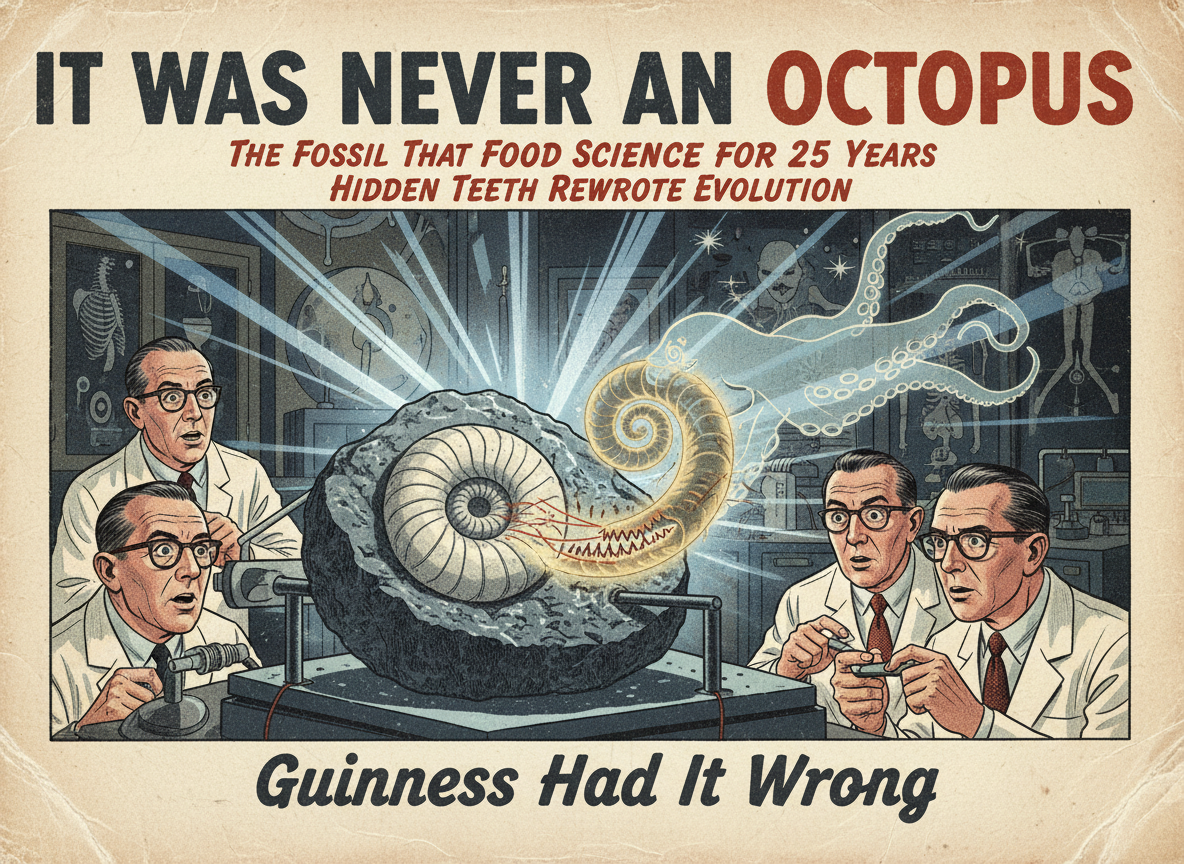
Pohlsepia mazonensis was identified as an octopus in the year 2000. Its discovery from a siderite nodule at the Mazon Creek site in Illinois, roughly 50 miles southwest of Chicago, pushed the known origin of octopuses back by approximately 150 million years, making it the earliest known cephalopod of its kind by an enormous margin. Guinness World Records listed it. Scientific literature cited it. The evolutionary history of the entire octopus lineage was built around it. On April 8, 2026, a study published in Proceedings of the Royal Society B confirmed that the fossil is not an octopus. It is a decomposed nautilus relative that fooled scientists for 25 years because its body had been rotting for weeks before it was preserved in rock. The evidence that cracked the case: eleven hidden teeth, detected inside the fossil using synchrotron imaging technology that produces X-rays billions of times more intense than hospital equipment.
The fossil sits in the collection of the Field Museum in Chicago. It is roughly hand-sized. It looks, in the words of Dr. Thomas Clements, lead author of the new study and Lecturer in Invertebrate Zoology at the University of Reading, “like a white mush.” That it was ever identified as anything at all is a testament to the skill and ambition of the paleontologists who first described it. That it was misidentified is a testament to what happens when the body of a 300-million-year-old animal spends weeks decomposing before it is permanently preserved.
When Pohlsepia died, it sank into the mud of a Carboniferous sea. But before the sediment sealed it, the soft tissues of its body went through significant decay. The shell, if it had one, dissolved. The shape of the body changed. What remained when the animal finally fossilized was a squashed, altered version of whatever it had been in life — convincing enough, to the researchers who described it in 2000, to suggest the features of a cirrate octopus: eight arms, possible fins, a body outline consistent with the group. The 25-year paper was wrong, but it was not an unreasonable reading of what was available.
What the Synchrotron Found
Clements and his team used three separate analytical techniques to re-examine the fossil: scanning electron microscopy, micro-CT scanning, and synchrotron imaging, the last of which uses X-rays generated by particle accelerators, producing radiation billions to trillions of times more intense than conventional X-ray equipment. This intensity allows researchers to detect structures buried inside dense rock that no surface examination could reveal.
What they found inside the fossil was a radula — the ribbon-like feeding structure with rows of teeth that is found in all mollusks. The radula had at least eleven tooth-like elements per row. Octopuses have seven or nine. Nautiloids have thirteen. Eleven is between the two, but the shape of the structures matched nautiloid morphology, not octopus morphology. There was also no evidence of melanosomes, the pigment structures that should accompany an ink sac, which the original paper had tentatively identified. When the researchers compared the newly revealed radula with other cephalopod fossils from the same Mazon Creek site, they found a precise match: Paleocadmus pohli, a known fossil nautiloid already in the collection from the same location.
Their conclusion: Pohlsepia mazonensis is not a distinct species at all. It is a decomposed, misidentified specimen of Paleocadmus pohli.
What This Changes
The reclassification rewrites the timeline of octopus evolution in both directions simultaneously. The earliest known soft tissue evidence of a nautiloid has been pushed back by approximately 220 million years. The earliest known evidence for octopuses has been pushed forward by approximately 150 million years, eliminating a gap in the fossil record that had made researchers uncomfortable for a quarter century.
“It’s a huge gap,” Clements told CNN. “And so that big gap got researchers sort of questioning: is this thing actually an octopus?” The answer was no. It was never an octopus.
Guinness World Records confirmed it will no longer list Pohlsepia mazonensis as the earliest known octopus. The Field Museum’s Paul Mayer described being “a little surprised” by the reclassification but noted that researchers had been questioning the original identification since the paper first appeared. He added that the museum now holds “the oldest soft tissue nautilus in the world.” The octopus remains, as it has always been, one of the most poorly documented major animal groups in the entire fossil record — a ghost lineage that almost never leaves a trace.
Sources: Proceedings of the Royal Society B — Synchrotron Data Reveal Nautiloid Characters in Pohlsepia mazonensis (April 8, 2026) — University of Reading — Oldest Octopus Fossil Is No Octopus at All, Scans Reveal (April 8, 2026) — CNN — The Oldest Octopus in the World Isn’t an Octopus After All (April 9, 2026) — CBS News — Weird Blob Creature Thought to Be World’s Oldest Octopus Isn’t an Octopus After All (April 9, 2026) — ScienceAlert — World’s Oldest Known Octopus Turns Out to Be an Entirely Different Animal (April 9, 2026) — Natural History Museum — World’s Oldest Octopus Fossil Isn’t an Octopus After All (April 9, 2026) — ScienceDaily — The World’s Oldest Octopus Was Never an Octopus (April 7, 2026)

Romans Were So Obsessed With a Plant They Ate It Into Extinction. It Was a Contraceptive, an Aphrodisiac, and Possibly Worth Its Weight in Denarii.
Silphium was a plant that grew on a narrow strip of coastal land near the ancient Greek colony of Cyrene, in what…

A Uniformed US Army Officer Briefed Matt Gaetz on a Secret Program. Captured Aliens Were Breeding With Humans.
Former Representative Matt Gaetz appeared on the Benny Johnson podcast on March 31, 2026, and described receiving a formal briefing from a…

Drones Are Flying Over Sensitive Military Bases Across the US. The Pentagon Says They Are Not Foreign.
In late 2024 and into 2026, a sustained wave of drone sightings over US military installations, power infrastructure, and restricted airspace has…

Mohenjo-Daro Is 700 Years Older Than We Thought. One of the Greatest Cities in Human History Just Rewrote Its Own Timeline.
Mohenjo-Daro — the UNESCO World Heritage site on the banks of the Indus River in Pakistan, a city that once housed 40,000…