Original Story
Mohenjo-Daro Is 700 Years Older Than We Thought. One of the Greatest Cities in Human History Just Rewrote Its Own Timeline.
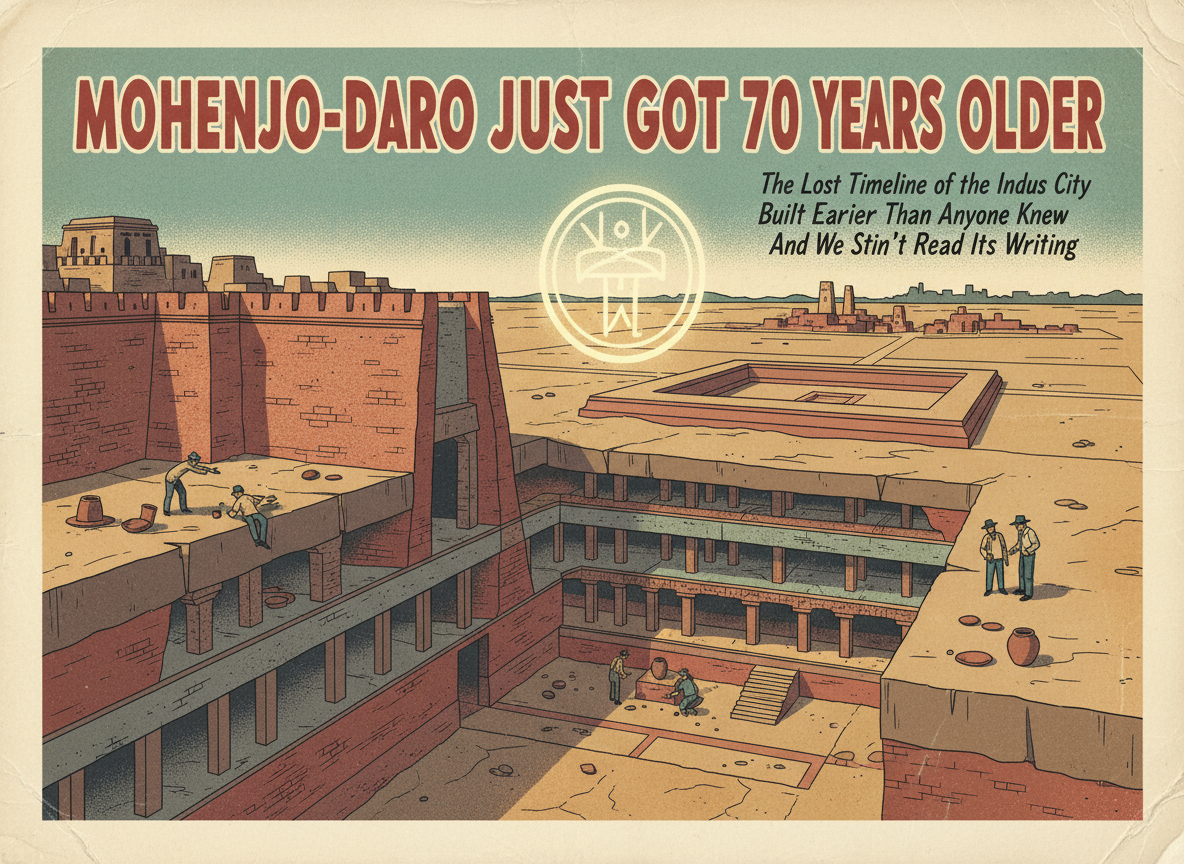
Mohenjo-Daro — the UNESCO World Heritage site on the banks of the Indus River in Pakistan, a city that once housed 40,000 people and ran sewage systems when most of the ancient world was still living in huts — just got significantly older. New radiocarbon dates from a joint Pakistani and American excavation team have pushed the city’s origins back to at least 3300 BCE, some 700 years earlier than the previously accepted founding date of around 2600 BCE. The structure at the center of the discovery was first uncovered in 1950 by the archaeologist Sir Mortimer Wheeler, who misidentified it as a flood-protection embankment. It is now confirmed to be a multi-phase city wall, built and rebuilt across centuries, and its lowest construction layers predate everything previously known about Mohenjo-Daro by a considerable margin.
The excavation was carried out by the Sindh Directorate General of Antiquities and Archaeology in partnership with the Sindh Exploration and Adventure Society, led by Pakistani archaeologists Dr. Asma Ibrahim and Ali Lashari alongside Dr. Jonathan Mark Kenoyer of the University of Wisconsin. The team focused their work on a massive mudbrick perimeter wall surrounding the western Stupa Mound — the same wall Wheeler excavated in 1950 and mistakenly classified as a revetment or flood control feature. New deep coring below that wall revealed Kot Dijian-style pottery in the earliest layers, indicating a substantial settlement was already present at the site before the wall itself was even constructed.
Five new radiocarbon dates were taken from different construction phases of the wall. The lowest layers — the earliest construction — date to the end of the Early Harappan Kot Diji Phase, around 2700 to 2600 BCE at the latest, with evidence of occupation pushing back further still to approximately 3300 BCE. The radiocarbon dating was carried out in the United States, as Pakistan does not currently have its own facility for carbon dating.
What This Changes
The accepted view of Mohenjo-Daro held that it was essentially a Mature Harappan creation — a city that appeared, largely formed, around 2600 BCE, reached its peak, and was mysteriously abandoned around 1900 BCE. That narrative was always somewhat unsatisfying. Cities of that sophistication — with standardized baked bricks, carefully planned street grids, the Great Bath, covered drainage systems, and weights and measures consistent across hundreds of miles of civilization — do not emerge fully formed.
The new dates confirm what some researchers suspected: Mohenjo-Daro evolved from a pre-existing settlement over several centuries before reaching the urban scale for which it is famous. It was not a creation of the Mature Harappan phase. It was a long process of gradual urban development with roots deep in the Early Harappan world. The findings align with similar evidence from Harappa itself, where comparable early occupation layers and fortification structures have been dated to approximately 2800 to 2600 BCE.
The upper layers of the wall confirm sustained expansion into the Mature Harappan period and beyond, with the wall maintained until at least 2200 BCE. Wheeler had identified those upper layers correctly. What he missed — and what the new coring reveals — is everything below them.
The Mystery That Remains
The new dates do not solve Mohenjo-Daro’s deepest problem: nobody can read its writing. The Indus script appears on thousands of seals and tablets across the civilization, but it has never been definitively deciphered. Without readable texts, the city’s political structure, religious life, and the reason for its abandonment around 1900 BCE remain opaque. Theories for the collapse range from prolonged megadrought to flooding to the disruption of trade networks — but the evidence for any single catastrophic cause is scarce.
What the new excavation does is push the beginning of that story significantly further back. A city that was already complex and organized enough to build city walls by 3300 BCE is a different kind of civilization than one that appeared 700 years later. Whatever Mohenjo-Daro was, it had a much longer run than anyone previously documented. The team plans to continue tracing the full extent of the wall around the Stupa Mound, looking for gateways and evidence of how the structure functioned at different periods. The lower levels they need are now below the water table — a limitation that will require new excavation engineering to resolve.
Sources: Archaeology Magazine — New Dates Push Back Occupation of Mohenjo-Daro (April 6, 2026) — Ancient Origins — New Dating Pushes Ancient Mohenjo-Daro Origins Back Centuries (April 7, 2026) — Arkeonews — New Radiocarbon Dates Push Mohenjo-Daro Back to 3300 BC — Greek Reporter — New Evidence Dates Ancient Indus Valley City Mohenjo-Daro to 3300 BC (April 3, 2026) — DAWN — Fresh Studies Trace Mohenjo Daro’s Urban Roots to 3300 BC (March 25, 2026) — The Archaeologist — New Dates Push Back Occupation of Mohenjo-Daro

Drones Are Flying Over Sensitive Military Bases Across the US. The Pentagon Says They Are Not Foreign.
In late 2024 and into 2026, a sustained wave of drone sightings over US military installations, power infrastructure, and restricted airspace has…

Nick Pope Is Gone, and the Field He Helped Build Has Never Mattered More
The man who ran Britain's government UFO desk, gave the phenomenon its credibility bridge to the mainstream, and spent his final weeks…

A Surf Cam in Western Australia Caught Something Large Moving Through the Water. Nobody Agrees on What It Is.
Swellnet operates a network of surf monitoring cameras along the Australian coastline. Their camera positioned at Scarborough, Western Australia, was rolling on…

Luis Elizondo Survived a Near-Fatal Motorcycle Crash on St. Patrick's Day. He Had Less Than 50% Chance of Living.
Luis Elizondo, the former Pentagon intelligence officer who ran the Advanced Aerospace Threat Identification Program and became the most prominent public face…