Original Story
The Shroud of Turin Carries 40% Indian DNA, and Now Nobody Knows What It Is
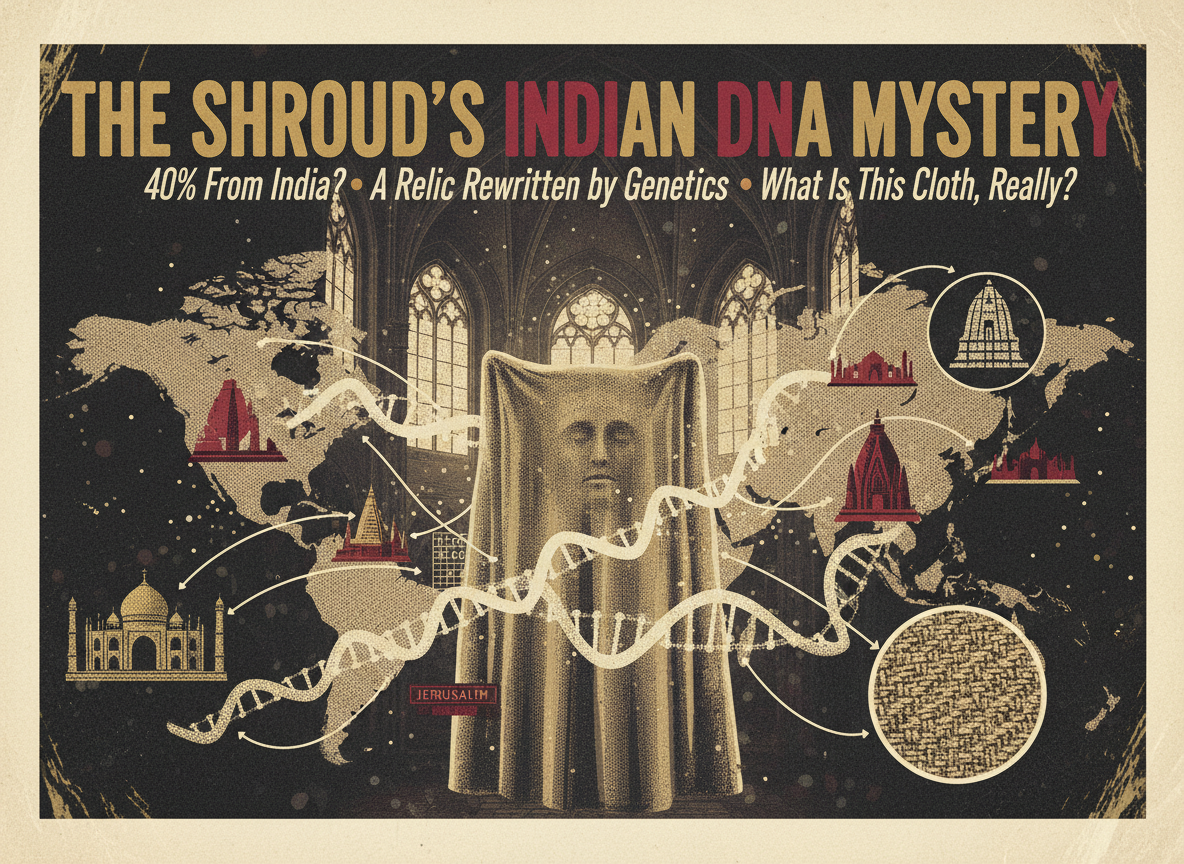
A new metagenomic study from the University of Padova has found that nearly 40 percent of the human genetic material on Christianity’s most contested relic traces back to Indian lineages, and the implications reach far deeper than the cloth itself.
The Shroud of Turin has survived seven centuries of scientific scrutiny without yielding a clean answer. Carbon dating, image analysis, spectroscopy, pollen studies, blood chemistry testing, and forensic photography have all taken turns at it. Each new technique either adds a piece to the puzzle or knocks another piece off the table. None of them have closed the case.
The latest round belongs to genetics.
In late March 2026, a preprint study titled “DNA Traces on the Shroud of Turin: Metagenomics of the 1978 Official Sample Collection” appeared on bioRxiv. It was led by Professor Gianni Barcaccia of the University of Padova, the same geneticist who produced a landmark 2015 study in Nature Scientific Reports on the shroud’s DNA. This time, Barcaccia’s team deployed Next Generation Sequencing technology against the same dust particles vacuumed from the cloth in 1978, and what came back from the analysis rewrote the geographic story of the relic in a way that no one anticipated.
Nearly 40 percent of the human DNA found on the Shroud of Turin traces back to Indian lineages.
That number has sent historians, theologians, and fringe researchers scrambling in different directions. Some see confirmation of a theory older than the modern DNA era. Others see a puzzle that deepens the mystery rather than solving it. The scientists themselves are careful. The cloth, they note, has been handled by enormous numbers of people across enormous stretches of time. The DNA on its surface is not a pristine record. It is a layered, contaminated, centuries-thick archive of every hand that ever touched it.
That caveat, however, does not make the finding less significant. It makes it more complicated, which in the case of the Shroud may amount to the same thing.
What the Study Actually Found
The 1978 sample collection was taken during a rare period of access granted to the Shroud Commission, a group of researchers permitted to vacuum the cloth and collect dust samples from its surface. Those samples have been analyzed multiple times in the decades since, producing a variety of findings that have not always agreed with each other. Barcaccia’s 2015 study was the first major metagenomic analysis of that material, and it revealed a wide distribution of human DNA from geographically diverse populations, with notable concentrations from the Near East and India.
The 2026 study builds on that foundation with more advanced sequencing and a deeper analysis of what the research team is calling a “cornucopia” of biological material. Beyond the human genetic signatures, the cloth carries DNA from a remarkable range of organisms. Domestic animals, including dogs, cats, cattle, chickens, pigs, horses, and goats. Wild animals, including deer and rabbits. Plant species including wheat, carrots, peppers, tomatoes, and potatoes, with the latter two being notable because neither tomatoes nor potatoes reached Europe until after contact with the Americas in the 15th and 16th centuries, which the researchers note as evidence of contamination from more recent centuries.
The human DNA tells a different story depending on where you look. The overall profile of human lineages on the cloth breaks down with more than 55 percent from the Near East, approximately 38.7 percent from Indian lineages, and less than 6 percent from Europe. The striking underrepresentation of European DNA on a cloth that has been housed in Turin, Italy, since 1578 and in France before that is one of the more counterintuitive findings in the entire study.
Two Theories for the Indian DNA
Barcaccia’s team offers two primary explanations for the Indian genetic signature, and neither one requires a dramatic revision of known history.
The first is commercial. Ancient trade routes between India and the Mediterranean were well-established long before the cloth’s first documented appearance in France in 1354. The Romans maintained extensive commercial ties with the Indus Valley. Biblical scholar Lavergne has noted that the Greek term “sindôn,” the word used in the Gospels to describe the burial cloth of Jesus, may itself be derived from “Sindhon,” referencing fabric of Indian origin, valued for its quality and used across the Mediterranean world. Rabbinical texts reference “Hindoyin,” a term associated with linen imported from regions near the Indus Valley. If the yarn used to weave the Shroud was produced in India and traded westward, the genetic material of the people who grew, processed, and handled that fiber would have been woven into the cloth before it ever touched the body of anyone in Jerusalem or medieval France.
The second explanation is contact. The Shroud has been touched, kissed, venerated, and examined by an incalculable number of hands over its documented history. If any significant portion of those people, pilgrims, merchants, traders, or the ecclesiastical figures involved in its transportation along ancient routes, carried Indian genetic lineages, that contact would leave traces. The researchers note that haplogroup H33, prevalent in the Near East and frequent among the Druze people of Lebanon and Syria, was confirmed in the sample, adding another layer to the geographic picture.
What neither explanation fully accounts for is the DNA found not merely on the surface of the fibers, but embedded within them. A 2026 interpretation of the data, noted separately in commentary from other researchers, argues that internal fiber DNA is less likely to be casual contact contamination and more likely to reflect the cloth’s production environment. If that interpretation holds, the Indian DNA is not incidental. It is structural.
The Carbon Dating Problem Has Not Gone Away
Any discussion of the Shroud’s DNA findings has to be placed alongside the most definitive test ever run on it, and the most contested.
In 1988, three independent laboratories conducted radiocarbon dating on samples taken from the cloth. The results placed the Shroud’s origin between 1260 and 1390 CE, solidly in the medieval period, consistent with the relic’s first documented historical appearance in France in 1354. For many scientists, that settled the matter. The Shroud was a medieval creation. Its authenticity as a first-century burial cloth was off the table.
Skeptics of the 1988 dating have never fully accepted that conclusion. The specific criticism most often cited is that the samples used for carbon dating were taken from a corner of the cloth that had been repaired in the medieval period, meaning the dated material was not representative of the original linen. Raymond Rogers, a chemist who participated in the 1978 examination, published a study in 2005 arguing that the corner sample had a different chemical composition from the main body of the cloth, showing lower vanillin content consistent with significantly greater age, potentially placing the Shroud between 1,300 and 3,000 years old.
Giulio Fanti, a professor of mechanical and thermal measurement at the University of Padua, used spectroscopic and tensile testing methods and arrived at similar range estimates. Neither study displaced the 1988 carbon dating as the dominant scientific view, but both kept the authenticity question alive in the scientific literature.
The 2026 DNA study does not resolve the dating dispute. Barcaccia’s team notes explicitly that their findings do not allow them to date the cloth. What the findings do is complicate the narrative in a specific way: the presence of plant DNA from species that only arrived in Europe after the 15th century demonstrates that the cloth accumulated biological material across multiple time periods, which means the surface DNA is not a snapshot of any single moment in history. The same argument that skeptics of the 1988 carbon dating make about contaminated samples could theoretically apply to the genetic record as well. The cloth is not a pristine artifact. It is, in the researchers’ own words, a biological time capsule.
What Has Never Been Explained
The DNA debate is only one thread in a much larger problem. The physical image on the Shroud itself remains unexplained by any mechanism that the scientific community has fully accepted.
The image is a photographic negative. That was not discovered until 1898, when Secondo Pia photographed the Shroud for the first time and noticed that the negative of his photograph produced a recognizable positive image of a face. The implication was that the Shroud itself functioned as a kind of natural negative, a phenomenon that has no parallel in known medieval art or textile production.
The image also does not penetrate the fibers. It sits on the outermost layer of the linen threads at a depth of roughly 200 nanometers, about one-500th of a human hair. No known medieval technique, painting, printing, or dyeing, produces marks at that depth with that consistency. Attempts to reproduce the image using various methods, contact with a heated statue, radiation bursts, acid treatments, and other approaches, have produced images that are similar in some respects and wrong in others. No method has produced an exact match.
Blood stains on the cloth test as human blood type AB. The bloodstain patterns are consistent with the wounds described in the Gospel accounts of the crucifixion, including stains consistent with a crown of thorns, lance wound, and nail wounds. Whether those stains were produced by a genuine body or were placed intentionally as part of a medieval composition is a question that remains, after decades of forensic analysis, genuinely open.
The Shroud in 2026: More Questions, Not Fewer
What the new DNA study has done, more than anything else, is reframe the mystery. The Shroud is not a simple object. If the medieval forgery hypothesis were completely correct, the cloth would carry medieval European DNA and little else. What it carries instead is a genomic fingerprint that reads like a crossroads of the ancient world: predominantly Near Eastern, significantly Indian, with traces of every era the cloth has passed through layered on top of each other like geological strata.
None of that proves the Shroud is the burial cloth of Jesus of Nazareth. The Catholic Church, which currently holds the relic at the Cathedral of Saint John the Baptist in Turin, has never officially authenticated it. The Church’s position has remained formally neutral on the question of authenticity for decades, treating the Shroud as a powerful object of veneration without requiring believers to accept it as a genuine first-century relic.
What the DNA study does prove is that the Shroud of Turin has been many things in many places over a very long time, and that the genetic record embedded in its fibers reaches back into a world that was far more connected, and far more complex, than the simple medieval-forgery narrative accounts for.
The researchers’ concluding statement puts it plainly: “Our findings constitute a novel and significant contribution to the field, thoroughly elucidating the biological traces left by centuries of social, cultural, and ecological engagement.”
The Shroud itself offers no comment. It never has.
Sources: Ancient Origins, Shroud of Turin DNA Analysis Reveals Shocking Indian Origins, Vatican News, New DNA Research Confirms Shroud of Turin’s Passage Through the Middle East, The Print, Jesus Christ’s India Connection? Shroud of Turin Came From Indus Valley, BreezyScroll, New Study Suggests Shroud of Turin May Have Indian Origins, WION News, Scientist Traces Shroud of Turin Back to India
Prehistoric Humans May Have Interbred With Two Separate Archaic Species. The Genetic Evidence Is in Living People's DNA Right Now.
A 2026 study has found evidence that the ancestors of modern humans interbred with not one but two separate archaic hominin species…
The First Human Has Been Named for 60 Years. A New Skeleton Suggests It Might Not Be Human at All.
Homo habilis — "handy man" — has held its place as the earliest named member of the human genus since 1964. The…

The Man Running FEMA's Disaster Response Says He Has Been Teleported Multiple Times. Once to a Church. Once to a Waffle House. He's Standing by It.
Gregg Phillips leads FEMA's Office of Response and Recovery — overseeing billions in disaster funds and directing the agency's response to fires,…

Something Is Moving Through Ohio: Eight Witnesses, Two Creatures, and the Biggest Bigfoot Flap in Fifty Years
A concentrated cluster of sightings along a wooded northeast Ohio greenbelt has cryptozoologists calling it the most significant Sasquatch event since the…