Original Story
Prehistoric Humans May Have Interbred With Two Separate Archaic Species. The Genetic Evidence Is in Living People’s DNA Right Now.
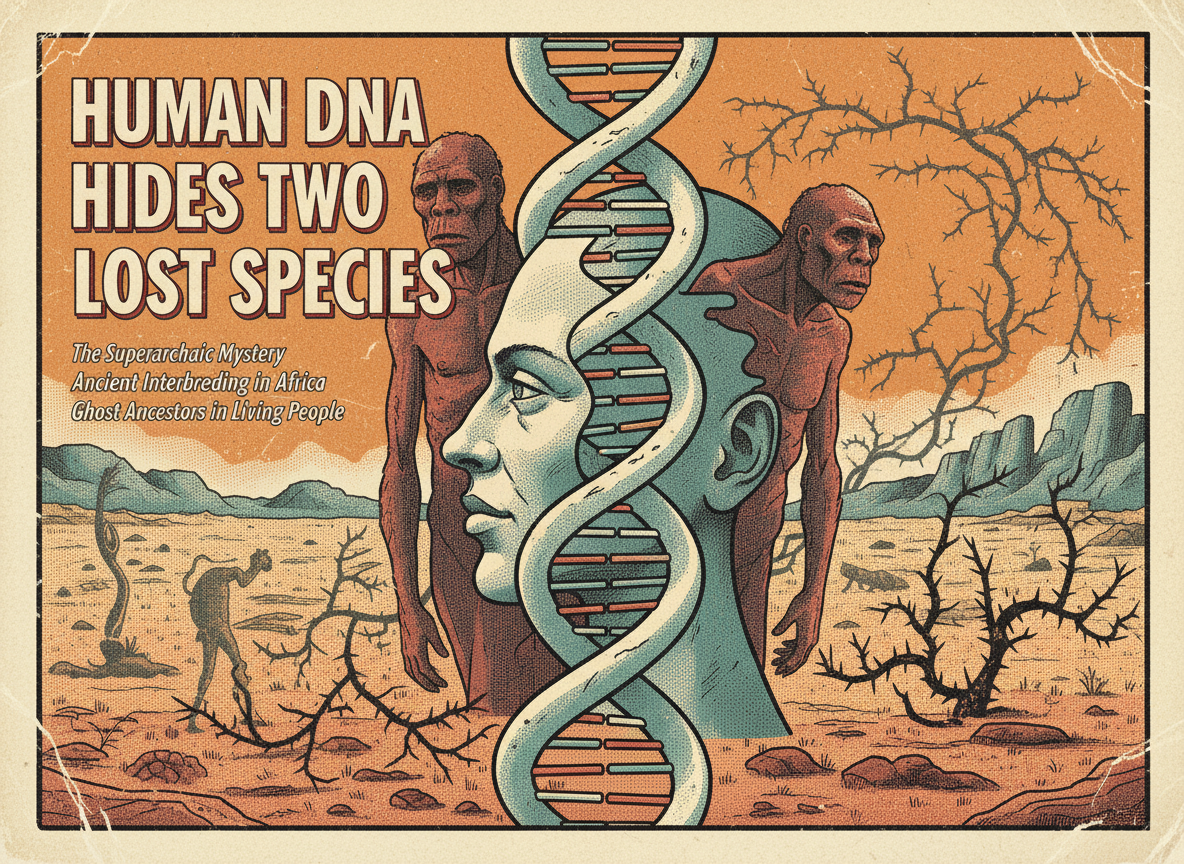
A 2026 study has found evidence that the ancestors of modern humans interbred with not one but two separate archaic hominin species — groups so genetically distinct from early Homo sapiens that researchers are calling them “superarchaic” populations. The evidence is not in fossils. It is in the genomes of six African populations alive today, preserved as fragments of DNA too unusual to have arisen within the modern human lineage. The research adds to a pattern established by previous ancient DNA studies of Neanderthals and Denisovans: our ancestors did not evolve in isolation. They mixed, repeatedly, with others who were profoundly different from them. The question of what those others were is not answered by the new study. It may never be.
The discovery of Neanderthal DNA in modern non-African populations was already a significant revision to the story of human evolution. The subsequent discovery of the Denisovans — a group known almost entirely from their DNA, with only scattered physical remains found in a Siberian cave — expanded that revision further. Modern humans did not simply replace archaic populations. They interbred with them, and those archaic genes are still present in living people.
The 2026 study pushes that timeline and scope considerably further.
Researchers analyzed vast regions of the genome from six African populations — populations whose ancestry remained in Africa throughout the period of human migration out of the continent. Because Neanderthal and Denisovan interbreeding occurred primarily after the out-of-Africa migrations, African populations have generally been assumed to carry less archaic genetic material. The new study found something unexpected in the African genomes: fragments of DNA too unusual, too lengthy, and too internally consistent to have arisen through normal mutation within the modern human lineage. The statistical signature matches what would be expected if those fragments had entered the human gene pool through interbreeding with a distinct archaic group — or two.
What “Superarchaic” Means
The research team uses the term “superarchaic” to distinguish these genetic donors from Neanderthals and Denisovans. While Neanderthals and Denisovans diverged from the modern human lineage somewhere between 300,000 and 700,000 years ago, the superarchaic populations appear to have split off much earlier — possibly two million years ago or more. These would not have been creatures that looked much like us. They would have been populations whose ancestors diverged before the evolution of modern Homo sapiens, and who had been following a separate evolutionary path for an enormous stretch of time.
The evidence for two distinct superarchaic populations comes from the structure of the unusual DNA fragments themselves. Different segments of the unusual DNA point to different origins — different divergence times and different genetic signatures. A single archaic interbreeding event cannot account for all of them.
The interbreeding likely occurred between 20,000 and 60,000 years ago — relatively recent in evolutionary terms, but long enough ago that the archaic DNA fragments have been shortened by generations of recombination. The length of the surviving fragments allows researchers to estimate the timing. The fact that fragments survive at all implies that some of them provided a selective advantage; neutral or harmful archaic genes tend to be lost from populations over time.
What This Leaves Open
The superarchaic populations behind these genetic fragments have no names and no confirmed physical remains. They may correspond to known fossil species — Homo erectus, Homo heidelbergensis, Homo naledi — or they may be unknown groups that left no fossil record at all. The genetic evidence can tell researchers approximately when the interbreeding occurred and approximately how genetically distant the archaic donors were. It cannot tell them what those donors looked like, where they lived, or what happened to them afterward.
What it does say is that the human family tree was not a ladder. It was a bush. Multiple lineages sharing the same landscape, occasionally producing offspring together, contributing pieces of themselves to descendants who outlasted them. Some of those pieces are sitting in the genomes of people alive today — fragments of vanished populations, carrying unknown genes, with unknown functions, inherited from something that may never be excavated.
Sources: Unexplained Mysteries forum — Prehistoric Humans May Have Interbred With Two Separate Archaic Species (April 2026) — ScienceDaily — Ancient Humans Were Mixing It Up: Anatomically Modern Humans Interbred With More Archaic Hominin Forms While in Africa — Wikipedia — Human Evolution (updated 2026)
The Shroud of Turin Carries 40% Indian DNA, and Now Nobody Knows What It Is
A new metagenomic study from the University of Padova has found that nearly 40 percent of the human genetic material on Christianity's…
The First Human Has Been Named for 60 Years. A New Skeleton Suggests It Might Not Be Human at All.
Homo habilis — "handy man" — has held its place as the earliest named member of the human genus since 1964. The…
The Man Running FEMA's Disaster Response Says He Has Been Teleported Multiple Times. Once to a Church. Once to a Waffle House. He's Standing by It.
Gregg Phillips leads FEMA's Office of Response and Recovery — overseeing billions in disaster funds and directing the agency's response to fires,…
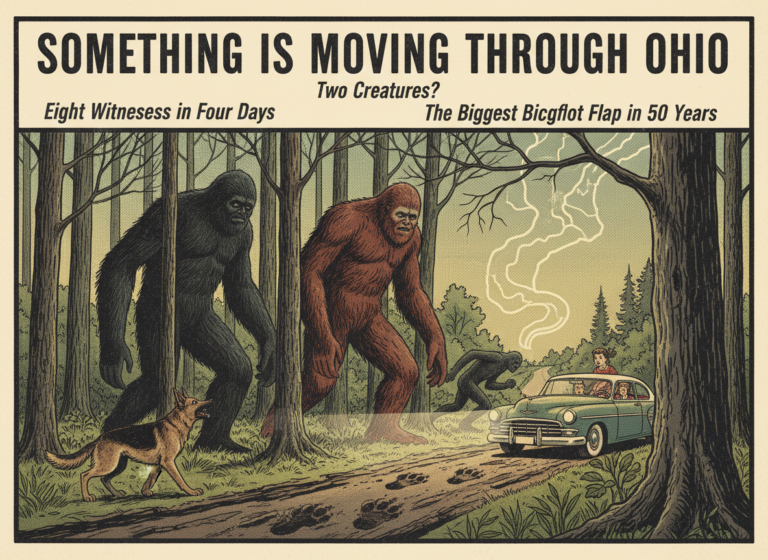
Something Is Moving Through Ohio: Eight Witnesses, Two Creatures, and the Biggest Bigfoot Flap in Fifty Years
A concentrated cluster of sightings along a wooded northeast Ohio greenbelt has cryptozoologists calling it the most significant Sasquatch event since the…