Original Story
The First Human Has Been Named for 60 Years. A New Skeleton Suggests It Might Not Be Human at All.
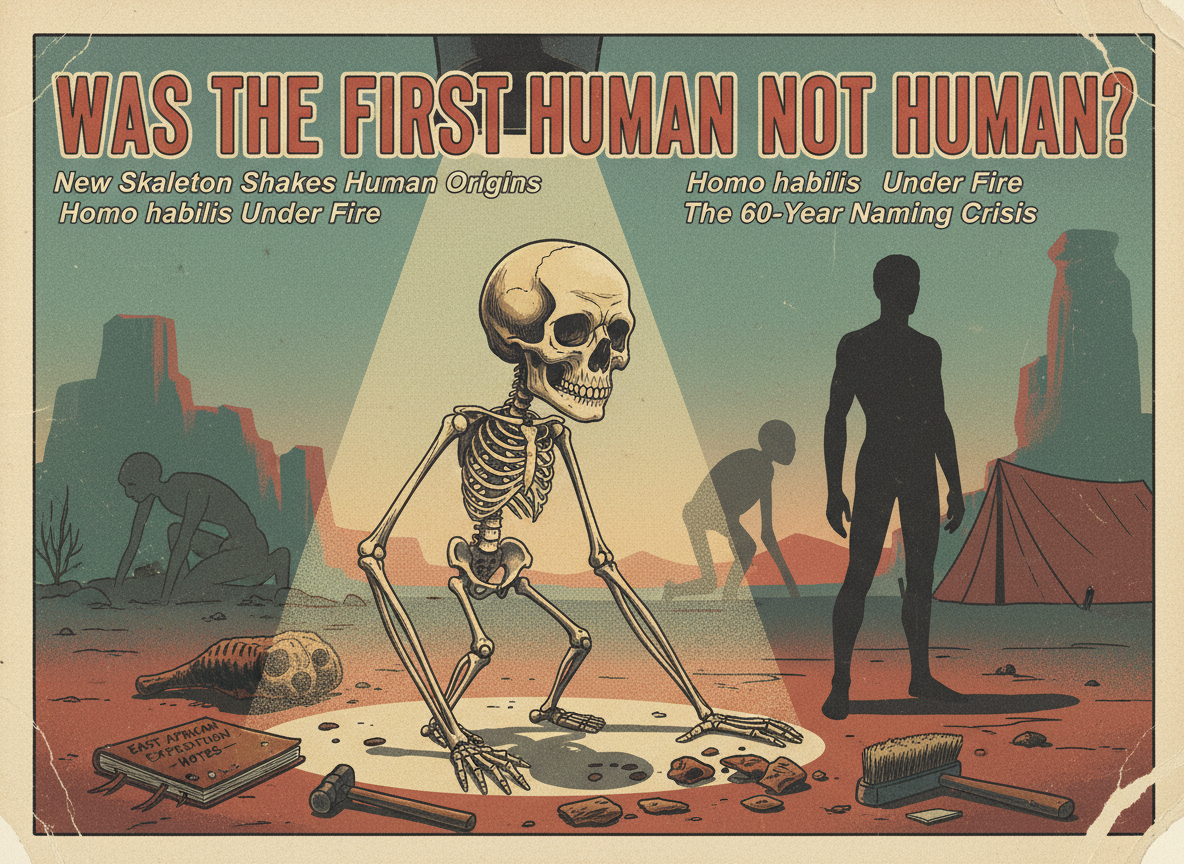
Homo habilis — “handy man” — has held its place as the earliest named member of the human genus since 1964. The designation was based primarily on one thing: a significantly larger brain than earlier australopithecines, found alongside stone tools. Everything below the neck was largely unknown. A new partial skeleton published in 2026 in The Anatomical Record — the most complete Homo habilis skeleton ever found — has finally provided a full look at the body. The problem is what it shows. The arms are long and ape-like, comparable to Lucy, the famous 3.2-million-year-old Australopithecus. The body is dramatically different from Homo erectus, the species that supposedly followed it. The implications are unsettling: either evolution proceeded with extraordinary speed between habilis and erectus, or Homo habilis is not the ancestor of later humans — and may not belong in the Homo genus at all.
For nearly six decades, the story of human origins has followed a reasonably clean sequence. Australopithecines — the ape-like bipedal hominins represented by species like Lucy — gave way to Homo habilis around 2.4 million years ago. Habilis’s larger brain and association with stone tools marked the transition into the human genus. Habilis then evolved into Homo erectus, the first long-distance traveler with a body much like our own, who spread out of Africa across Eurasia beginning around 1.9 million years ago.
That story is now complicated.
The new skeleton, described by researchers from Stony Brook University and published in The Anatomical Record, is approximately 2 million years old. It was recovered from Koobi Fora in Kenya, roughly 800 kilometers north of the original Tanzanian habilis finds. Crucially, it preserves the upper body in detail — arms, shoulder bones, portions of the pelvis — that earlier, far more fragmentary specimens could not provide.
What the Arms Reveal
The arms are long. Very long. In proportion to the body, they are closer to Lucy’s — an Australopithecus that lived 3.2 million years ago — than to any later Homo species. This anatomy is associated with tree-climbing adaptations: long forearms improve reaching and swinging, and are found in species that still spent significant time in the canopy.
Paleoanthropologist Carrie Mongle of Stony Brook, a co-author of the study, draws a direct conclusion from the comparison: “Their dramatically different bodies mean we either had extremely rapid evolution to a more modern H. erectus body, or that H. habilis is not a good candidate for the direct ancestor of H. erectus.”
The implications of that second possibility are significant. If Homo habilis did not evolve into Homo erectus, the clean sequence of human origins breaks down. Something else — possibly a lineage currently unknown or poorly documented — would need to bridge the gap between the australopithecines and the long-legged, large-brained Homo erectus. The question of where, exactly, our genus Homo actually began would need to be reopened.
Ian Tattersall, paleoanthropologist at the American Museum of Natural History, has argued in a 2026 article that the ape-like arms are precisely what should have been expected — and that they indicate Homo habilis should never have been placed in the genus Homo in the first place. The suggestion is not new: researchers proposed as early as 2010 that habilis’s skeleton was more adapted to tree life than ground life, making it a better fit for the Australopithecus genus. The new skeleton makes that argument considerably harder to ignore.
The Mosaic Pattern
What makes the Homo habilis puzzle particularly deep is the combination of traits the species presents. The skull looks modern — flatter face, bigger brain than any australopithecine. The teeth are smaller, more in line with the Homo pattern. But the body below the neck is old: long arms, small frame, proportions that belong to a creature that had not fully committed to life on the ground. This mosaic — a modern skull on a body that hadn’t caught up — has no clean parallel in the fossil record.
One interpretation is that cognitive and dental evolution raced ahead of body evolution in habilis, giving it a Homo-like head on an australopithecine body. Another is that habilis represents a side branch that experimented with larger brains but never gave rise to anything else. A third is that the story of early Homo is far more tangled than any single lineage can account for — that multiple species were experimenting with similar adaptations simultaneously, some of which died out, some of which converged toward what we eventually became.
The name “handy man” was meant to honor a creature on the threshold of humanity. The threshold, it turns out, may not be where we thought it was.
Sources: Live Science — Homo habilis Is the Earliest Named Human. But Is It Even Human? (April 2026) — Science / AAAS — The Earliest Homo Species Did Not Look Human, Partial Skeleton Shows (January 2026) — [The Anatomical Record — New Partial Skeleton of Homo habilis from Kenya (Grine et al., 2026)]
The Shroud of Turin Carries 40% Indian DNA, and Now Nobody Knows What It Is
A new metagenomic study from the University of Padova has found that nearly 40 percent of the human genetic material on Christianity's…
Prehistoric Humans May Have Interbred With Two Separate Archaic Species. The Genetic Evidence Is in Living People's DNA Right Now.
A 2026 study has found evidence that the ancestors of modern humans interbred with not one but two separate archaic hominin species…

The Man Running FEMA's Disaster Response Says He Has Been Teleported Multiple Times. Once to a Church. Once to a Waffle House. He's Standing by It.
Gregg Phillips leads FEMA's Office of Response and Recovery — overseeing billions in disaster funds and directing the agency's response to fires,…
Something Is Moving Through Ohio: Eight Witnesses, Two Creatures, and the Biggest Bigfoot Flap in Fifty Years
A concentrated cluster of sightings along a wooded northeast Ohio greenbelt has cryptozoologists calling it the most significant Sasquatch event since the…