Original Story
The Lost Colony of Roanoke Was Never Lost. An Amateur Archaeologist Just Proved It With Metal Flakes the Size of Rice Grains.
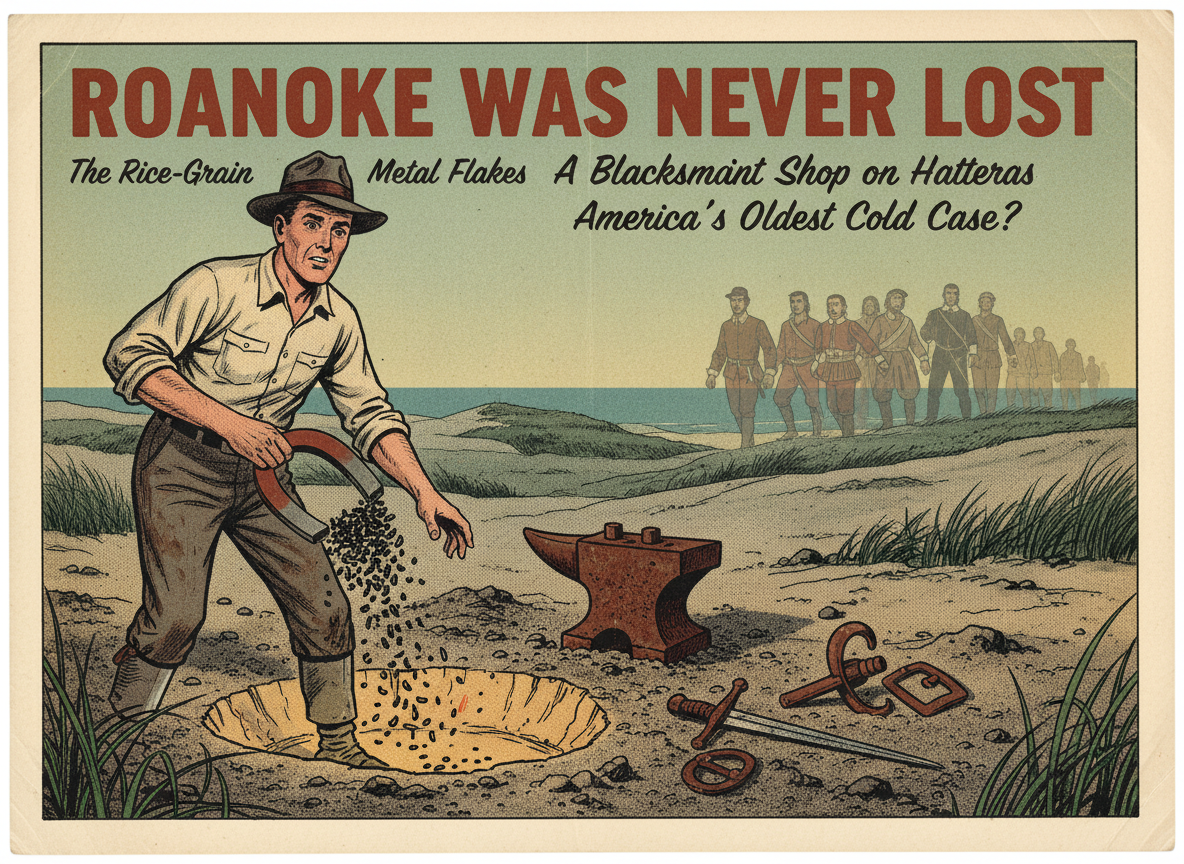
For more than 400 years, the fate of the 118 English colonists who disappeared from Roanoke Island in 1590 has been one of America’s most enduring unsolved mysteries. Scott Dawson, a Hatteras Island native, museum owner, and president of the Croatoan Archaeological Society, says it is not a mystery at all. After more than a decade of excavations on Hatteras Island alongside British archaeologist Mark Horton, he has found what he calls his smoking gun: dense deposits of hammerscale — the tiny iron flakes that only occur as a byproduct of active blacksmithing — in a 16th-century layer at a Croatoan settlement site. No Indigenous people in the region forged iron. The English did.
The standard telling of the Roanoke story begins with Governor John White sailing back to England for supplies in 1587, gets delayed by the Anglo-Spanish War for three years, and returns in 1590 to find the settlement abandoned. No bodies. No signs of violence. Only two clues: the word “CROATOAN” carved into a wooden post of the palisade, and the letters “CRO” cut into a nearby tree.
Croatoan was the name of an island 50 miles to the south — modern-day Hatteras Island — and its Indigenous people, with whom the colonists had previously established friendly relations. The sensible interpretation, as Scott Dawson has spent his career arguing, was that the colonists went there. They had told White they would do exactly that.
“The lost colony narrative was a marketing campaign,” Dawson said. “Mystery sells. But it was never a mystery.”
What a Blacksmith Shop Proves
Dawson has been excavating on Hatteras alongside Royal Agricultural University archaeologist Mark Horton since 2009. Over those years the team found swords, a Tudor Rose metal emblem, a Nuremberg token used for inventory counting on 16th-century ships, lead shot, and numerous other European artifacts in the 16th-century layers of Croatoan sites. Each discovery was compelling. Each could theoretically be explained by trade rather than permanent settlement.
The hammerscale cannot.
Hammerscale is produced when a blacksmith strikes hot iron on an anvil. Tiny flakes of metal fly off in every direction, fall to the ground, and accumulate at the forge site. They cannot travel far. They are not trade goods. They are not artifacts of passing contact. They are evidence of sustained, on-site metalworking — a permanent forge operating in a specific location. When Dawson’s team passed a magnet through soil samples from the 16th-century Croatoan layer, the effect was, in his words, like an afro: dense clusters of black flakes clung to the magnet. Enough hammerscale in a single bag to fill a Pepsi can.
Animal teeth found in the same soil layer were sent to the University of California, Irvine for independent dating. They came back: late 1500s. The blacksmithing and the teeth were contemporaneous with the missing colony.
“When you heat up an iron rod and hit it, little pieces of metal fly off,” Dawson said. “It gets walked over and forms a little pile, and no one gives it any mind — except for us, 400 years later.”
The Counterarguments That Remain
The Popular Mechanics piece from this week specifically drew attention to the fact that this story, while compelling, has contested elements. The hammerscale dates to the right era and is in the right location, but some scholars note that without a definitive Roanoke-specific marker — an identifiable personal object from the colony, a burial site, a written record — it cannot be tied unambiguously to the 1587 colonists as opposed to later 17th-century English traders or settlers who visited Hatteras.
Horton’s position is that coins and swords could arrive by trade; a permanent blacksmith forge cannot. “The hammerscale shows that English settlers lived among the Croatoans on Hatteras and were ultimately absorbed into their community,” Horton said.
The colony may not be perfectly solved. But the case that 118 people walked south to Hatteras Island, set up a working settlement alongside the Croatoan people, and were eventually absorbed into their community is now backed by a decade of excavation, 900 pages of documents, thousands of artifacts, and a forge. What it is not backed by is a mystery.
Sources: Popular Mechanics — An Amateur Sleuth Found Tiny Flakes of Metal, Then He Possibly Solved America’s Oldest Cold Case — Island Free Press — Smoking Gun Evidence of Lost Colony’s Relocation to Hatteras Island — ParaRational — Has the Roanoke Lost Colony Mystery Been Solved? — All That’s Interesting — The Mystery of the Lost Colony of Roanoke May Have Been Solved

A Bronze Age Spanish Treasure Sat in a Museum for 60 Years. Two Pieces of It Were Made from a Meteorite. Nobody Knew.
The Treasure of Villena — 66 objects found in 1963 near Alicante, Spain, dating to between 1400 and 1200 BCE — includes…
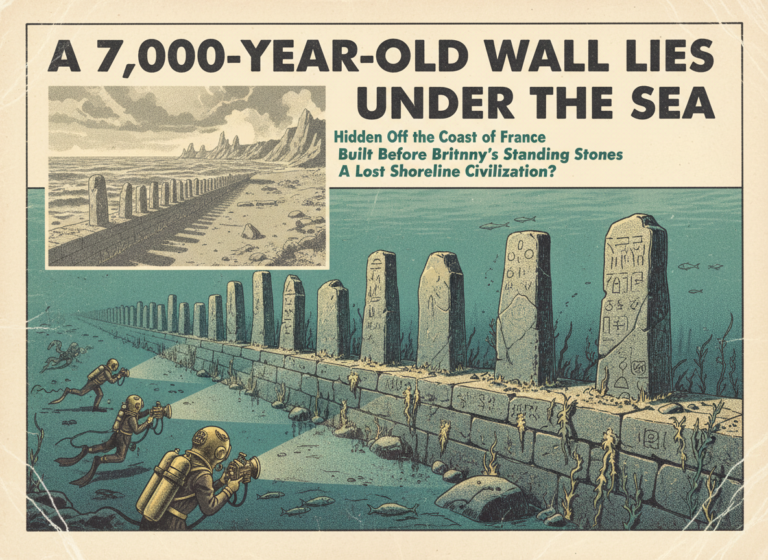
There Is a 7,000-Year-Old Stone Wall Sitting on the Ocean Floor off the Coast of France. Nobody Knew It Was There Until 2017.
A 120-meter granite wall built approximately 7,000 years ago has been confirmed beneath nine meters of water off the western tip of…
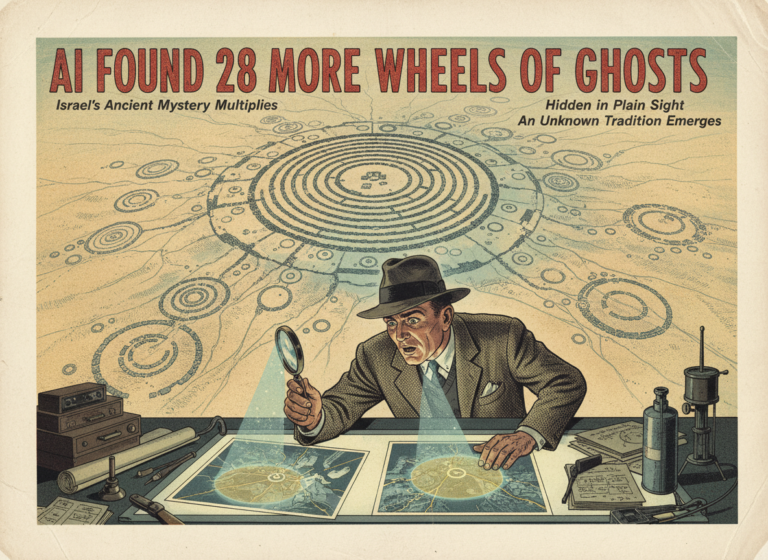
Israel's "Wheel of Ghosts" Has Been a Mystery Since 1968. AI Just Found 28 More of Them Hidden in Plain Sight.
Rujm el-Hiri — the Wheel of Ghosts — is a massive stone structure in the Golan Heights built from 40,000 tons of…

A New Theory Says Consciousness Is Not Produced by Neurons. It Comes from a Hidden Wave in the Brain That Has Never Been Detected.
A peer-reviewed paper published in Frontiers in Psychology in early 2026 proposes that conscious experience does not arise from neural computation at…