Original Story
There Is a 7,000-Year-Old Stone Wall Sitting on the Ocean Floor off the Coast of France. Nobody Knew It Was There Until 2017.
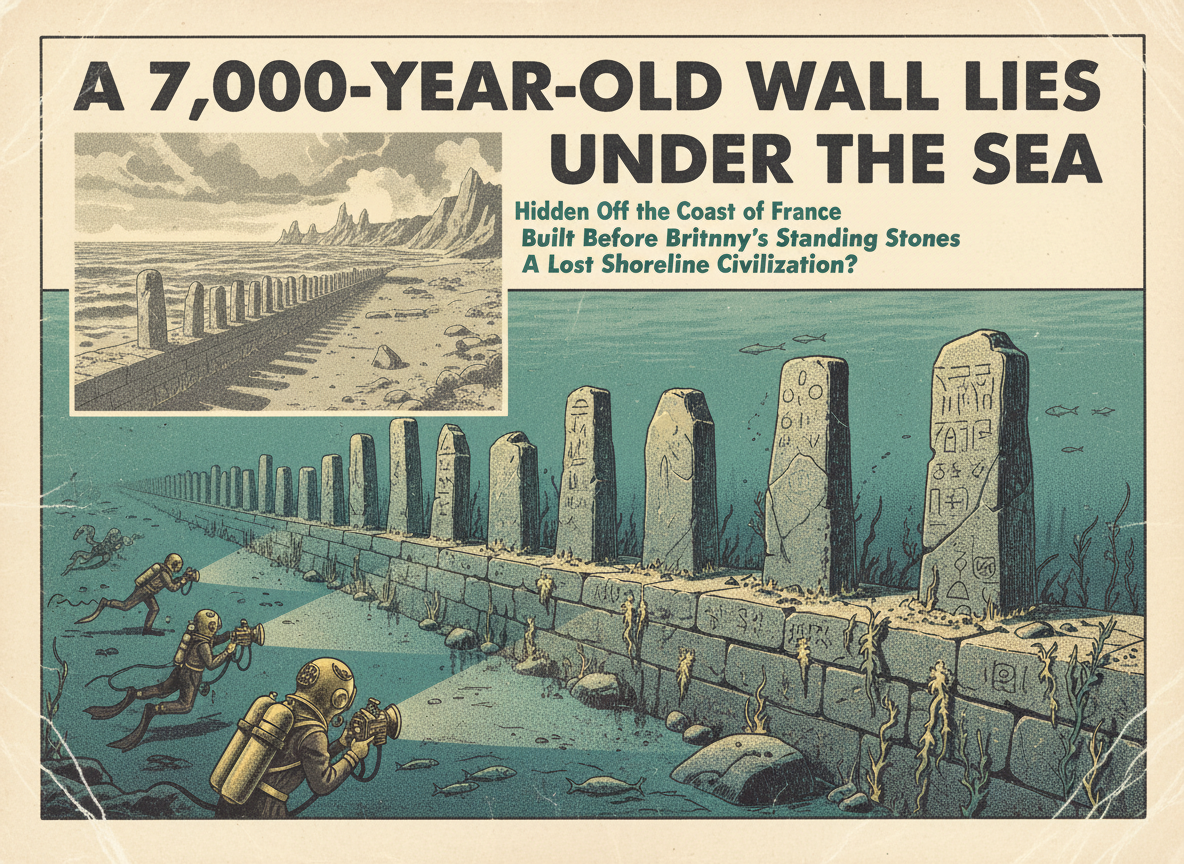
A 120-meter granite wall built approximately 7,000 years ago has been confirmed beneath nine meters of water off the western tip of Brittany, France. Sixty-plus monoliths rise from its crest in two parallel rows. Twelve additional stone structures surround it. The whole complex was built by hunter-gatherers — or possibly early Neolithic communities — who were not supposed to be capable of organized, large-scale construction. The site predates Brittany’s famous standing stones by at least 500 years. It only became visible when sea-level mapping technology caught a perfectly straight line where nature does not make straight lines.
Yves Fouquet is a geologist. In 2017 he was studying a newly produced seabed depth chart for the waters off Finistère — the jagged peninsula at France’s westernmost point — created using LIDAR, a laser-based remote sensing system. On the chart, off the tiny island of Sein, he saw something that did not belong.
A ruler-straight line, 120 meters long, cutting clean across an underwater valley.
“Just off Sein, I saw this 120-meter line blocking off an undersea valley,” Fouquet told the BBC. “It didn’t make sense from a geologic point of view.”
Nature makes curves. Nature makes irregular formations. Nature does not make a 120-meter straight line blocking a valley at a consistent height. Fouquet flagged it. Confirmation had to wait for winter, when seasonal seaweed die-off improved underwater visibility enough to dive.
What the Divers Found
Between 2022 and 2024, a team from the Society of Archaeology and Maritime Memory conducted 59 dives totaling more than 35 hours underwater to document what lay beneath the surface. The findings were published in the International Journal of Nautical Archaeology.
The wall is 120 meters long, 20 meters wide at its base, and two meters high. Its total mass is approximately 3,300 tons of carefully stacked granite blocks. At regular intervals across its crest, large standing stones — monoliths up to 1.7 meters tall — rise in two parallel rows, placed on the bedrock before the wall was built around them. The construction technique mirrors the famous menhirs of Brittany that stand on dry land, but this structure predates them by at least 500 years.
Twelve additional smaller man-made stone features have been mapped in the surrounding area. Two distinct construction methods are present: some structures appear to be monumental walls or territorial markers; others are narrower features built to block natural depressions, consistent with fish-weir design. Prehistoric fish traps are known from the coasts of Brittany and Normandy, but nothing like this has previously been found in the waters around Sein Island.
What It Means for the People Who Built It
Radiocarbon dating of materials found near the wall places its construction between 5,800 and 5,300 BCE. At that time, sea levels were approximately seven meters lower than today. The structure would have stood on dry land — near a tidal shoreline, facing the open Atlantic.
This was the Mesolithic-Neolithic transition: the period when the last hunter-gatherers in Western Europe were beginning to encounter early farming communities moving in from the east. Textbooks have long described Mesolithic coastal populations as small, mobile, lightly organized bands. A 3,300-ton granite wall says otherwise.
The researchers writing in the International Journal of Nautical Archaeology describe the construction of such a structure as requiring “careful planning, leadership, and collaboration over weeks or months.” More than a third of the stone tools found in comparable Mesolithic contexts are made from exotic materials transported from outside the local area, suggesting high mobility and long-distance exchange networks among the people who built sites like this.
The archaeologist Yvan Pailler noted the wall was likely the work of “a very structured society of hunter-gatherers” who had become sedentary when coastal resources permitted, or of early Neolithic populations. Either interpretation requires a fundamental revision of what we know about social organization in prehistoric northwestern Europe.
The wall has been underwater for roughly 7,000 years. It survived. The Breton legend of the sunken city of Ys — a drowned city beneath the sea off the coast of Finistère — has been attached to this region for centuries.
Sources: Ancient Origins — Massive 7,000-Year-Old Wall Found Underwater Off French Coast — ZME Science — A Massive Stone Wall Built 7,000 Years Ago Was Found Intact Beneath the Sea — Big Think — 7000-year-old underwater wall raises questions — Divernet — French Divers Hit Wall That’s 7000 Years Old — International Journal of Nautical Archaeology 2026

A Bronze Age Spanish Treasure Sat in a Museum for 60 Years. Two Pieces of It Were Made from a Meteorite. Nobody Knew.
The Treasure of Villena — 66 objects found in 1963 near Alicante, Spain, dating to between 1400 and 1200 BCE — includes…

Israel's "Wheel of Ghosts" Has Been a Mystery Since 1968. AI Just Found 28 More of Them Hidden in Plain Sight.
Rujm el-Hiri — the Wheel of Ghosts — is a massive stone structure in the Golan Heights built from 40,000 tons of…

A New Theory Says Consciousness Is Not Produced by Neurons. It Comes from a Hidden Wave in the Brain That Has Never Been Detected.
A peer-reviewed paper published in Frontiers in Psychology in early 2026 proposes that conscious experience does not arise from neural computation at…

The Lost Colony of Roanoke Was Never Lost. An Amateur Archaeologist Just Proved It With Metal Flakes the Size of Rice Grains.
For more than 400 years, the fate of the 118 English colonists who disappeared from Roanoke Island in 1590 has been one…